

In the U.S., 13 is unlucky and a scarf is an accessory. In Tibetan tradition, 13 counts as a sacred number. And a white khata (a Tibetan ceremonial scarf, also spelled katak or khatag) can say more than a card. Here is the short version. Fold the khata lengthwise. Offer it with both hands. Place it in the hands of anyone senior to you. Choose white when you are unsure, and give gifts in odd numbers.
Those habits come from Tibetan Buddhist practice, where how you hand over a gift matters as much as the gift. PotalaStore’s founder has returned to Tibet repeatedly over the past four years. We also checked every custom below against sources such as the Tibetan Nuns Project and the Tibetan Buddhist Encyclopedia. Where traditions disagree, we show both versions.
Below, you will find the step-by-step etiquette, what each scarf color traditionally means, and why odd numbers matter. We also show how to adapt it all for a wedding, graduation, or Losar visit in the U.S.
Quick facts
- Time needed: about 1 minute
- What you need: one clean, wrinkle-free khata, white if you are unsure
- Gift count: an odd number of items
Planning a Losar visit? See our Losar gift guide with Tibetan New Year presents by budget.
Table of Contents
What Is a Khata and Why Do Tibetans Offer One?
A khata (also spelled katak or khatag) is a traditional Tibetan ceremonial scarf offered as a sign of respect, gratitude, or greeting. In Tibetan Buddhist practice, people give it to welcome guests, wish travelers a safe journey, honor teachers, and mark births, weddings, graduations, and funerals.
The Tibetan word is ཁ་བཏགས་. Khatas are used across Tibet, Nepal, Bhutan, Sikkim, and Ladakh, and in Mongolia. Origin stories vary, so treat any single account as folklore.
For an American comparison, think of a Hawaiian lei. Like a lei, a khata greets guests, honors graduates, and sends loved ones off on a journey.
What Does a Khata Symbolize?
A khata symbolizes a giver’s pure, sincere intention, expressed as freely given goodwill. The Tibetan Nuns Project lists purity, auspiciousness, sincerity, kindness, and justice as the meanings of white. The Dalai Lama has explained that white stands for a warm heart, honesty, and truth, while the smooth cloth reflects non-violent conduct.
When Do Tibetans Offer a Khata?
Tibetans customarily offer a khata at births, weddings, funerals, graduations, and when welcoming or seeing off a guest. The occasion shapes the meaning:
- Welcome: a host offers a khata to a guest who arrives.
- Farewell: the scarf carries wishes for a safe journey.
- Life events: births, weddings, graduations, and funerals all call for one.
- Sacred spaces: people lay khatas over thangka paintings, statues, and altars, and bring one when visiting a temple, shrine, or teacher.
In Nepal, people also give khatas to mark awards and election wins, and both Buddhists and Hindus use them.

How Do You Offer a Katak? Step-by-Step Etiquette
Fold the khata lengthwise, offer it with both hands, and place it according to the recipient’s seniority.
- Start clean. Use a clean, wrinkle-free scarf and keep it off the floor.
- Fold it lengthwise. Make one double layer, with the folded edge toward you.
- Hold it in both hands. Keep the open edges facing the person you honor.
- Bow. A slight bow suits elders and hosts. A deep bow suits a lama.
- Place it by seniority. Hand it to seniors. Drape it on peers and younger people.
How Do You Fold a Khata Before Offering It?
Fold the khata lengthwise into a double layer, with the folded edge toward you and the open edges facing the recipient. The double layer represents interdependence, and the open edges represent your open, pure heart.
Some communities add a ritual step. The Tibetan Nuns Project describes folding the scarf into seven folds, rolling the rest into a loose roll, and unfurling it just before the offering. For a first offering, a clean lengthwise fold matters most.
Elder, Lama, or Friend: Where Should the Scarf Go?
Match the gesture to the person: hand the khata to anyone senior to you, and reserve draping for friends, peers, and younger people. The table below summarizes the usual pattern.
| Recipient | How to hold it | Where it goes |
|---|---|---|
| Lama or teacher | Both hands, raised to your forehead, deep bow | Into their hands, or on the seat or altar before them |
| Elder, parent, or host | Both hands, slight bow | Into their hands |
| Friend or peer | Both hands | Draped around the neck, or into their hands |
| Younger person | Both hands | Around the neck or shoulders |
| Statue, thangka, or altar | Both hands | Laid over or beside the image |
Hosts often drape a khata on arriving or departing guests, so as a guest, expect to receive one. When you offer a khata to a teacher or lama, you do not place it on their neck. The teacher usually returns it by placing it over your neck as a blessing. At large teachings, students often pass their khatas forward and do not expect them back, according to one Dharma Wheel forum thread.
Nervous about getting it wrong? One rule covers most situations: offer with both hands, and never drape the scarf over the neck of someone senior to you. A common first-timer mistake is draping it over a grandparent’s or lama’s neck. Traditionally, that gesture flows from seniors to juniors, not the other way around.
What Should You Do When Someone Offers You a Khata?
Accept a khata with both hands and a small bow, and if it is placed around your neck at an event, keep it on until the event ends. You can say “thuk je che,” a Tibetan phrase of thanks. Do not take it off in front of the giver or stuff it into a bag. Once you are home, fold it gently and keep it clean.
Ceremonial Scarf Colors: White, Yellow, Blue and the Five-Color Set

Most Tibetan khatas are white, which traditionally stands for the pure heart of the giver. Yellow is often offered to high lamas. Blue is favored in Mongolia. Five-colored khatas, linked to the five elements, are generally reserved for sacred images, revered teachers, and close relatives.
| Color | Traditional association | Typical use |
|---|---|---|
| White | Purity, sincerity, the giver’s pure heart | All occasions; the safest default |
| Ivory or cream | Same meaning as white | A very common alternative |
| Yellow | Offered to high lamas; tied to wealth deities in some traditions | Teachers and specific rites |
| Blue | The sky | Mongolia and Mongolian communities |
| Five-colored | The five elements | Sacred images, revered teachers, close relatives |
Why Is White the Default Khata Color?
White is the most common khata color because Tibetans associate it with purity, auspiciousness, sincerity, kindness, and justice. That is why white suits weddings, funerals, greetings, and visits to teachers alike. Ivory khatas are also very common, so a cream scarf will not look out of place. If you are unsure, choose white.
When Is a Five-Color Khata Appropriate?
A five-colored khata (blue, white, red, green, and yellow) is traditionally treated as especially precious and is generally reserved for sacred images, revered teachers, or very close family. As with the five colors of Tibetan prayer flags and their elements, each color maps to one of the five elements.
Here is the limit of what we can tell you. Sources disagree on the mapping. The Tibetan Nuns Project links white to air and wind. One Tibet travel guide links white to clouds, blue to sky, yellow to earth, green to rivers, and red to protector deities. Your host’s tradition decides which version applies.
Can You Give a Red Khata as a Gift?
Many sources advise against giving a red khata as a personal gift. Some traditions reserve red for personal or ritual use, such as offerings to protector deities. Other sources describe red khatas as offerings to protectors rather than gifts between people. Both accounts point the same way. For a gift to a person, choose white.
Odd vs. Even: How Many Gifts Should You Give a Tibetan Host?
Tibetan custom favors an odd number of gifts and never an even number, so a set might hold three, nine, or thirteen items. Some sources add that cash follows the same rule, so an amount like $21 is a better choice than $20.
Sources agree on the odd-number rule but not on every exception. One Tibet travel guide calls 6 lucky because it is a multiple of 3. The Tibetan Buddhist Encyclopedia lists 18, 36, 72, 81, and 108 as auspicious multiples of nine. If you want the safest option, pick an odd number.
Americans may flinch at 13. In Tibetan folk tradition, heaven has 13 layers, so 13 reads as a holy number rather than a warning.
Why Are Odd Numbers Considered Auspicious in Tibetan Culture?
Tibetans have long favored odd numbers, choosing odd-numbered days for journeys and important events and giving gifts in odd quantities rather than pairs. The Tibetan Buddhist Encyclopedia notes that gift sets top out at 9 or 13 items. One thoughtful item, or three, fits the custom.
What Do 3, 9, 13, and 108 Mean?
Four numbers come up again and again: 3, 9, 13, and 108, each tied to Buddhist teaching or Tibetan folk tradition.
- 3: the Three Jewels of Buddhism, which are the Buddha, the dharma, and the sangha.
- 9: a number of abundance, often read as “many” or “without end.”
- 13: the layers of heaven in Tibetan folk tales.
- 108: the bead count of a mala, linked to the 108 afflictions in Tibetan Buddhist teaching.
The number 108 is a bead count, not a target for how many gifts to bring. One mala bracelet is one gift, and one is an odd number.
Khata + Gift: How to Hand Over a Present Tibetan-Style in the U.S.
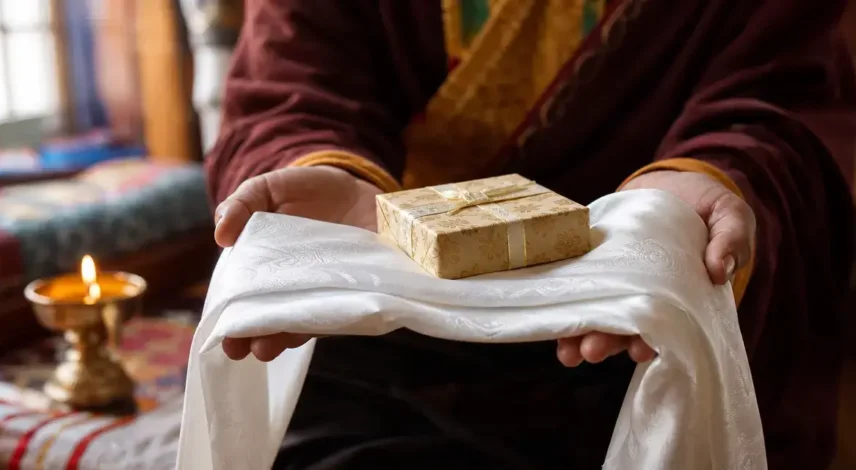
To give a present the Tibetan way, offer it with both hands, bow slightly, and, for elders, lift it a little higher than your head. Many people lay a white khata over or around the gift, which turns an ordinary present into a blessing.
How Do You Hand Over a Gift the Tibetan Way?
Hold the gift in both hands, bow slightly, and for an elder, lift it a little higher than your head as you offer it. Four habits make the gesture land well:
- Use both hands: Tibetans give and accept gifts with both hands.
- Raise it by seniority: the older the recipient, the higher the gift.
- Accept what you are given: one travel source warns that refusing a gift from a Tibetan host can offend.
- Expect a return gesture: the family will often give you something back or leave part of your gift for you. That is hospitality, not a sign they dislike it.
Tibet travel guides name butter tea and chang, a barley beer, as traditional host gifts.

What Gifts Pair Well With a Khata for American Occasions?
A khata pairs best with a small, meaningful keepsake the recipient will use, presented in an odd-numbered set. This matrix adapts the custom to common U.S. occasions.
| U.S. occasion | Khata gesture | Pairing idea | Count tip |
|---|---|---|---|
| Wedding | White khata to the couple, both hands | Gift plus a card | 1 or 3 items |
| Graduation | Draped around the graduate’s neck | A small keepsake | 1 or 3 items |
| Housewarming or Thanksgiving host | Placed into the host’s hands | Tea or a food basket | Odd item count |
| Losar visit (02/07/2027) | White khata, with “Losar Tashi Delek” | Pick from the Losar gift guide above | Odd item count |
| Meeting a lama at a dharma center | Raised toward your forehead, placed in their hands | Dana, a monetary offering, in an envelope | Odd amount, such as $21 |
For the keepsake, we suggest the 108 Mala Beads Bracelet from PotalaStore, priced at $25.95. It has 108 wood beads of 8 mm (0.31 in) plus one guru bead on an elastic cord. The 108 beads echo a number central to Tibetan Buddhist practice. The cord stretches to fit, so you can give one bracelet, an odd count of one, without asking for a wrist size.
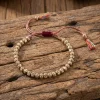
If you prefer a smaller gift, the handmade Tibetan knot bracelet with red string costs $28.95 to $58.95, depending on the option. For more ideas, browse Tibetan jewelry and ritual items in our Tibet’s collection.
Which Offering-Scarf Mistakes Should Americans Avoid?
The most common mistakes are small and easy to fix. They include draping a khata over an elder’s neck, choosing red for a personal gift, bringing an even number of items, and offering a wrinkled scarf. Each has a simple, respectful alternative.
Is It Rude to Put a Khata Around an Elder’s Neck?
Traditionally, yes: you place a khata in the hands of an elder or lama rather than around their neck, while seniors may drape one on you. The gesture flows from higher to lower, which is why the placement table above separates hands from necks.
What Other Gift-Giving Missteps Should You Watch For?
Beyond the neck rule, watch for five easy-to-avoid missteps: red scarves as gifts, even-numbered sets, wrinkled cloth, a scarf on the floor, and declining a gift.
- Red as a personal gift: choose white instead.
- Even-numbered sets: add or remove one item to reach an odd number.
- Wrinkled or soiled cloth: keep the khata folded flat in a clean bag until you offer it.
- A scarf on the floor: never let a khata touch the floor or ground.
- Declining a gift: accept with both hands, even if you plan to share it later.
Most hosts will appreciate the gesture even if your fold is not perfect. Sincerity is the point. Customs vary across Ü-Tsang, Amdo, and Kham, and among Nepali, Bhutanese, and Mongolian communities. When in doubt, ask your host. If your gift is a statue rather than a scarf, read our guide to Buddha statue gift etiquette and how to present one.
Frequently Asked Questions About Gift-Giving With a Khata
Yes, in most settings. A khata expresses respect and goodwill, and we found no source that limits the custom to Tibetans or Buddhists. Use a white scarf, offer it with both hands, and follow the same placement rules a Tibetan guest would.
Keep it. Many people fold it and store it in a clean, high place or near a home altar. A khata returned to you by a lama is traditionally regarded as a blessing and kept respectfully. Never let it touch the floor.
Yes. It is traditional to offer a khata to a teacher after the last session of a teaching, often with dana, a monetary offering, in an envelope. Some sources say money should not be given in even amounts, so an odd figure such as $21 is a thoughtful choice.
Look for a white or ivory khata in silk or cotton, often woven with the eight auspicious symbols. Retail listings we reviewed run from about 12 x 58 inches to 20 x 104 inches, and single scarves list from roughly $3 to $18. The Tibetan Nuns Project online store sells silk kataks blessed by Tibetan Buddhist nuns. To complete the gift, explore the 108-bead wood mala bracelet at $25.95.
The takeaway: A khata is a simple scarf that carries a large message. Fold it lengthwise, hold it in both hands, hand it to anyone senior to you, choose white when unsure, and give an odd number of gifts. If customs differ at your event, follow your host.
Complete your gift.
Browse PotalaStore’s Tibetan ritual items and jewelry to find a keepsake that pairs well with a khata.
📚 References
- Khata meaning, folding, and colors: The Tibetan Nuns Project explains offering etiquette, white and ivory kataks, and the five-element colors. Tibetan Nuns Project
- Regional Losar traditions: A museum scholar’s overview of how Losar customs differ across Himalayan communities. Rubin Museum of Himalayan Art
- Odd numbers, 9, and 13: Background on auspicious numbers and gift counts in Tibetan tradition. Tibetan Buddhist Encyclopedia
- Khata overview and regional use: Where khatas are used, including Mongolia and Nepal. Wikipedia