
What Is a Mantra? The Exact Meaning in Buddhism, Hinduism, and Modern Practice
 by Yang Tso
0 comments
A mantra is more than a word you repeat. In Sanskrit it means an “instrument of thought.” It is a sacred sound, syllable, or phrase repeated aloud, whispered, or silently to steady the mind. You may have heard the word in a yoga class, a meditation app, or a company slogan, and each setting uses it differently.
This guide explains the exact meaning of mantra in Hinduism, Buddhism, and modern meditation. It also gives you the numbers you need to start, including three ways to recite and the reason a mala holds 108 beads. Our sources include Britannica, StudyBuddhism, and a 2026 peer-reviewed meta-analysis.
At PotalaStore, we visit partner workshops in Tibet, Nepal, China, and Thailand each year to support fair compensation and small-batch production. That time with prayer-bead makers shapes the practical notes below.
Table of Contents
What Is a Mantra?
A mantra is a sacred sound, syllable, word, or phrase repeated aloud, whispered, or silently to focus and steady the mind. The word comes from Sanskrit man (“to think”) and -tra (“instrument”), so a mantra is literally an “instrument of thought,” used across Hinduism, Buddhism, Jainism, and Sikhism.
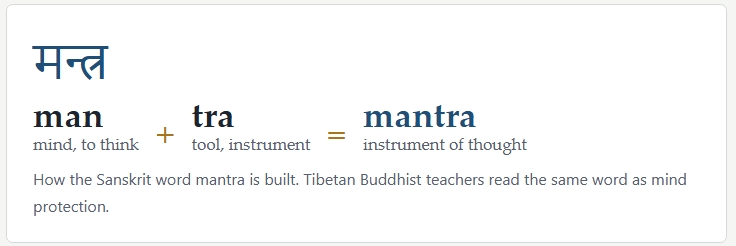
Mantras come in two broad shapes. Some are full sentences with a clear meaning, such as the Gayatri Mantra. Others are seed syllables (bija), short sounds like Om that carry no ordinary dictionary meaning.
English also uses the word in a secular sense. A company’s mantra or an athlete’s mantra is a short guiding slogan. That idea differs from a sacred formula passed down through religious practice, and this guide covers the religious and meditative meaning.
Where Does the Word “Mantra” Come From?
The word mantra comes from two Sanskrit parts: man, meaning “mind,” and -tra, meaning “tool.” Dr. Alexander Berzin of StudyBuddhism notes that Tibetans understood the word as “mind-protection,” a tool that guards the mind from disturbing thoughts and emotions.
The idea traveled across Asia. Chinese Buddhists translate the word as zhenyan, often rendered “true word.” The Japanese Shingon school takes its name from the same term.
What Is the Purpose of Chanting Mantras?
In both Hindu and Buddhist traditions, the core purpose is to focus attention and turn the mind toward a chosen quality or deity. Hindu practitioners often chant to bring a deity or sacred truth to mind. Buddhist practitioners often chant to cultivate a state such as compassion and to keep the mind from drifting into disturbing thoughts.
Practitioners describe this as a discipline of attention. They do not present it as a guaranteed result.
The Vedic Roots: How Is Sacred Sound Used in Hinduism?
In Hinduism, a mantra is a sacred formula, often a verse from the Vedas, used to bring a deity or spiritual truth to mind. The oldest mantras are written in Vedic Sanskrit and preserved in the Vedas, the earliest Hindu scriptures. The Rigveda, the oldest Veda, holds many of them.
Tradition links each Vedic mantra to a seer (rishi), a meter, and a deity. Hindu teachers also sort mantras into types. Bija mantras are seed sounds, saguna mantras address a deity with form, and nirguna mantras point to the formless absolute.
Group devotional chanting, called kirtan, is another common setting. Jain and Sikh traditions also use sacred recitation, such as the Jain Namokar Mantra and the Sikh Mool Mantar.
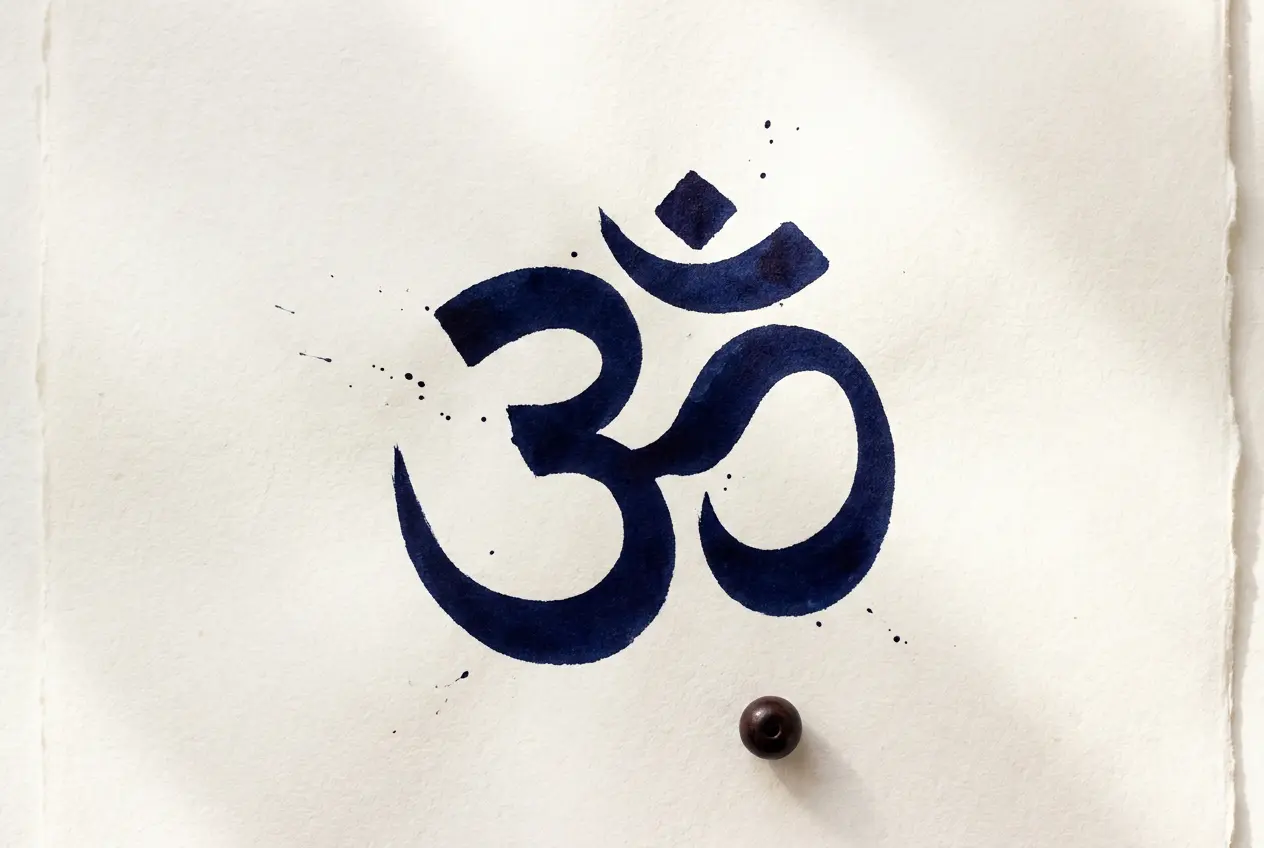
Om (Aum): The Seed of Every Mantra
Om, also written Aum, is the most widely recognized seed syllable. Hindu tradition treats it as a root sound, and many Vedic recitations begin with it. Om also appears in Buddhism and Jainism, so you will meet it in many settings.
In the United States, many yoga classes open or close with a group Om. The teacher leads one long, steady chant, and students follow.
The Gayatri Mantra: A 24-Syllable Prayer from the Rigveda
The Gayatri Mantra is a 24-syllable verse from the Rigveda (3.62.10), dedicated to the Vedic deity Savitr and traditionally attributed to the sage Vishvamitra. The verse has three lines of eight syllables each.
The opening phrase “oṃ bhūr bhuvaḥ svaḥ” is added before the verse and is not counted in the 24. Scholarly translations render the verse as a wish to receive the radiance of the god Savitr, who stirs human insight.
Mind Protection: What Is a Mantra in Buddhism?
In Buddhism, a mantra is a tool for protecting the mind, and Tibetans understood the word as mind protection, a way to guard attention against disturbing thoughts and emotions. The 14th Dalai Lama gives the same reading of the word.
Buddhist teachers describe the practice as keeping attention on a beneficial state, such as compassion, so that negative states have less room to take hold.
Why Is Vajrayana Called “The Path of Mantras”?
Vajrayana Buddhism is also called Mantrayana, the “path of mantras,” because mantra recitation sits at the center of its practice. Vajrayana is the tantric branch of Buddhism associated with Tibet, Nepal, and Bhutan. In it, mantras are usually paired with meditation on a particular deity.
Some of these tantric practices are traditionally received from a qualified teacher through initiation. This guide therefore describes them but does not give instructions.
Chanting is not limited to Vajrayana. Theravada monks, for example, recite verses in Pali, and longer Buddhist formulas called dharani are often treated as close relatives of the mantra. The Heart Sutra, a short Mahayana text, closes with a mantra and describes the perfection of wisdom as a mind-protecting mantra.

Om Mani Padme Hum: The Six-Syllable Mantra of Compassion
Om Mani Padme Hum is the six-syllable mantra of Avalokiteshvara (Chenrezig), the Buddhist bodhisattva of compassion, and one of the most widely recited mantras in Tibetan Buddhism. Its syllables are traditionally linked to the six perfections: generosity, ethics, patience, perseverance, concentration, and wisdom.
The mantra first appears in the Kāraṇḍavyūha Sūtra, a Mahayana text. Practitioners usually recite it on a mala or turn it inside a prayer wheel. For the full meaning of each syllable, read the six syllables of Om Mani Padme Hum explained.
Hinduism vs Buddhism: How Mantra Use Differs
The table below compares how the two traditions use mantras.
| Feature | Hinduism | Buddhism |
|---|---|---|
| Source texts | The Vedas, especially the Rigveda, and the Upanishads | Mahayana sutras such as the Heart Sutra and Kāraṇḍavyūha Sūtra, plus tantric texts |
| Signature mantras | Om, the Gayatri Mantra, Om Namah Shivaya | Om Mani Padme Hum, the Heart Sutra mantra, the Medicine Buddha mantra |
| Main purpose | Bring a deity or sacred truth to mind, and express devotion | Protect the mind from disturbing states and cultivate qualities such as compassion |
| Initiation needed? | Many well-known mantras are open to all; some are received from a guru | Common mantras are open to all; tantric practices traditionally require empowerment from a teacher |
Repetition with Intention: Sacred Sound in Modern Meditation and Yoga
Today, many people use a mantra as an anchor for attention in meditation or yoga, a steady sound to return to when the mind wanders. In mantra meditation, you repeat one word or phrase and gently return to it whenever your attention drifts.
Common choices include Om and So Hum, a Sanskrit phrase often translated as “I am that.” Others pick a plain English phrase, such as “peace” or “I am here.” Some people repeat a phrase silently during a slow commute, keeping their eyes open and their attention on the road.
Is a Mantra the Same as an Affirmation?
No. A mantra is a traditional sacred sound handed down through a lineage, while an affirmation is a positive statement you write for yourself. Both rely on repetition, but they differ in source and aim.
A mantra points attention toward a sacred quality or deity. An affirmation targets a belief or habit you want to change. Prayer is a third category, because it usually addresses a deity directly.
What Does the Research Say About Mantra Meditation?
Research on mantra meditation is early. The newest meta-analysis found preliminary mental health benefits in people with pain conditions, but no effect on pain intensity itself.
The review, by Coitinho Biurra, Naude, Coitinho Biurra, and Thompson, appeared in Pain Research and Management on 10/15/2026. It pooled 7 studies with 374 participants. Participants reported better mental quality of life and less negative mood, and people with chronic pain also reported less depression.
The authors call for further high-quality randomized controlled trials. The studies were small, about 53 participants on average, and every participant had a pain condition. The findings therefore do not show that mantra practice treats anxiety or depression in the general population.
The authors also cite US survey data. About 1.6% of US adults, roughly 3.6 million people, practiced mantra meditation over a 12-month period.
Important note: Mantra practice is a traditional spiritual and attention practice. The research above studied people with pain conditions and does not show that mantras treat any condition. This content is educational and does not replace professional medical or mental health care.
Japa in Practice: Counting Recitations on a 108-Bead Mala
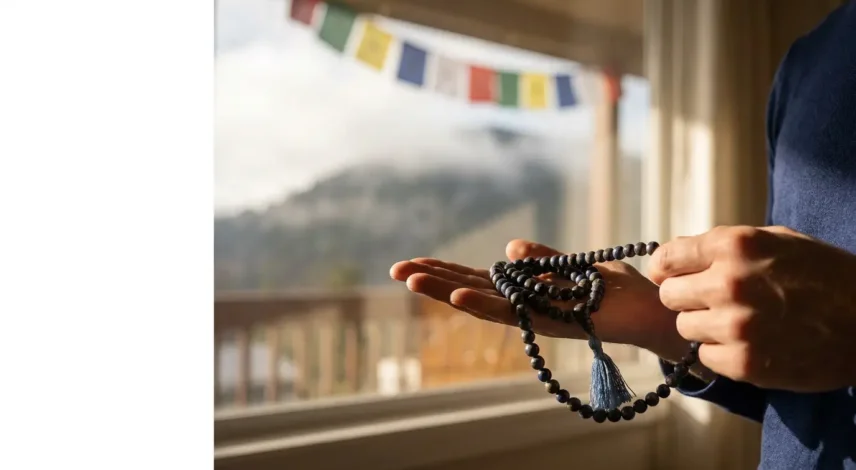
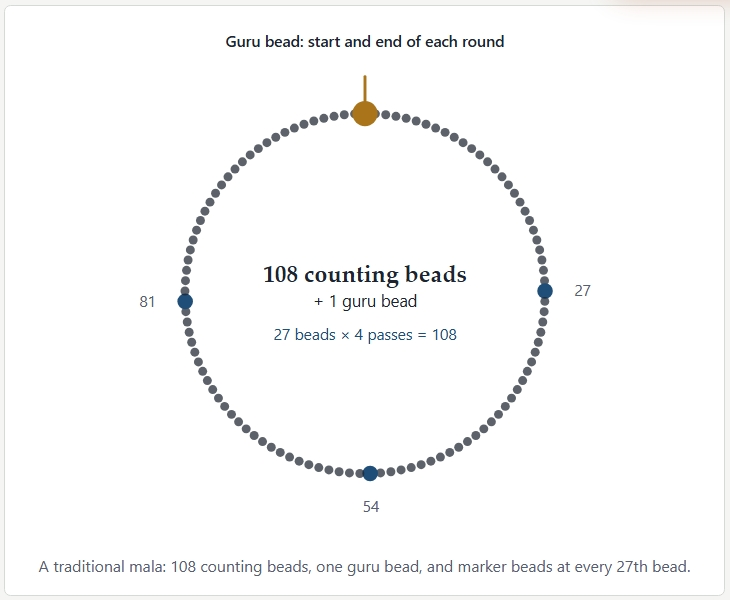
Japa is the practice of repeating a mantra a set number of times, traditionally counted on a mala of 108 beads plus one larger guru bead that marks the start and end of each round.
You move one bead for each repetition and stop at the guru bead. Tradition says not to cross it. Instead, you turn the mala around and continue in the opposite direction.
Why 108 Beads?
Traditions explain the number 108 differently. Tibetan Buddhist teachers often link it to the mental afflictions (kleshas) a practitioner works to overcome, while Hindu explanations point to cosmic wholeness. For a longer treatment, read why a Buddhist mala has 108 beads.
Many malas add marker beads at every 27th bead, which divide a round into four equal parts. A 27-bead wrist mala works on the same logic: 27 beads times four passes equals 108 repetitions. Wrist malas with 18 or 21 beads also exist.

Aloud, Whispered, or Silent: Three Ways to Recite
Traditions recognize three ways to recite a mantra:
- Aloud (vachika or vaikhari): Speak the mantra at a normal, steady volume. This is the easiest method for beginners and the usual one in group recitation.
- Whispered (upamshu): Move your lips and let the sound stay barely audible. This suits shared spaces such as an office or a quiet apartment.
- Silent (manasika): Repeat the mantra only in your mind. Many practitioners move to silent recitation once their attention is steady.
Start with 11 or 21 repetitions a day. One full round of 108 typically takes about 10 to 20 minutes, depending on your pace and the length of the mantra.
At first, many beginners assume faster is better. In our experience, first-time mala users often rush through the beads, and a hurried count loses the sound itself. If 108 feels like too many, use a 27-bead wrist mala and finish a round in four passes.
If you’d like a tool for counting, a 108-bead wood mala is a simple place to start. PotalaStore’s 108 Mala Beads Bracelet in wood costs $25.95 as of 11/14/2026. Its 108 beads and guru bead mark one full traditional round, so your attention stays on the sound instead of the count. The 8 mm (about 0.3 in) beads wrap four times around your wrist, so a round fits into a commute or a lunch break.
For a darker look, the obsidian tiger eye mala bracelet with 108 beads costs $30.95 and also includes a guru bead. You can compare other materials and lengths in the Tibetan mala and necklace collection with 108-bead prayer malas.
Choosing a First Mantra Respectfully
Most widely taught mantras, such as Om and Om Mani Padme Hum, are traditionally open to anyone who recites them sincerely. Many beginners worry about mispronouncing a mantra or borrowing from a tradition that is not theirs. That concern is understandable, and acting on it is a good habit.
Learn the pronunciation from a teacher or a reliable recording, and read what the words mean before you chant them. Pronunciation varies by language, so Sanskrit and Tibetan speakers say the same mantra differently. Practices received through initiation are best learned from a qualified teacher within their tradition.
Mantra FAQs: Quick Answers for Beginners
Yes. Most widely taught mantras, such as Om or Om Mani Padme Hum, are traditionally open to anyone who recites them sincerely. Some tantric practices, however, are traditionally received from a qualified teacher through initiation, so it is respectful to learn those within their tradition.
Not always. In everyday American English, “mantra” also means a guiding slogan, and many people use a calming phrase in secular meditation. Traditional mantras, though, come from Hindu and Buddhist practice.
Traditional counts are 108, or shorter rounds of 21 or 27. Many beginners start with 11 or 21 repetitions a day. Consistency matters more than the number, and five focused minutes daily is a realistic New Year’s resolution.
No, but a mala makes counting effortless so your attention stays on the sound. If you want one, start with a simple 108-bead wood mala or a 27-bead wrist mala. Then read our guide on how to choose mala beads for mantra practice.
In summary, a mantra is an instrument of thought. Hindu practice uses it to bring a deity to mind, Buddhist practice uses it to protect the mind, and modern meditators use it to hold attention.
The key takeaway for beginners is simple. Choose one mantra, learn it respectfully, and repeat it with attention for a few minutes a day.
Ready to count your first round? Browse PotalaStore’s Tibetan mala collection, or read our full guide to the Om Mani Padme Hum mantra for its six syllables in detail.
References
- Encyclopaedia Britannica, “Mantra.” Definition of the term, Hindu and Buddhist use, and the name Mantrayana. britannica.com
- Dr. Alexander Berzin, “What Is a Mantra?” StudyBuddhism. Etymology, the Tibetan reading of mind protection, and the Heart Sutra mantra. studybuddhism.com
- Coitinho Biurra Y, Naude C, Coitinho Biurra Z, Thompson A. “Mantra Meditation for Pain Conditions: A Systematic Review and Meta-Analysis.” Pain Research and Management, 2026. The 7-study, 374-participant review discussed above. pmc.ncbi.nlm.nih.gov
- Wikipedia, “Gayatri Mantra.” Rigveda 3.62.10, the 24-syllable meter, and the attribution to Vishvamitra. en.wikipedia.org