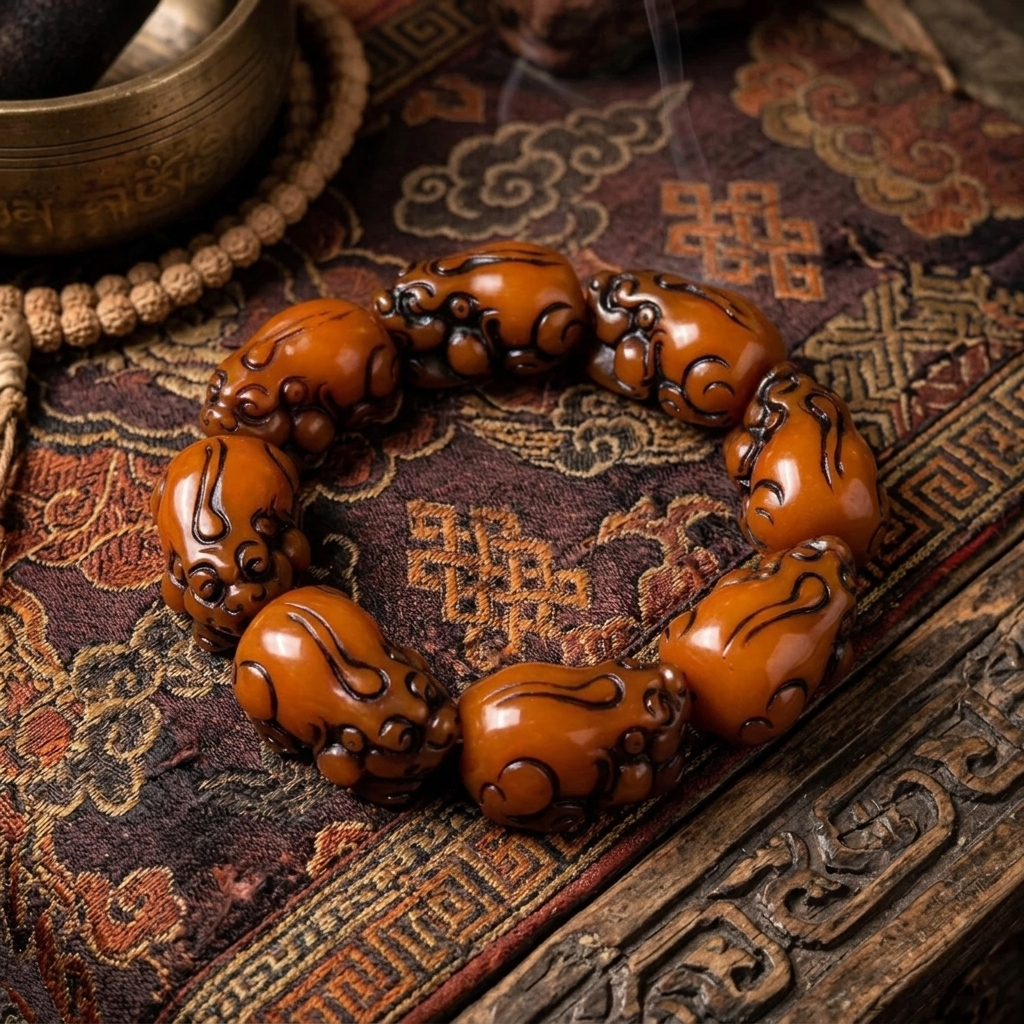

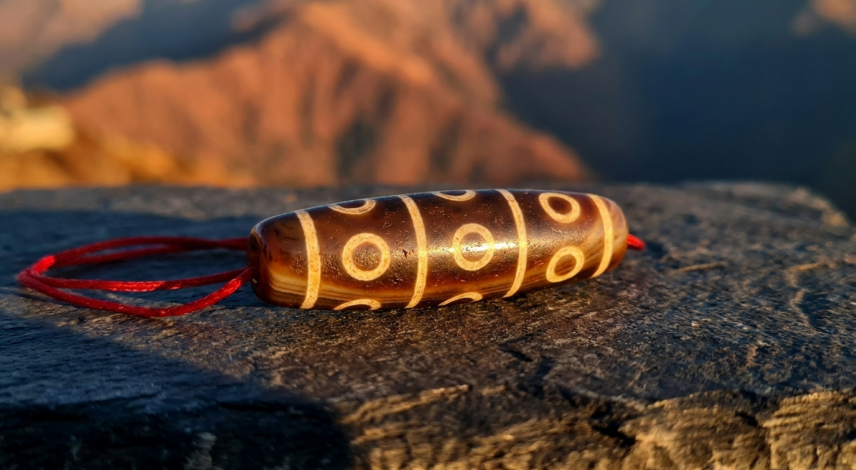

The eyes on a dzi bead are etched circles, and the number of circles signals the meaning Tibetan tradition attaches to that bead. One eye is traditionally linked to clarity, three to wealth and health, six to the Om Mani Padme Hum mantra, and nine to complete blessing. Dzi beads (Tibetan gzi, also called tian zhu) are agate beads decorated with etched patterns and worn as protective amulets.
Table of Contents
How to Read a Bead’s Pattern: Counting Rows and Combined Motifs
Count only the full circular eyes, not the stripes, waves, or squares around them. Follow these three steps:
- Hold the bead flat: Rotate it slowly under steady light for 10 to 15 seconds so every side is visible.
- Count full circles only: Tally each complete etched ring on one side, then check that the other side matches.
- Set aside stripes and extras: Lines, waves, and squares belong to other motif families and do not change the eye count.
Why Are the Circles Called “Eyes”?
Tibetans have long treated the eye as a guardian, and dzi eyes were traditionally believed to counter the evil eye. Wikipedia describes this as a “fight fire with fire” form of protection, with artisans placing eyes on amulets to turn the evil eye back on itself.
Eyes vs. Stripes vs. Combined Motifs
A bead with three evenly spaced rings is a three-eye dzi, while one with only lengthwise lines belongs to the striped chung dzi family. Some beads combine eyes with other marks, such as a lotus or wave. In that case, count the eyes first and treat the extra mark as a second layer of meaning.
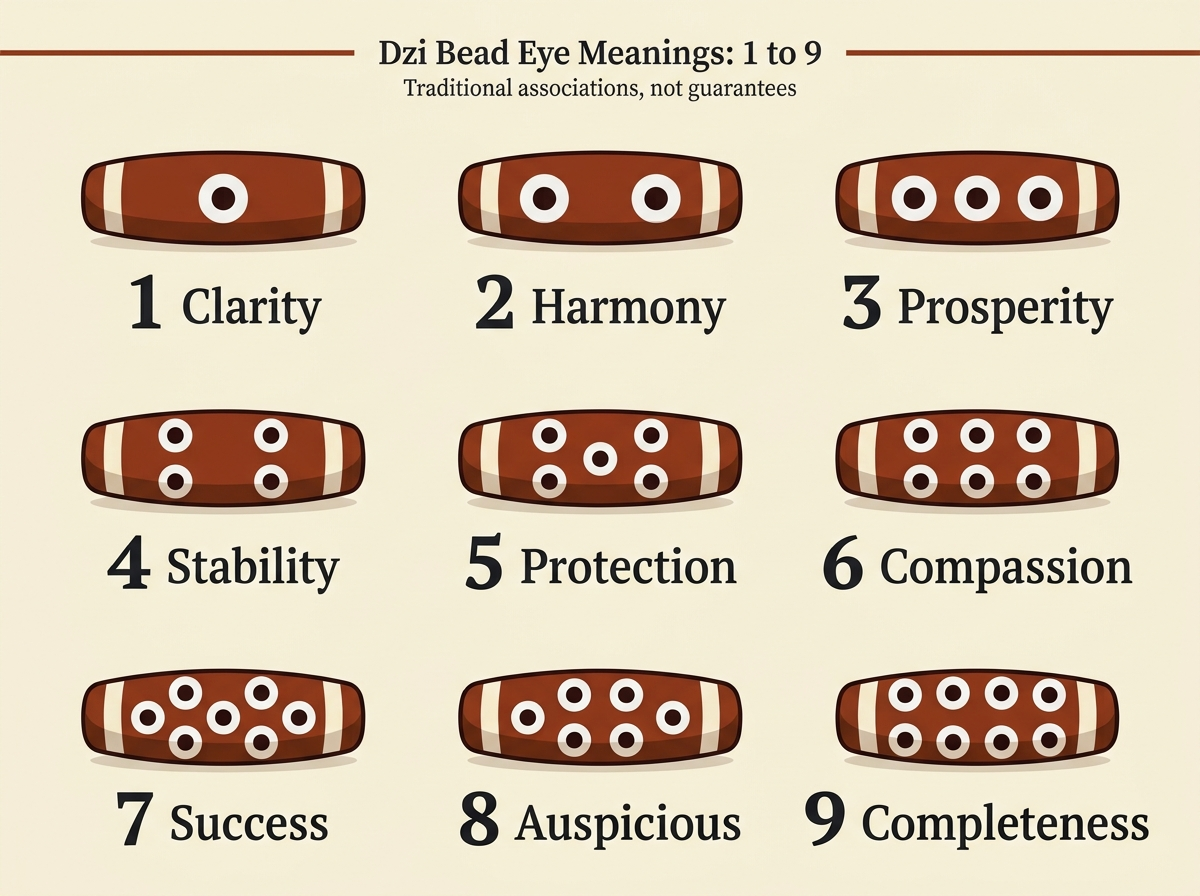
Dzi Bead Eye Meanings From 1 to 9 Eyes
The eye count signals a traditional association: one eye for clarity, three for wealth and health, six for compassion, and nine, the “King of Dzi,” for complete blessing and protection. These are cultural beliefs, not guaranteed outcomes. The table shows each count, where its meaning usually comes from, and how closely sources agree.
| Eyes | Traditional association | Where the meaning is usually cited | Agreement |
|---|---|---|---|
| 1 | Clarity, unity, single-pointed focus | Tibetan Buddhist practice and modern retail guides | High |
| 2 | Harmony, partnership, relationships | Chinese folk and modern retail guides | High |
| 3 | Prosperity, health, longevity; linked to Fu Lu Shou and Jambhala | Chinese folk belief and Tibetan wealth tradition | High |
| 4 | Stability and protection | Doctrinal link varies by seller | Disputed |
| 5 | Protection; sometimes tied to the five Dhyani Buddhas | Tibetan Buddhist and retail guides | Medium |
| 6 | Compassion; matched to the six syllables of Om Mani Padme Hum | Tibetan Buddhist | Medium |
| 7 | Wealth and success, often tied to the seven treasures | Retail guides | Medium |
| 8 | Auspiciousness; the Eight Auspicious Symbols or the Eightfold Path | Varies by source | Disputed |
| 9 | Complete blessing, protection, and success; the “King of Dzi” | Tibetan tradition and collector literature | High |
Agreement reflects our reading of the leading English-language dzi guides we compared. It is a qualitative judgment, not a formal ruling.
1 to 3 Eyes: Clarity, Harmony, and Wealth
Start here for a focused, everyday intention: one eye is linked to clarity, two to partnership, and three to prosperity, health, and longevity. The three-eye dzi is also the bead studied in the 2020 laboratory research discussed below. Many shoppers treat it as an approachable first choice because it pairs a clear meaning with a lower price than the nine-eye.
4 to 6 Eyes: Protection, Abundance, and Compassion
The six-eye dzi is the compassion bead, and its six eyes are traditionally matched to the six syllables of Om Mani Padme Hum. That mantra belongs to Avalokiteshvara, the Buddhist figure of compassion. Four and five eyes are described mainly as protective, though sellers disagree on the exact doctrine behind them.
7 to 9 Eyes: Success, Safety, and the “King of Dzi”
The nine-eye dzi is called the “King of Dzi” because nine reads as completeness. The 2020 Heritage study also calls it the most highly coveted dzi pattern. Our nine-eye dzi bead meaning and benefits guide covers its symbolism, wearing tips, and costs in full.
Rare 10-Eye to 21-Eye Beads: What High Counts Symbolize
Traditional dzi run from one eye up to twenty-one, and the higher counts are rare enough that most buyers only see them in collections. Here is what sources commonly say:
- 10 eyes: Perfection or the ten virtues, a collector tradition.
- 11 eyes: Some collectors connect it to the eleven-faced form of Avalokiteshvara.
- 12 eyes: The twelve links of dependent origination, or the twelve vows of the Medicine Buddha.
- 13 eyes: One regional news feature describes each of the thirteen eyes as a different deity.
- 21 eyes: The Twenty-One Taras, a collector tradition.
10 to 12 Eyes: Virtue, Perfection, and Time Cycles
Ten, eleven, and twelve eyes borrow their meanings from Buddhist lists such as virtues, forms of Avalokiteshvara, and the twelve links of dependent origination. These associations come mostly from collectors and sellers rather than from a single written authority. Treat them as traditions in circulation, not as settled doctrine.
13 to 18 Eyes: Thinly Documented Counts
Beads with 13 to 18 eyes are rare, and we found no consistent source for most of their meanings. Where a seller gives a precise meaning for a 14-, 15-, or 17-eye bead, ask what source it comes from. If none is given, read the claim as marketing language.
21 Eyes: The Twenty-One Taras Connection
The 21-eye dzi is traditionally linked to the Twenty-One Taras, which is why some collectors rank it beside the nine-eye. Tara is a Buddhist figure of compassionate action, and each of the twenty-one forms carries its own praise in Tibetan practice. A genuine 21-eye bead is uncommon, so verify the material carefully before buying one.
Consensus vs. Disputed Meanings: Where Sources Disagree
Use this section to avoid paying for a meaning that only one seller invented: the 1-, 2-, 3-, and 9-eye meanings are widely shared, while 4, 8, and 10 vary by source.
| Eye count | Agreement | What varies |
|---|---|---|
| 1, 2 | High | Wording only (clarity or unity; harmony or partnership) |
| 3 | High | Whether health or wisdom is emphasized alongside wealth |
| 9 | High on rank, mixed on reason | Why nine: nine planets, nine virtues, or nine vehicles |
| 4 | Disputed | Which doctrine the four eyes represent |
| 8 | Disputed | Eight Auspicious Symbols or the Eightfold Path |
| 10 | Disputed | Some sellers promote it as the strongest, against the more common nine-eye ranking |
The Consensus Core: 1, 2, 3, and 9 Eyes
Sources agree most on these four counts, mainly in intent rather than exact wording. The 2020 Heritage paper itself states that the nine-eye bead is the most highly coveted. That shared ranking is the strongest consensus point in the whole topic.
The Disputed Middle: 4, 8, and 10 Eyes
The four-, eight-, and ten-eye counts attract the widest range of claims. For nine eyes, the same bead is explained as the nine planets in the Heritage paper, as nine virtues by DharmaShop (wisdom, compassion, clarity, power, wealth, health, longevity, fame, and karma), and as nine vehicles by Ancient Dzi Shop. Those explanations coexist because they come from different traditions.
Why Meanings Vary: Three Cultural Layers
Dzi meanings come from three overlapping layers: Tibetan Buddhist teaching, Chinese folk belief and feng shui, and modern retail copy. A single bead can carry all three at once. When two sellers disagree, ask which layer each one is quoting. The table above flags where a meaning is usually cited so you can judge for yourself.

Which Eye Count Fits Your Intention?
Pick the count that matches one clear intention: three eyes for prosperity, two for a relationship, nine for an all-around blessing. Our Tibetan bracelet meaning, symbols, and materials guide explains how dzi fit alongside other protective pieces.
| Your intention | Eye count to consider | Why |
|---|---|---|
| Focus and clarity | 1 eye | Traditionally linked to single-pointed attention |
| A relationship | 2 eyes | Associated with harmony and partnership |
| Prosperity and steady wellbeing | 3 eyes | Tied to wealth, health, and longevity |
| Compassion and mantra practice | 6 eyes | Matched to Om Mani Padme Hum |
| An all-around blessing | 9 eyes | The “King of Dzi,” read as completeness |
Browse PotalaStore’s handmade Tibetan bracelet collection to compare protective designs by material, symbol, and style.
Matching Eye Count to Your Goal
Choose one goal and read the meaning for that count before you compare designs. A bead that fits a single, clear intention is easier to wear with purpose than one bought for its reputation. Stay realistic: a dzi is a cultural symbol, and it does not guarantee any result.
Is a Nine-Eye Always Better Than a Three-Eye?
No, because nine eyes signal breadth while three eyes signal a narrower intention such as prosperity. A nine-eye dzi also costs more and is imitated more often. If you want one specific focus, a three-eye or six-eye bead can be the better fit.
Gifting a Dzi: From Thanksgiving to Lunar New Year
You do not want to give the wrong meaning, so match the eye count to the recipient’s stated hopes. Prosperity themes suit Lunar New Year (02/06/2027), while protection themes suit a move or a new job. Include a short note explaining the meaning, since many recipients will not know it.
Buying a Dzi Bead: Material, Price Tiers, and Respectful Wear
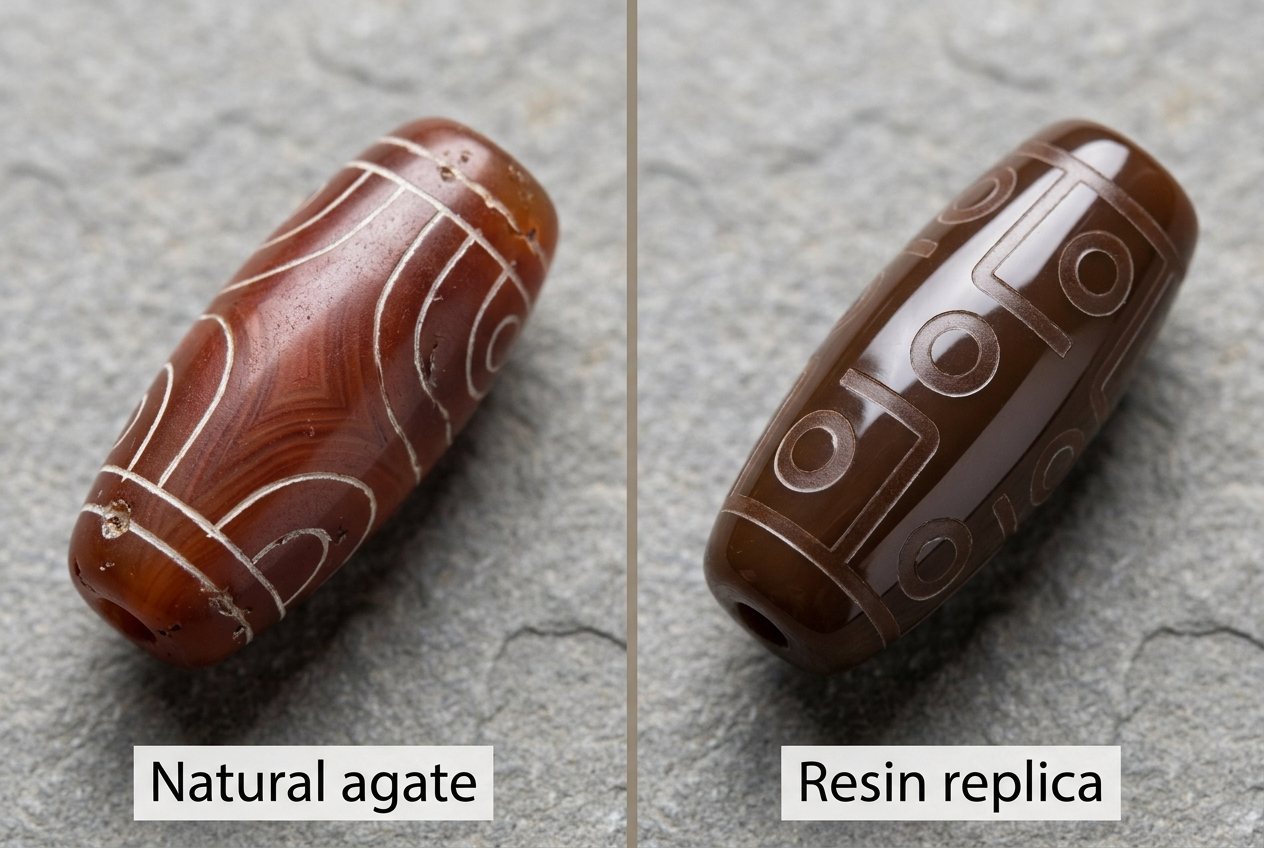
Know three numbers before you buy: real dzi is agate rated 6.5 to 7 on the Mohs scale, modern agate beads typically cost $80 to $300, and anything under $20 is almost certainly imitation. Many inexpensive beads are resin or glass. Check the material first, then judge the price.
What a 2020 Lab Study Revealed About Real Dzi
Researchers at Western University and the Canadian Light Source tested a three-eye dzi with X-ray diffraction and fluorescence. They found the bead was made of agate (silicon dioxide). The etched rings contained regular copper hot spots on their circumference. The authors concluded the bead started out as an earth-formed agate with the pattern crafted onto it.
That finding means a genuine dzi is natural stone with a made pattern, not a stone that fell with the design already on it. The limit matters too: the study examined a single bead, so it supports a method, not a rule for every dzi. To apply this at home, see our real vs fake dzi bead tests, and our 5-point Tibetan jewelry authenticity checklist for the wider quality questions.
Replicas are another reason to check. The same paper notes that dzi replicas are usually plastic, glass, or light metal such as aluminum, and some carry a metal center to mimic the weight of a real bead.
Price Tiers: Imitation, Modern Agate, and Antique
| Tier | Typical price | What you usually get |
|---|---|---|
| Imitation | $5 to $20 | Resin or glass, decorative only |
| Modern agate | $80 to $300 | Etched agate made in recent decades |
| High-quality handmade | $500 to $5,000 | Fine craftsmanship, stronger patterns |
| Antique | $10,000 and up | Aged beads with documented history |
Ranges are drawn from PotalaStore’s nine-eye guide and vary widely by seller, weight, and age. Treat them as orientation, not a quote.
If an offer for a “rare antique” arrives at the imitation price, the gap itself is the warning sign.
How to Wear and Care for an Eye Dzi
Wipe your dzi with a soft, dry cloth, and store it apart from harder jewelry. Agate chips on impact, so remove the bead before heavy exercise or manual work. Wear it where you will see it daily. Our Tibetan bracelet guide lists the left wrist for dzi worn for fortune and protection, though traditions differ.
Important note: The meanings described here reflect Tibetan Buddhist and regional folk traditions. They are cultural and spiritual beliefs, not guaranteed outcomes, and they are not scientific claims. This content is educational and does not replace medical, financial, or legal advice.
Dzi Bead Eye FAQs
Most Tibetan and collector traditions rank the nine-eye dzi, the “King of Dzi,” as the most complete bead, and the 2020 Heritage paper calls it the most highly coveted. A few sellers promote other counts. “Power” here is a traditional belief, not a measurable effect.
PotalaStore’s Tibetan bracelet guide suggests the left wrist for a dzi worn for fortune and protection. Traditions differ, so choose the wrist where the bead stays in contact with your skin and in your sight each day.
In Tibetan tradition, a broken dzi bead is generally seen as neutral or positive, as though the piece has completed its karmic function. Thank it, retire it respectfully, and choose a new bead when you are ready.
Start with one intention, then match the eye count to it: three eyes for prosperity, two for a relationship, nine for an all-around blessing. Confirm the material is real agate and fairly priced, then explore our handmade Tibetan bracelet collection.
In summary: count only the full eyes, treat 1, 2, 3, and 9 as the most widely agreed meanings, and verify the agate before you pay. Whatever the eye count, a dzi bead is best chosen for a single clear intention.
Find the Dzi Design That Fits Your Intention
Browse PotalaStore’s collection of handmade Tibetan bracelets and compare symbols, materials, and styles.Shop Tibetan bracelets
📚 References
- Dzi bead laboratory analysis: Reinhardt, A., Feng, R., Xiao, Q., Hu, Y., & Sham, T.-K. (2020). Peer-reviewed X-ray study of a three-eye dzi bead, Heritage 3(3), 1035-1045. MDPI Heritage
- Research summary: Plain-language account of the dzi study using the synchrotron at the Canadian Light Source. Canadian Light Source
- Study background: How the Western University chemistry team approached the bead and what questions remain open. Western University
- Dzi bead overview: Name meaning, the evil eye tradition, and early archaeological finds. Wikipedia