
Compare Buddha Pendant Sizes, Dimensions, and Weight: A Measured Chart by Material
 by Yang Tso
0 comments
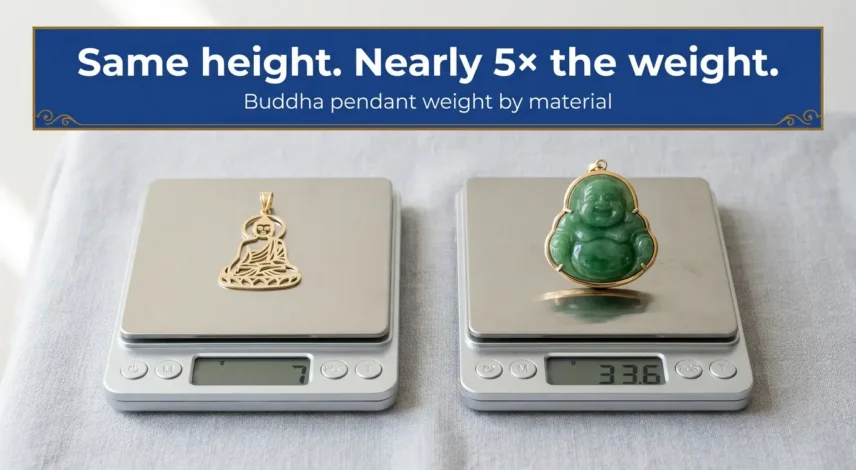
Two Buddha pendants can stand nearly the same height, 2.2 and 2.3 inches (56 and 58.6 mm), and weigh about 7 grams and 33.6 grams. Swap the first for a 1.6-inch (41 mm) gold relief and the gap hits ten times: 3.37 grams against 33.6.
Photos hide scale, and many listings give millimeters but not grams. That is how a pendant ends up too small to read across a table, or too heavy for the chain it hangs on.
This guide gives you a size chart with US coin comparisons, a weight-by-material table, a five-step spec checklist, chain rules for heavy pendants, and three Potala Store Tibetan pendants side by side. We compiled specs from seven outside seller listings and our own product pages on 11/13/2026. Every weight is the seller’s listed figure, not a reading from our scale, and we flag each number a listing leaves out.
Short answer: most Buddha pendants run 0.6 to 2 in tall. For daily wear, 1 to 1.6 in (25 to 40 mm) keeps the carving readable without dragging on your neck.
This guide covers physical sizing. Spiritual meanings are described as traditionally believed, not guaranteed.
Want a pick with the numbers already listed? The Citrine Guardian Buddha lists 2.0 × 1.2 in and 2.1 oz (60 g) with its bead chain, at $32.95 as of 11/13/2026.
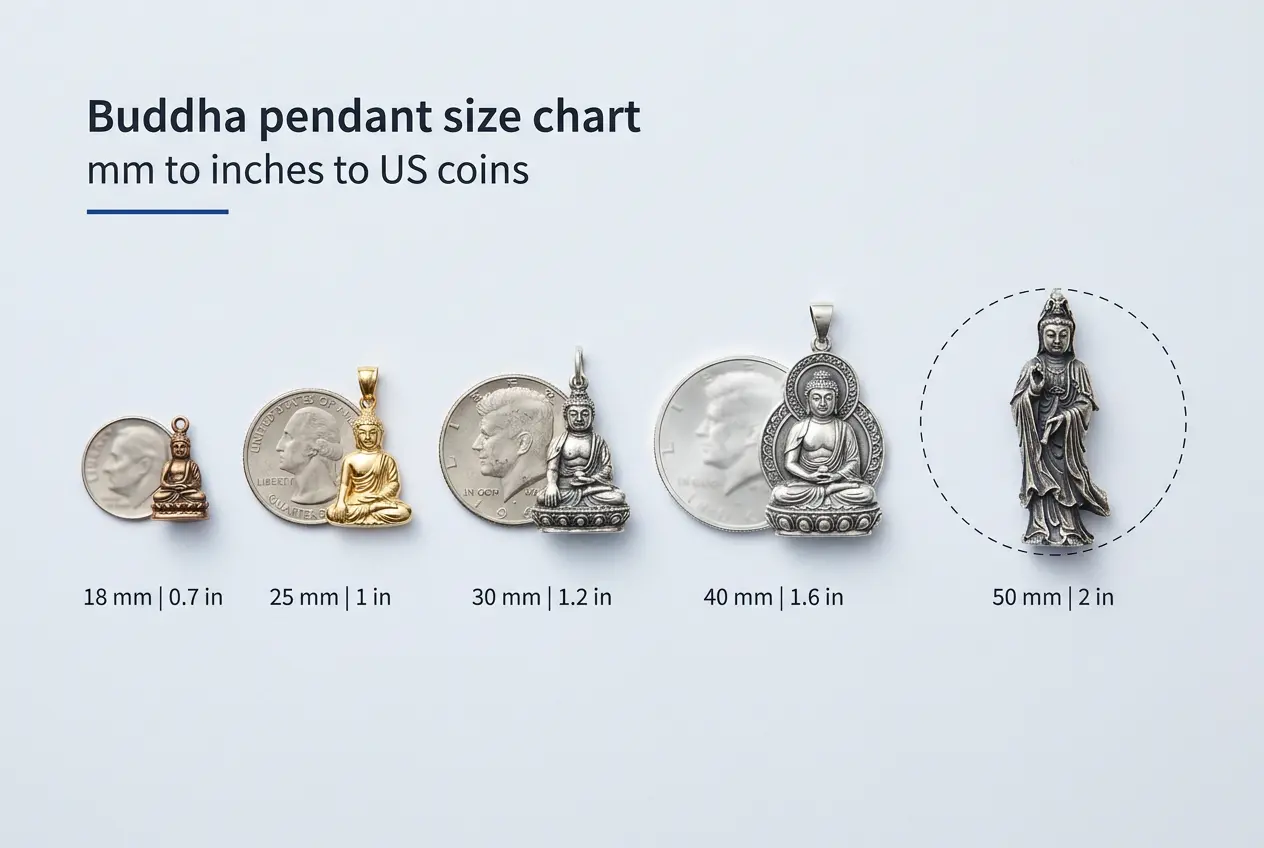
Table of Contents
What Are Standard Buddha Pendant Sizes in Millimeters and Inches?
Buddha pendants are sold from about 15 mm (0.6 in) to well over 50 mm (2 in) tall, measured with the bail. Small pendants run under 15 mm, medium 15 to 30 mm, and large 30 to 50 mm; anything over 50 mm is a statement piece. A 25 mm pendant is about the size of a US quarter.
| Tier | Height (mm) | Height (in) | US coin comparison | Typical use |
|---|---|---|---|---|
| Small | under 15 | under 0.6 | Smaller than a dime (17.91 mm) | Charms and fine layering |
| Medium | 15–30 | 0.6–1.2 | Dime up to just under a half dollar; a quarter (24.26 mm) sits mid-range | Everyday wear that tucks under a collar |
| Large | 30–50 | 1.2–2.0 | Half dollar (30.61 mm) up to a Silver Eagle (40.6 mm) and beyond | A visible focal point |
| Statement | over 50 | over 2.0 | Wider than a Silver Eagle | Worn on purpose, often over clothing |
Size bands follow TheSize.net’s pendant size chart. Jewelers don’t define them formally, and other guides draw the lines differently. Coin diameters are US Mint specifications.
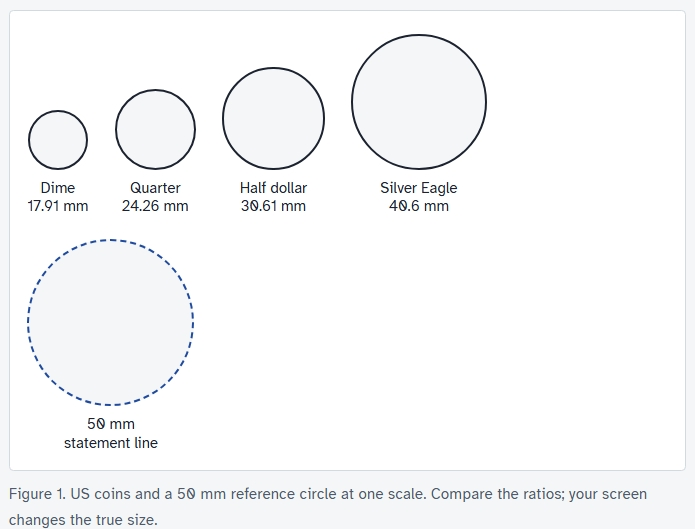
Size grows with area, not just height. If a pendant keeps its shape, a 50 mm piece has about 2.8 times the face of a 30 mm one, which is why the jump looks bigger than 20 mm sounds. Product photos make it worse: tight crops can make a 12 mm pendant read like a 40 mm one. Go by the listed dimensions, and try this: hold a quarter against your collarbone in a mirror. That is a 25 mm pendant.
Small vs. Medium vs. Large Buddha Pendants
Under 15 mm, a Buddha pendant is closer to a charm: you see the shape and not much else, which suits layering. Medium pieces, 15 to 30 mm, are the everyday size. They tuck under a collar and still show a figure. Large pendants, 30 to 50 mm, are where carving detail becomes easy to read and where weight starts to matter. Past 50 mm you are wearing a statement piece.
How Big Is a 30 mm Pendant Compared With a US Coin?
A 30 mm pendant is 1.18 in tall, just under a half dollar (30.61 mm, 1.205 in). Use the coin list to match other sizes.
| US coin | Diameter | In inches | Pendant height it matches |
|---|---|---|---|
| Dime | 17.91 mm | 0.705 in | about 18 mm |
| Penny | 19.05 mm | 0.750 in | about 19 mm |
| Nickel | 21.21 mm | 0.835 in | about 21 mm |
| Quarter | 24.26 mm | 0.955 in | about 25 mm |
| Half dollar | 30.61 mm | 1.205 in | about 30 mm |
| American Silver Eagle | 40.6 mm | 1.598 in | about 40 mm |
Coin diameters: United States Mint.Silver Eagle diameter as listed by TheSize.net.
At 50 mm (1.97 in) no US coin comes close. The nearest everyday match is the 50.8 mm length of a military dog tag.
How Much Does a Carved or Cast Buddha Amulet Weigh by Material?
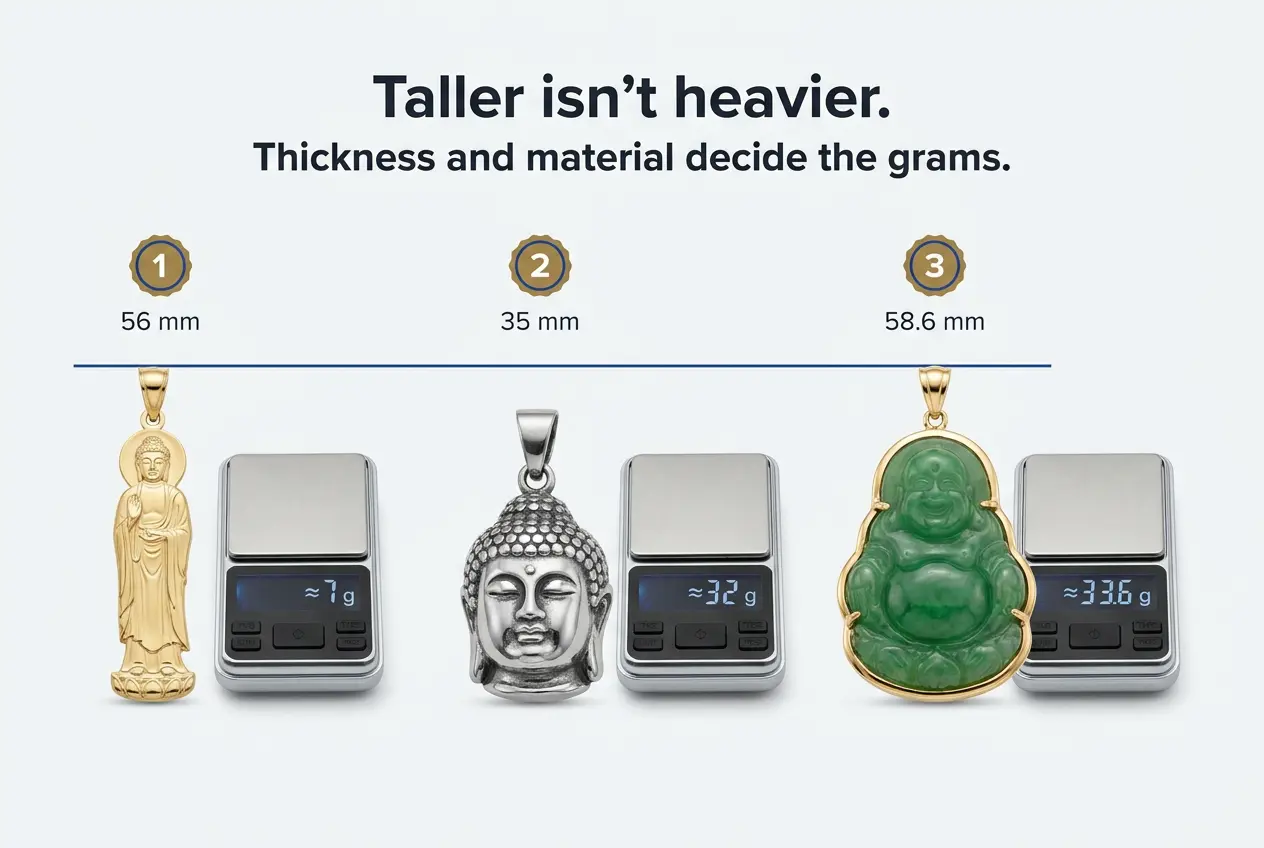
Across the listings we compiled, a Buddha pendant weighs anywhere from about 2.4 g to 48 g. Material and thickness matter more than height: a 41 mm (1.6 in) 10K gold relief weighs 3.37 g, while a 58.6 mm (2.3 in) jade Laughing Buddha set in 14K gold weighs about 33.6 g, ten times as much.
| Material and form | Listed size | Listed weight | Source |
|---|---|---|---|
| Fine silver (.999) Buddha | 30.5 mm (1.20 in) tall with bail, 17.0 mm wide | ≈ 2.4 g (0.08 oz) | Popular Jewelry |
| 10K gold meditating Buddha, relief | 41.4 mm (1.63 in) tall with bail, 27.7 mm wide, 2.03 mm deep | 3.37 g (0.12 oz) | Factory Direct Jewelry |
| 14K gold and jade Laughing Buddha medallion | 34 mm (1.34 in) tall with bail, 26 mm across | ≈ 5.1 g (0.18 oz) | Popular Jewelry |
| 10K gold Buddha, large size | 56 mm (2.2 in) tall, 30 mm wide, 6 mm thick | ≈ 7 g (0.25 oz) | WJD Exclusives |
| Stainless steel Buddha head | 35 × 24 × 11 mm (1.38 in tall), as listed | ≈ 32 g (1.13 oz) | K-Design Schmuck Factory |
| 14K gold and jade Laughing Buddha | 58.6 mm (2.31 in) tall with bail, 44.1 mm wide | ≈ 33.6 g (1.19 oz) | Popular Jewelry |
| Sandalwood in white copper and Tibetan silver | 55 mm (2.17 in) long, 43 mm wide, 12 mm thick | 48 g (1.69 oz) | Mooras |
Specs come from the sellers’ own product pages. ≈ marks figures the seller calls approximate. These are listed weights, not readings from our scale. Highlighted rows: nearly the same height, about five times the weight.
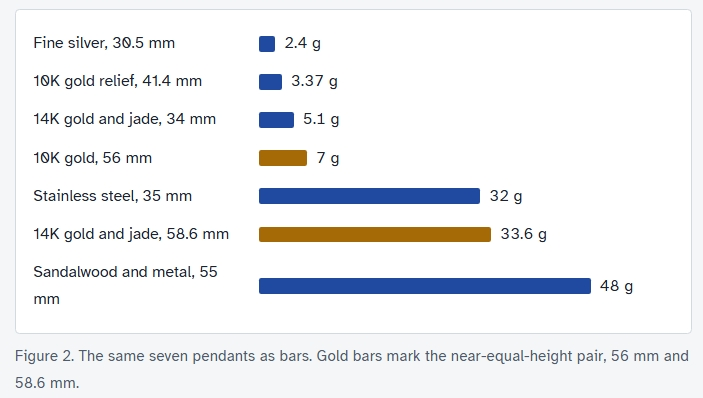
Gold sounds like the heavy option, but the thin gold pieces here are the light ones: the 10K relief is just 2.03 mm deep. Compare the highlighted rows. The 56 mm gold Buddha and the 58.6 mm jade Buddha are within 3 mm in listed height, yet they weigh about 7 g and 33.6 g. A 35 mm steel head, at about 32 g, outweighs the 56 mm gold piece more than four times over.
Gold, Silver, and Steel Buddha Pendants in Grams
Density sets the baseline, since gold is far denser than silver or steel, but thickness decides how much material you actually wear. The Factory Direct Jewelry relief shows both levers. Its medium size (34.8 mm with bail) weighs 2.35 g in 10K gold and 2.80 g in 14K; its large (41.4 mm) weighs 3.37 g in 10K and 4.00 g in 14K. Within each size the design is the same, so the 14K version is the heavier one.
Silver is the budget metal: a .999 silver Buddha at 30.5 mm lists about 2.4 g. We found no sterling silver (.925) Buddha with a listed weight, so check the grams on any silver piece. Ask whether a piece is solid or hollow, too, since a hollow casting weighs far less.
Stainless steel is common in men’s pendants. The 35 mm steel Buddha head in the table is 11 mm thick and lists about 32 g, which is why steel can feel heavy for its size.
Jade, Citrine, and Sandalwood Carvings in Ounces
Stone and wood carvings are usually thick, so the grams add up. The 14K gold and jade Laughing Buddha at 58.6 mm lists about 33.6 g (1.19 oz). A similar jade piece from the same seller, 55.2 mm tall and 12.6 mm thick, lists about 38.8 g (1.37 oz). Sandalwood is light by volume, but not when it is carved in the round and framed in metal: the 55 mm Mooras pendant lists 48 g (1.69 oz).
Citrine, a quartz, is another carved-stone option. Our own Citrine Guardian Buddha lists 2.1 oz (60 g), but that includes its bead chain, so don’t set it beside the pendant-only weights above.
“Jade” covers two different stones, jadeite and nephrite, so ask which one you are getting. Still deciding which kind of amulet suits you? Our guide to Tibetan Buddhist protection amulets and their meanings covers the main types.
How Do You Measure a Buddha Pendant Before You Buy?
Measure five things: height with the bail, height without it, width, thickness, and the bail’s inner opening. Listings often mix these up. If a page gives two heights, the larger one includes the bail, which typically adds 4 to 8 mm.
- Height with the bail. Top of the loop to the lowest point of the figure. This is how far the pendant hangs below the chain.
- Height without the bail. The body alone. Subtract it from the first number to see what the bail adds.
- Width. The widest point, left to right. A listing that reads “27.6 × 30.5 mm” usually gives width first, then height.
- Thickness. Front to back. It drives weight, and it decides whether the piece lies flat under a shirt.
- Bail inner opening. The hole your chain passes through. It must be wider than the chain, and wider than the clasp if you thread the clasp through.
No number for one of these? Ask the seller. If you already own the piece, a kitchen scale that reads to 0.1 g will give you the weight.
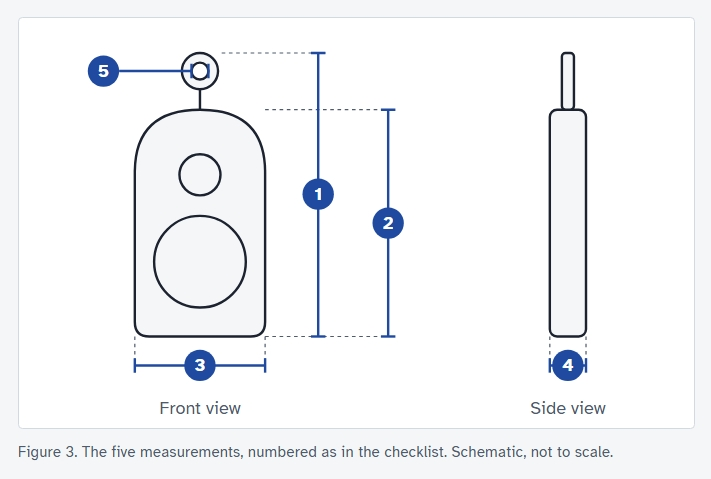
Height With vs. Without the Bail
Height with the bail tells you how far the pendant hangs below the chain. Height without the bail tells you how big the figure itself is. Factory Direct Jewelry’s meditating Buddha lists both: 41.4 mm (1.63 in) with the bail and 34.54 mm (1.36 in) without, so the bail adds about 6.9 mm (0.27 in). Our Ga Wu box listing gives 47 × 56.3 mm for the “pendant body,” which suggests its vajra-shaped bail is not counted. Expect a longer drop than the 2.22 in suggests.
Total Weight vs. Pendant-Only Weight
Check what a weight covers. Our own listing for the 2.0 × 1.2 in Citrine Guardian Buddha pendant says 60 g (2.1 oz) under “Total Weight,” and that total includes its 27.6 in (70 cm) bead chain. It is not the pendant alone, and we don’t have a pendant-only figure yet.
It matters because the chain rules later in this guide compare pendant weight with chain weight. Feed them 60 g by mistake and the 1.5 to 2.5 times guideline asks for a 90 to 150 g chain, far heavier than anyone would wear. If a listing only says “weight,” ask whether the chain is included.
Which Buddha Necklace Size Suits Your Frame and Daily Wear?
For everyday wear, choose a Buddha pendant about 1 to 1.6 in (25 to 40 mm) tall. Below roughly 25 mm, a carved Laughing Buddha’s face starts to lose definition; above 45 mm, it becomes a statement piece, and the weight can climb fast.
Your frame sets the scale. A 15 mm Buddha looks elegant in photos and like a dot across the room. A 50 mm piece on a petite frame takes over the chest. If you are between sizes, go by how you dress: under a collar, stay near 25 to 30 mm; over a sweater or an open collar, 35 to 45 mm holds its own.
Men’s pendants tend to run larger. TheSize.net lists men’s crosses at 25 to 50 mm, and the same chain sits higher on a man, so adjust the chain length before you adjust the pendant size.
A note on height. Keep a Buddha pendant at chest height or above, not down by your waist. Many Buddhist traditions treat sacred images this way as a sign of respect, and our Ga Wu box page tells wearers to keep it against the heart, above the waist.
Everyday Under-Shirt Wear vs. Statement Pieces
As a rule of thumb, a piece up to about 30 mm tall and 8 mm thick tucks under a shirt without showing through; anything bigger shows. Match the drop to the neckline too. A short drop stays visible above a crew neck, and a pendant that lands at the point of a V-neck looks intentional. Statement pieces over 50 mm wear best over clothing, so check the grams before you commit.
Why Carved Faces Need at Least 25 mm
Budai, the Laughing Buddha, is a separate figure from Shakyamuni, the historical Buddha. The Metropolitan Museum’s catalog describes Budai as believed to be an incarnation of Maitreya, the future Buddha. Either way, a carved face is small. A 25 mm pendant is no wider than a quarter, and the face is only part of that, so smiles, eyes and earlobes run out of room. Jade retailer BMjade’s size guide also ties carving detail to size.
Our line is 25 mm. Below it, treat the pendant as a charm. Between 30 and 40 mm, the face is easy to read in daily wear.
What Chain Length and Thickness Does a Heavy Pendant Need?
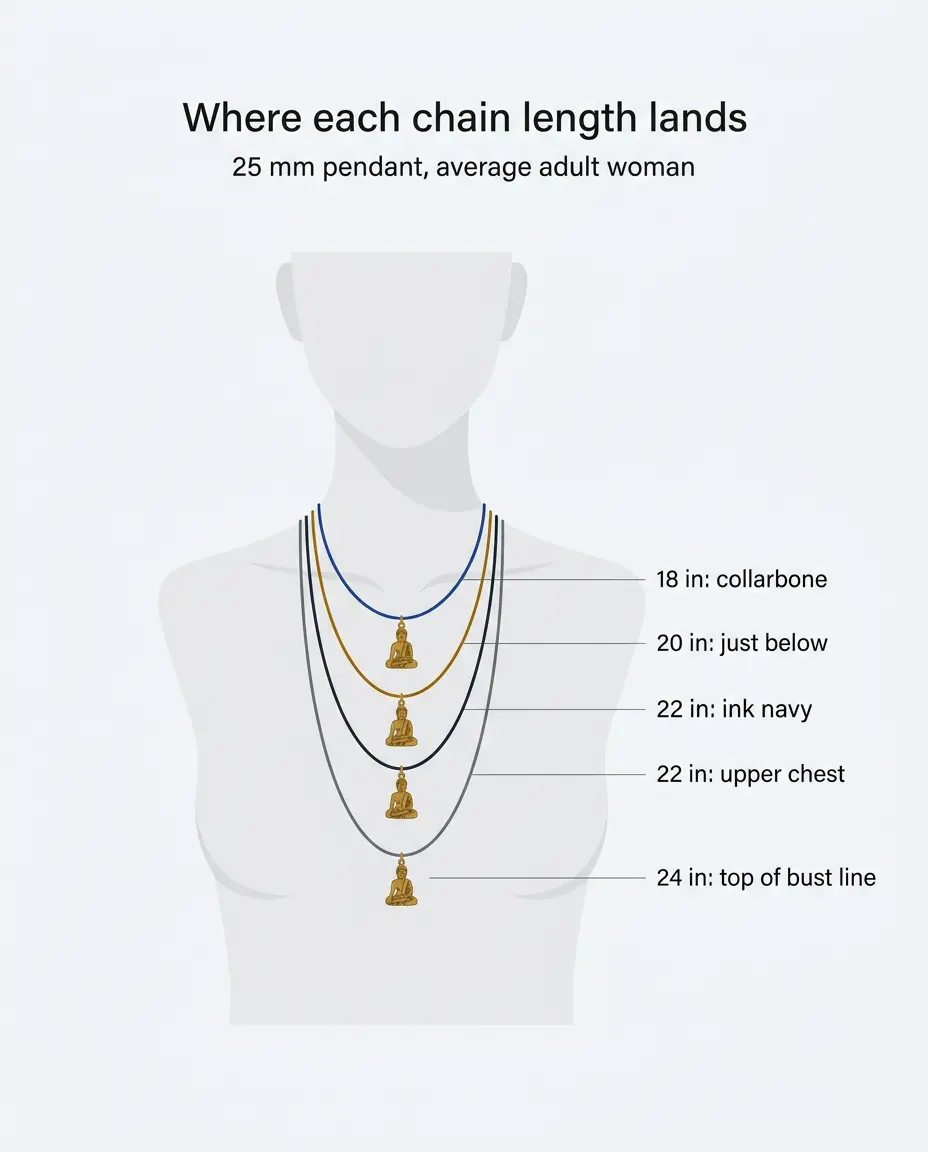
Pick a chain that weighs at least as much as the pendant, and give anything over 1.2 in (30 mm) at least a 20-inch chain. With a 25 mm pendant, 18 in lands at or just below the collarbone, 22 in on the upper chest, and 24 in at the top of the bust line.
A heavy pendant on a thin chain is an easy way to lose a sacred piece. If the bail looks wide and the chain looks thin, stop and match them first.
Where 18, 20, 22, and 24 Inch Chains Land
| Chain length | Pendant bottom below the base of the neck | Lands at |
|---|---|---|
| 16 in | 1.7 in | The collarbone |
| 18 in | 2.7 in | On or just below the collarbone |
| 20 in | 3.7 in | Below the collarbone |
| 22 in | 4.7 in | Upper chest |
| 24 in | 5.7 in | Top of the bust line |
Source: TheSize.net, which builds the chart on ANSUR II average base-of-neck sizes (14.6 in for women, 17.1 in for men).
A heavy pendant pulls the chain into a deeper V, so the real drop is often a little lower than the table shows. On a man the same chains sit about 1.25 in higher. A thick pendant on a fine chain tends to flip and show its back, and a large pendant on a short chain rides up against the throat. Between lengths, an extender adds an inch or two; when layering, keep chains about 2 inches apart.
For a full length-by-length chart, plus mala and gau box sizing, see our Buddhist necklace length guide.
Chain-to-Pendant Weight Ratio and Bail Fit
Jewelry guides don’t agree on the ratio. One treats equal weight as the limit: the pendant should weigh no more than its chain. Another recommends a chain that weighs 1.5 to 2.5 times the pendant. Think of 1:1 as the floor and 1.5 to 2.5 times as the comfortable range. Our own necklace length guide leans the same way: a chain near the pendant’s own weight carries it comfortably.
Run the numbers with pendant weight and chain weight side by side. A 5.1 g jade medallion needs a chain of at least 5.1 g, ideally 7.7 to 12.8 g. A 33.6 g jade Buddha needs at least 33.6 g, ideally 50 to 84 g. At that weight most people choose a thick cord or bead strand. Above about 10 g, move up from a fine chain to something sturdier.
| Chain width | Minimum bail opening |
|---|---|
| 1 to 1.5 mm | 2 to 2.5 mm |
| 2 to 2.5 mm | 3.5 to 4 mm |
| 3 to 4 mm | 5 mm |
| 5 mm and up | 6 to 8 mm, or an enhancer bail |
Source: TheSize.net.Sellers state their own limits too. Factory Direct Jewelry says its bail fits chains up to 4 mm.
An adjustable cord sidesteps the math: you set the drop yourself, and the cord spreads weight across the back of your neck. Our Thangka Buddha pendant comes on a sliding-knot cotton cord with no clasp.
Prefer a wearable shrine? See the 1.85 × 2.22 in Ga Wu box, listed at $68.95 as of 11/13/2026.
How Do Potala Store’s Tibetan Pendants Compare Side by Side?
The Citrine Guardian Buddha is the one Potala pendant with a full spec sheet: 2.0 × 1.2 in, 2.1 oz (60 g) with its bead chain, $32.95. The Ga Wu box measures 1.85 × 2.22 in in white copper, and its weight isn’t listed yet, so we say so.
Citrine Guardian Buddha vs. Ga Wu Box vs. Thangka Buddha Specs
| Spec | Citrine Guardian Buddha | Ga Wu box | Thangka Buddha |
|---|---|---|---|
| Form | Hand-carved natural citrine pendant | Hollow, openable white copper box with a painted miniature Thangka | Leather Gawu box with a 3D hand-painted Thangka |
| Size | 5 × 3 cm (2.0 × 1.2 in) | 47 × 56.3 mm (1.85 × 2.22 in), pendant body | Not listed |
| Weight | 60 g (2.1 oz), total with chain | Not listed | Not listed |
| Chain or cord | 27.6 in (70 cm) bead chain | Not listed | Adjustable hand-knotted cotton cord |
| Variants | 8 | 14 | 16 |
| Price | $32.95 | $68.95 | $68.95 |
Specs and prices taken from the three Potala Store product pages on 11/13/2026. “Not listed” means the page doesn’t publish the number.
We haven’t weighed the Ga Wu box or the Thangka pendant for publication yet, so those cells say “not listed” instead of a guess. The gap matters. One customer review of the Thangka Buddha pendant says it turned out “bigger than I had imagined,” though the buyer adds that the size works well.
For a closer look at how a solid amulet and an openable box differ, see our Buddha amulet vs Gawu box size and weight comparison. For scale, the Rubin Museum’s Project Himalayan Art notes that men’s gau boxes range from about 1 inch to over 14 inches tall, so a 2.22 in box sits at the compact, wearable end.
Which One Fits Your Budget and Wear Style?
Worried a pendant will feel heavy by noon? Start with the one that publishes its weight.
- Under $40, with weight and chain on the page: the Citrine Guardian Buddha. At 2.0 in (about 50 mm) it tops the large tier, above our 25 to 40 mm everyday range, so expect a pendant you will notice. The 60 g includes its chain.
- The traditional openable box: the Ga Wu box. Its back panel opens to a red silk lining, and the white copper frame holds a painted Thangka. Weight and cord aren’t listed yet.
- An adjustable cord and a box you can fill: the Thangka Buddha pendant. Its page says the leather Gawu box opens to hold a small printed mantra or prayer, and the sliding-knot cord lets you set the drop yourself.
Choosing by birth year? Start with our guide to Guardian Buddha by Chinese zodiac birth year. Each Guardian Buddha is traditionally matched to a zodiac year; then match the form to how you wear it.
Any blessing or protection statements on these listings are the seller’s own and are not independently certified.
Ready to compare more options? Browse the full Tibetan Buddha pendant necklaces collection.
Frequently Asked Questions About Buddha Pendant Size and Weight
It depends on the seller. Many list the overall height with the bail, and others list the body only. When a listing shows two heights, the taller one includes the bail, which typically adds about 4 to 8 mm. One 10K gold Buddha we checked lists 41.4 mm with the bail and 34.54 mm without, so its bail adds about 6.9 mm.
Most men wear 20 to 24 inches. On an average man the same chain sits about 1.25 in higher than on an average woman, which is why men’s pendants usually go on longer chains. For a pendant 1 to 1.5 in tall, start at 22 inches and check the drop in a mirror.
It depends on material and thickness more than height. In the listings we compiled, a 56 mm (2.2 in) gold Buddha weighs about 7 g, while a 58.6 mm (2.3 in) jade and gold piece weighs about 33.6 g (1.19 oz). Above roughly 10 g, choose a sturdier chain or an adjustable cord.
When in doubt, choose 1 to 1.6 in (25 to 40 mm) on an adjustable cord, which suits most frames. Look up the recipient’s Guardian Buddha by Chinese zodiac birth year first. Potala ships within 24 to 48 hours and lists 5 to 10 business days of U.S. transit, so order by 12/8/2026 to clear even the slow end before Christmas. Earlier is safer.
Pick the height first, then the weight, then the chain. A pendant of 25 to 40 mm with its grams listed, on a chain that matches it, is the one you will still be wearing next month. If a listing leaves out a number, ask before you buy. Specs and prices here were checked on 11/13/2026 and can change.
Shop Tibetan Buddha pendant necklaces
References
- TheSize.net, “Pendant Size Chart: How Big Each Pendant Size Really Is,” updated October 9, 2026. thesize.net/pendants. Its chain-landing figures rest on average base-of-neck sizes from the ANSUR II survey (Gordon et al., Technical Report NATICK/TR-15/007; dataset).
- United States Mint, “Coin Specifications.” usmint.gov/learn/coin-specifications
- The Metropolitan Museum of Art, “Buddhist monk Budai” (Chinese, Dehua porcelain), accession 32.100.422. metmuseum.org
- James Gentry, “Amulet Box (Gau) with Its Contents,” Project Himalayan Art, Rubin Museum of Art. rubinmuseum.org