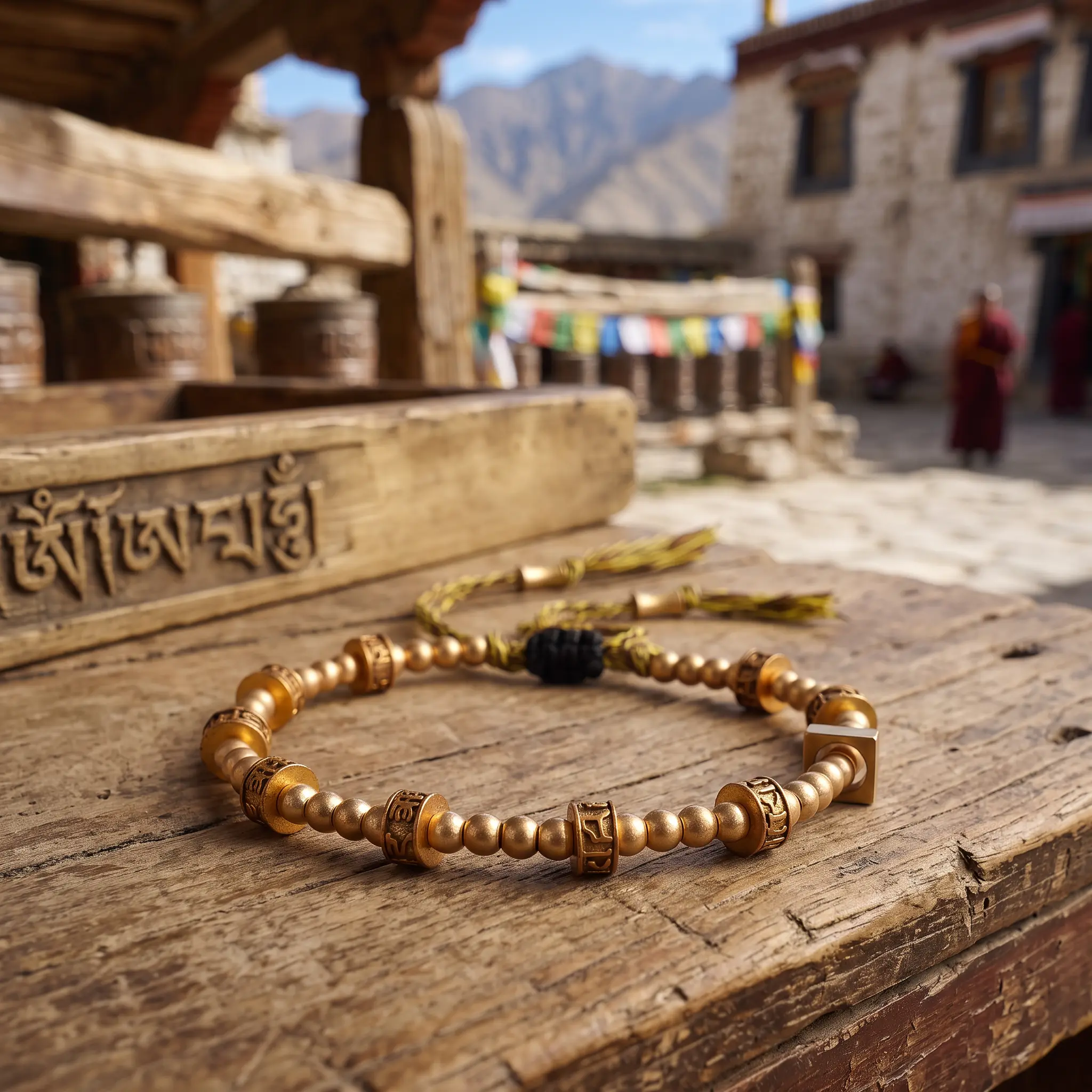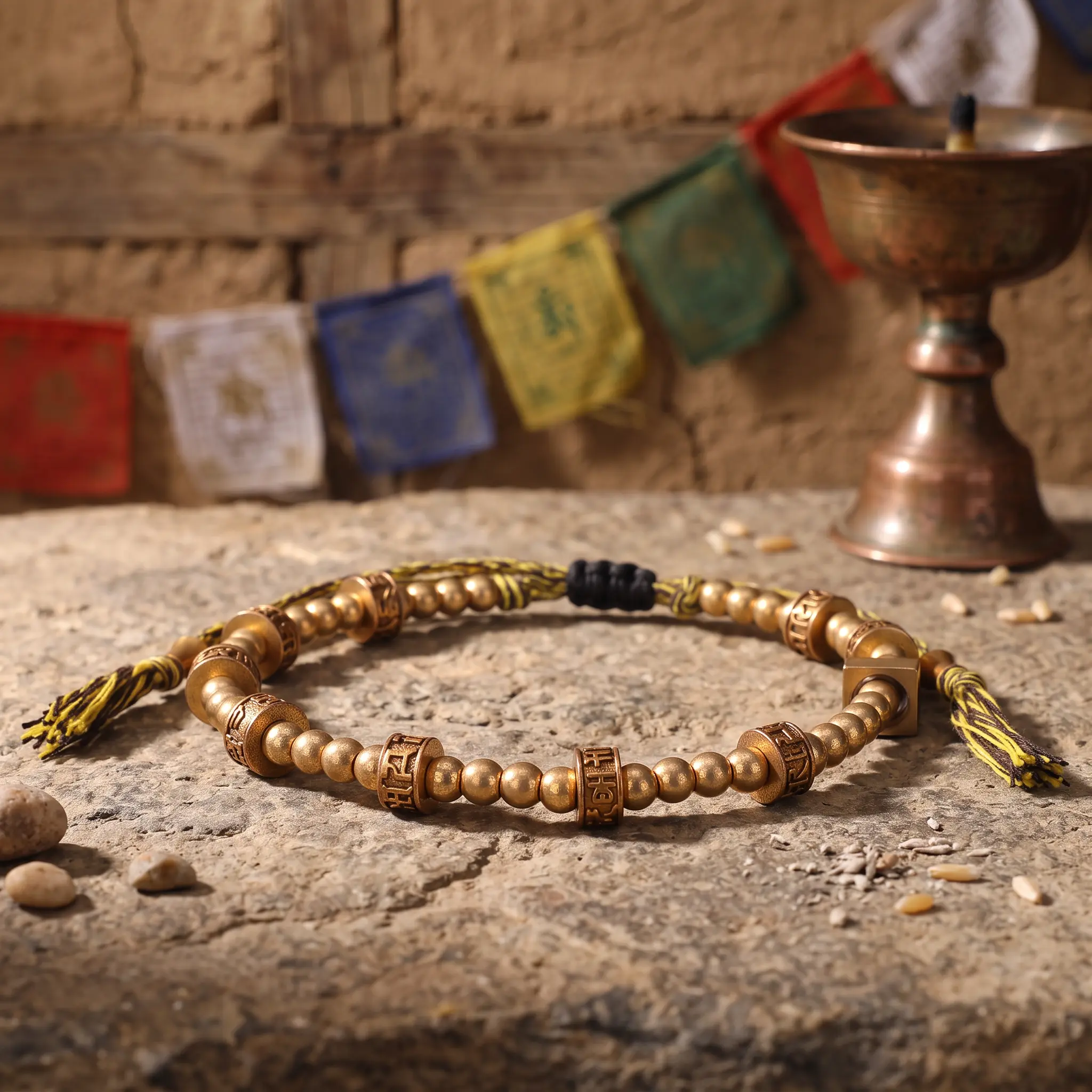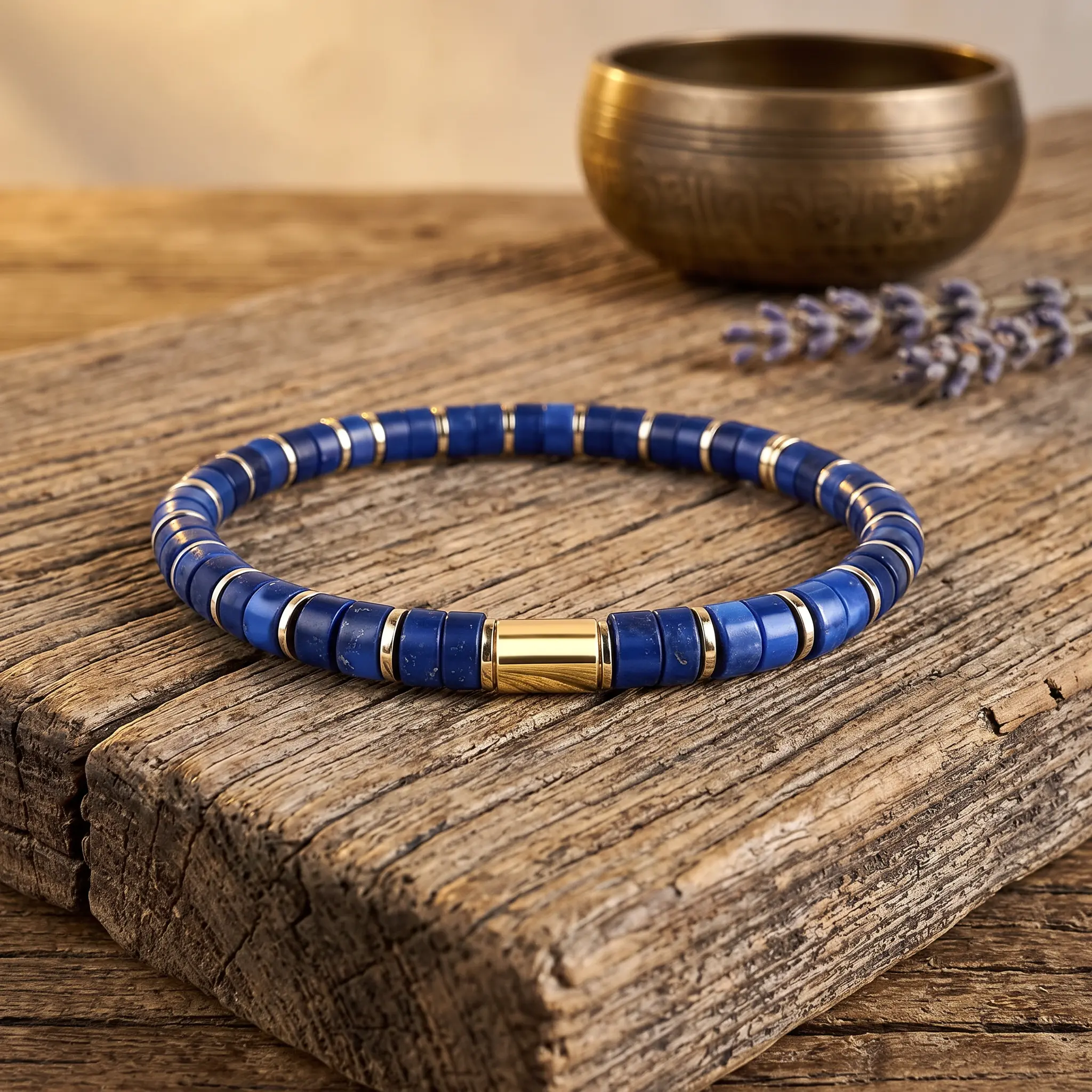

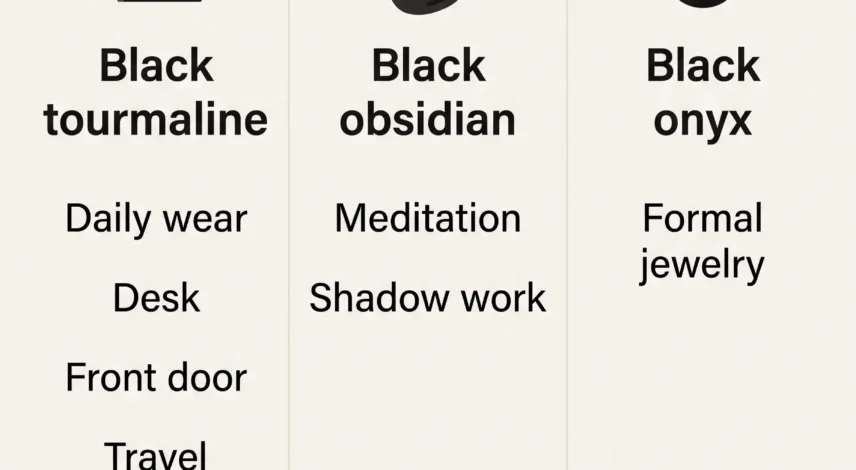

If you are comparing black tourmaline vs black obsidian vs onyx for a protection bracelet, here is the short answer. Choose black tourmaline for everyday wear, since this iron-rich crystal rates 7 to 7.5 on the Mohs hardness scale. Choose obsidian, a natural volcanic glass, for meditation and occasional wear. Choose black onyx for a sleek, formal black, and ask the seller whether it is dyed.
All three look like the same jet-black bead in a product photo. They are not. One is a crystal, one is glass, and one is usually quartz that was dyed black. The stones chip, scratch, and age differently, so you should know what you are paying for.
We built this guide from GIA and Mindat data instead of crystal folklore, and we will be straight with you about one thing. Potala Store does not currently stock a single-stone black tourmaline bracelet, so the verdict below will not bend toward our inventory.
Want to see styles before you read on? Browse the black obsidian and protection bracelets in our Attract Protection collection.
Important note: The protective and energetic qualities described here reflect traditional crystal beliefs, not scientific or medical claims. Crystals are not a substitute for professional medical or mental-health care.
Table of Contents
Black Tourmaline vs Obsidian vs Onyx: The Quick Comparison Table
Black tourmaline (schorl) is a striated crystal rated 7-7.5 on the Mohs scale, black obsidian is natural volcanic glass at 5-5.5, and black onyx is chalcedony at 6.5-7 that is usually dyed. For everyday wear, tourmaline is the toughest and obsidian is the most fragile.
| Stone | Composition | Mohs Hardness | Usually Dyed? | Best For |
|---|---|---|---|---|
| Black Tourmaline | Schorl, an iron-rich boron silicate crystal | 7-7.5 | No, the iron makes it black | Daily wear, desk, doorway |
| Black Obsidian | Volcanic glass, amorphous, over 65% silica | 5-5.5 | No, but black glass imitations exist | Meditation, occasional wear |
| Black Onyx | Chalcedony, a microcrystalline quartz | 6.5-7 | Yes, most solid-black onyx | Formal jewelry, an even jet-black finish |
Hardness figures vary online. Some sites list obsidian anywhere from 5 to 7, which is too wide to be useful. We use GIA’s range for tourmaline and the commonly cited mineralogy ranges for the other two.
What’s the main difference between black tourmaline, obsidian, and onyx?
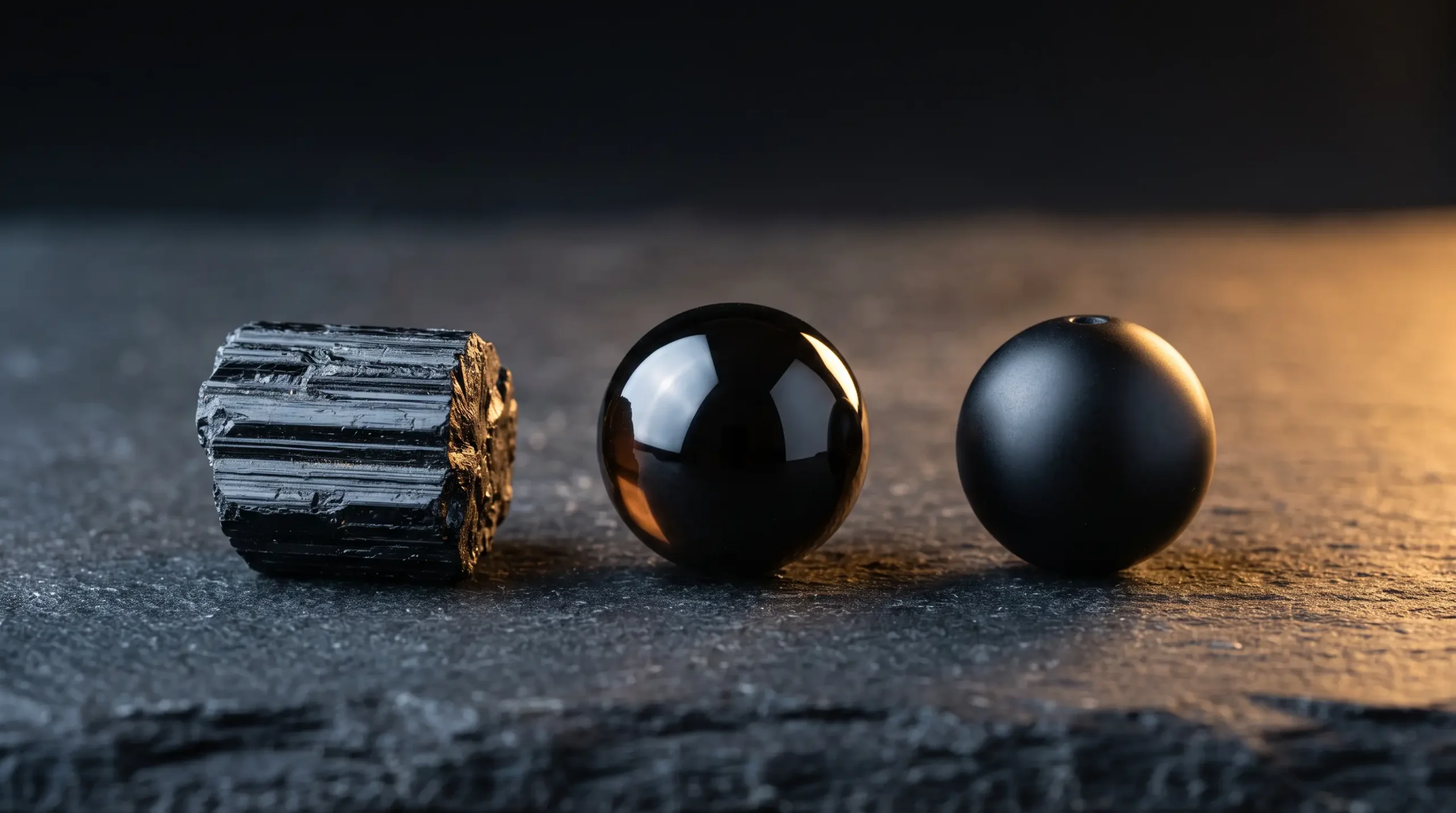
Black tourmaline is a crystal, black obsidian is glass, and black onyx is quartz that is usually dyed. A crystal has atoms in a repeating pattern, which gives tourmaline its grooves. Glass has no repeating pattern, which gives obsidian its mirror shine and curved breaks. Onyx packs microscopic quartz fibers together, so it polishes to an even, solid color.
Which one is hardest and best for daily wear?
Black tourmaline is the hardest at 7 to 7.5, onyx follows at 6.5 to 7, and obsidian is softest at 5 to 5.5, so it chips first. Fine quartz dust rates 7 on the Mohs scale, so anything softer slowly picks up tiny scratches. Obsidian also breaks along sharp, curved edges when knocked.
If you bump your wrist on desks all day, that matters more than any meaning chart. Tourmaline gives you a bracelet you can wear to work every day without babying it.
Glass, Crystal, or Dyed Chalcedony? What Each Black Stone Really Is
The fastest way to separate them: obsidian is glass, onyx is quartz that is usually dyed, and black tourmaline is a true crystal with lengthwise grooves. Here is what that means for each stone.
Black tourmaline (schorl): an iron-rich crystal with built-in grooves
Schorl is the iron-rich, sodium-bearing member of the tourmaline family, and the iron is what turns it black. Mindat lists its specific gravity at 3.18 to 3.22, which makes it the heaviest of the three stones. Raw crystals show lengthwise grooves called striations, and polishing mostly erases them.
Schorl is also pyroelectric and piezoelectric, so it builds a tiny electric charge when heated or squeezed. Yes, that is real. No, it does not make tourmaline a Wi-Fi shield. Mineralogy references describe the charge as a physical property and do not describe tourmaline as blocking phone or router radiation, so treat the EMF claim as folklore.
Black obsidian: natural glass from silica-rich lava
Black obsidian is volcanic glass, formed when silica-rich lava cools too fast for crystals to grow. That gives it an amorphous structure and more than 65% silica. When it breaks, it leaves smooth, curved surfaces called conchoidal fracture and very sharp edges.
In the U.S., Obsidian Cliff in Yellowstone and Glass Butte in Oregon are well-known sources, and Native peoples quarried Obsidian Cliff for thousands of years. For the symbolism and wearing tips, read our guide to black obsidian bracelet meaning and how to wear it.
Black onyx: why most of it is dyed chalcedony
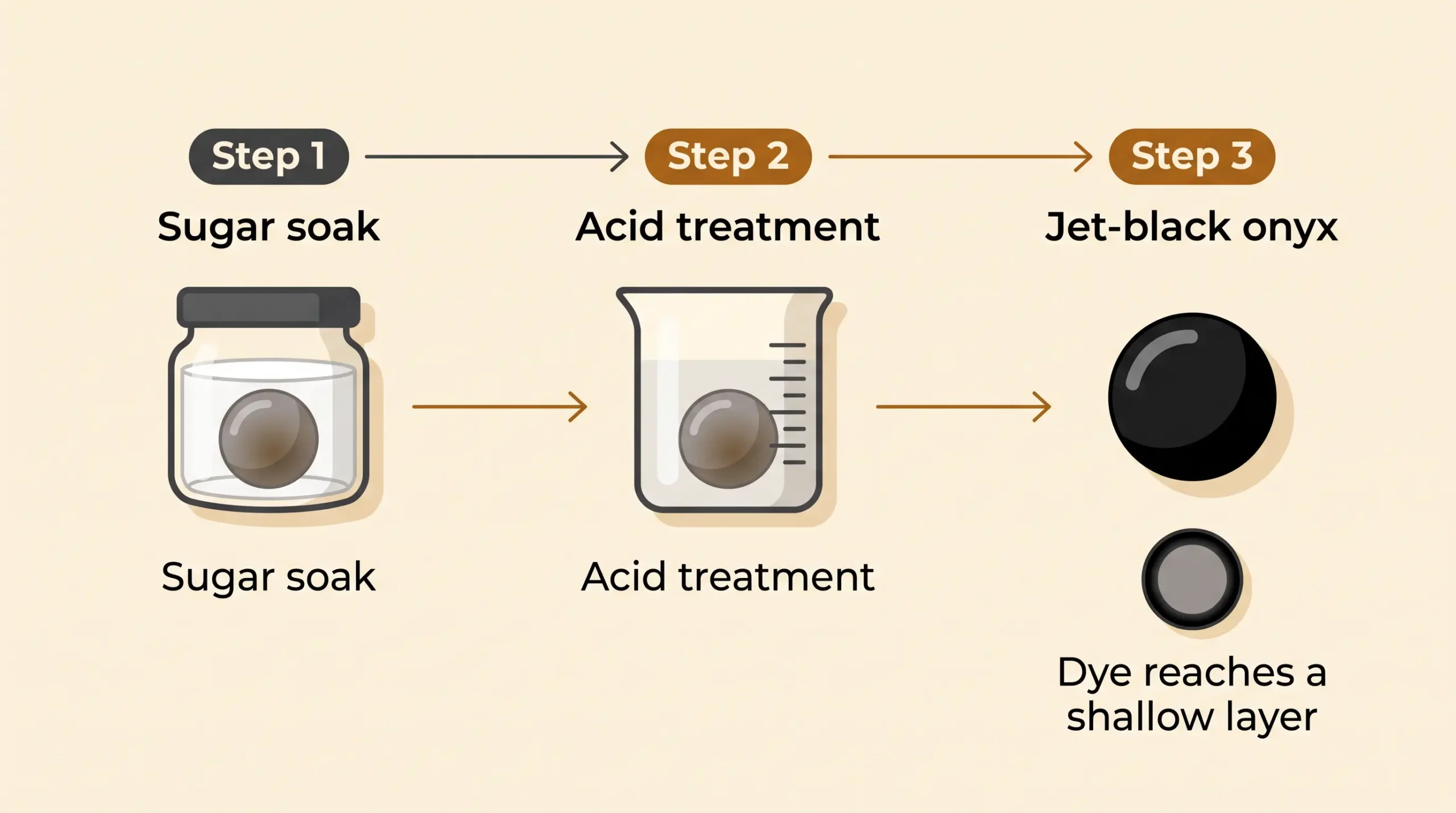
Black onyx is chalcedony, a microcrystalline quartz, and most solid-black onyx on the market has been dyed. Sellers typically soak gray or brown chalcedony in a sugar solution, then treat it with sulfuric acid to turn the sugar into carbon. The result is a deep, even black. GIA has documented this treatment, and a gem lab can detect it.
The dye only reaches a shallow layer, so skip harsh chemicals and long soaks. Dyed is not fake. Hidden is the problem. Ask the seller directly, and pay a fair price for a treated stone, not a premium for “natural” black.
How to Tell Them Apart at Home: 3 Checks Under a Lamp
You can separate all three in under a minute with a flashlight, your eyes, and a kitchen scale. No scratch test needed.
- Light test (10 seconds): Press a flashlight against the thinnest edge. Obsidian usually glows smoky brown.
- Surface check (20 seconds): Look for lengthwise grooves (tourmaline), straight bands (onyx), or a mirror shine with curved chips (obsidian).
- Weight check (30 seconds): Weigh a bracelet against a same-size piece. Tourmaline feels noticeably heavier.
Try this with any bead you own. Each check has a limit, so here is how to read the results.
Can you see through black obsidian or onyx? The thin-edge light test
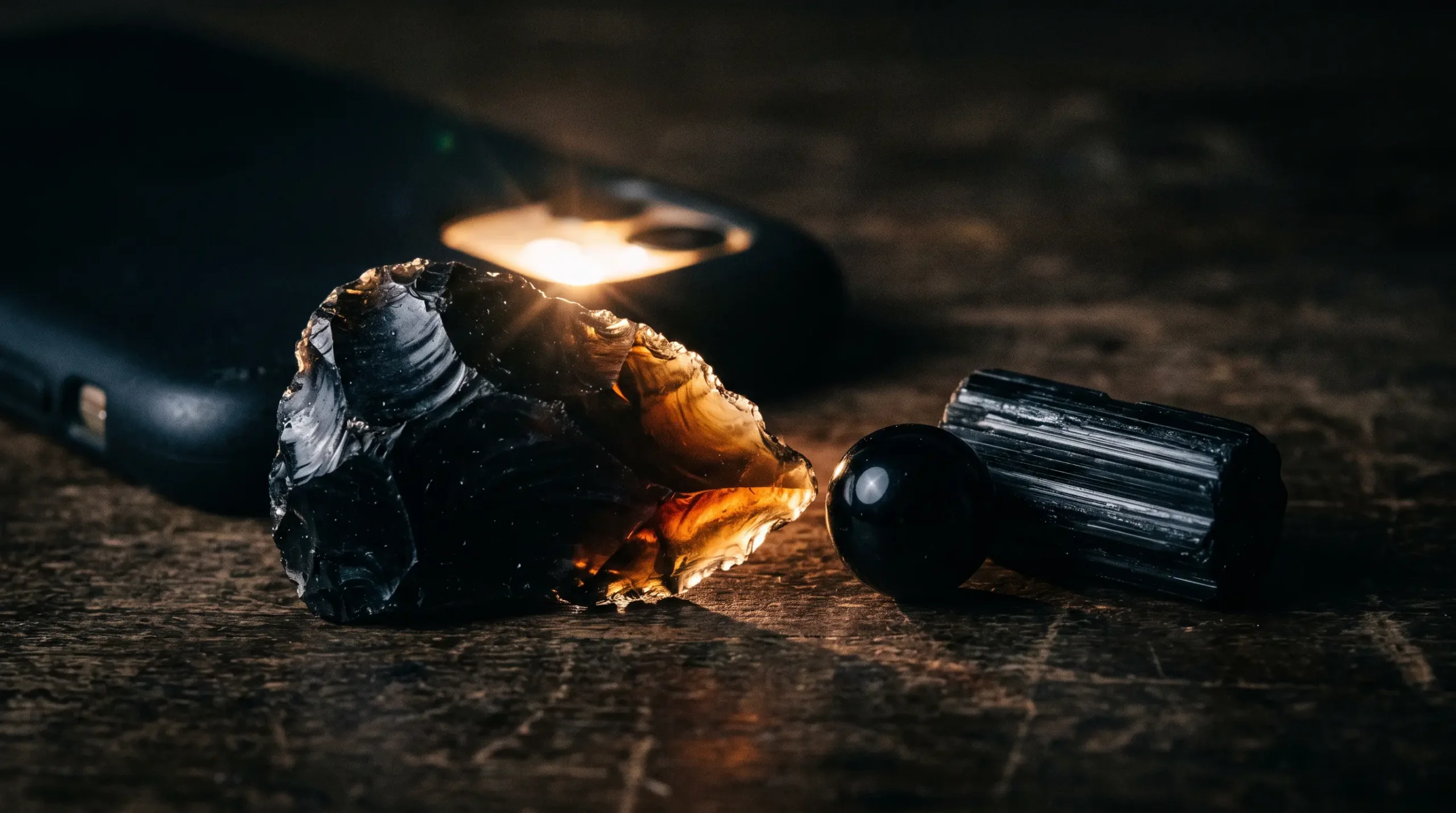
Shine a flashlight through the thinnest edge: obsidian usually glows smoky brown, while onyx and tourmaline stay fully opaque. Use a bright phone flashlight in a dark room and press it against the thinnest spot you can find, such as a chipped edge. The first time you see obsidian glow brown, it is oddly satisfying.
The limit: black glass imitations can glow the same way. This test separates obsidian from onyx and tourmaline, but it cannot prove the stone is natural.
Grooves, bands, or nothing at all?
Lengthwise grooves point to tourmaline, straight parallel bands point to onyx, and a mirror shine with no pattern points to obsidian. A smooth, polished bead is the hardest case, because polishing erases tourmaline’s grooves. If a polished bead shows no glow under the light, use weight as the tiebreaker.
Does weight give it away? A quick scale test
Black tourmaline is the heaviest of the three, roughly 20 to 35 percent denser than onyx or obsidian, so a same-size bracelet weighs noticeably more. The table below shows what 8 mm (0.31 in) beads should weigh.
| Stone | Specific Gravity Used | One 8 mm Bead | 20 Beads |
|---|---|---|---|
| Black Tourmaline | 3.2 | 0.86 g (0.03 oz) | 17.2 g (0.61 oz) |
| Black Onyx | 2.6 | 0.70 g (0.02 oz) | 13.9 g (0.49 oz) |
| Black Obsidian | 2.4 | 0.64 g (0.02 oz) | 12.9 g (0.45 oz) |
These are calculated values, not measurements from our stock. They assume solid spheres with no stringing hole, so real beads weigh slightly less. Obsidian’s density varies by source, so treat its row as a rough guide. Weigh your own beads on a kitchen scale that reads to 0.01 oz and compare.
Desk, Doorway, Wrist, or Gift: Which Protection Stone Fits Your Life?
In crystal traditions, black tourmaline is often called the everyday shield, obsidian the mirror for inward work, and onyx the steady, formal stone, so match each to where it will live.
| Scenario | First Pick | Why |
|---|---|---|
| Everyday bracelet | Black tourmaline | Hardest of the three; traditionally used for grounding |
| Desk or home office | Black tourmaline (raw) | Sturdy enough to sit by a monitor; traditionally placed near work areas |
| Front door | Black tourmaline | Traditionally placed at entrances; hard enough to survive a knock |
| Meditation and shadow work | Black obsidian | Mirror-like surface; traditionally used for inward reflection |
| Formal jewelry | Black onyx | Even, jet-black polish; ask whether it is dyed |
| Travel | Black tourmaline | Survives a packed bag better than obsidian |
| First-time gift | Tourmaline or onyx | Less fragile than obsidian |
Is black tourmaline or black obsidian better for protection?
Neither is scientifically proven to protect you; in crystal traditions, tourmaline is used as a daily shield, while obsidian is used for deeper, occasional inner work. Both are traditionally linked to the root chakra, the energy center associated with feeling grounded and secure.
If you want one stone you will actually wear every day, tourmaline wins on toughness alone. Obsidian suits shorter, deliberate moments, like a meditation session or a journaling night.
Best pick for beginners, office desks, and travel
If this is your first protection stone, start with the one that is hardest to break. You will wear it more, and worry about it less. For a desk, a small raw black tourmaline piece sits safely beside your monitor. People often put one there to block EMF, but that is popular belief, not established science. Keep it for the grounding ritual and the look.
For travel, pack obsidian in its own soft pouch. Obsidian and a hard-shell suitcase are not friends. Building a starter set? Our top 10 crystals for protection covers what else to add.
Can you wear black tourmaline and obsidian (or onyx) together?
Yes, many people stack them, but keep obsidian away from harder beads, since tourmaline and onyx can scratch it. Buying for someone this Black Friday? Pick the stone that survives a dropped bag, then tuck in a note about its meaning.
Want obsidian’s mirror-black shine on your wrist? The Black Obsidian Pixiu Bracelet for fortune and protection is priced from $43.95. A Pixiu is a mythical Chinese guardian creature traditionally linked to wealth and protection. Because obsidian takes the brightest polish of the three stones, the bracelet reads as a statement piece, and the price makes it an easy way to try obsidian before you commit to a larger piece.
Care Rules That Keep Each Black Stone Intact
Warm, soapy water and a soft cloth are safe for all three, but skip ultrasonic and steam cleaners, salt soaks, and sudden temperature swings.
| Care Step | Black Tourmaline | Black Obsidian | Black Onyx |
|---|---|---|---|
| Warm soapy water | Yes (GIA) | Yes, briefly | Yes, briefly |
| Ultrasonic or steam cleaner | Avoid (GIA) | Avoid (precaution) | Avoid (precaution) |
| Salt soak | Avoid | Avoid | Avoid |
| Heat or sudden temperature change | Avoid (GIA) | Avoid (precaution) | Avoid (precaution) |
| Harsh chemicals | Avoid | Avoid | Avoid (shallow dye layer) |
Care advice for crystals contradicts itself all over the internet. This is the one rule set we follow. It rests on GIA’s guidance for tourmaline, and we apply the same caution to obsidian and onyx where no equivalent guidance exists.
Can black tourmaline, obsidian, or onyx go in water or salt?
A quick rinse in warm, soapy water is fine for all three, but long soaks, especially in salt, are not worth the risk. Salt soaks are popular in crystal traditions, but they add residue risk and no physical cleaning benefit, so we skip them. Water also weakens the elastic cord on stretch bracelets, so rinse the beads, pat dry, and keep the cord as dry as you can.
That is the whole routine: rinse, pat dry, done. For more ways to avoid damage, see our guide to common beginner crystal care mistakes.
Sunlight, heat, and ultrasonic cleaners
GIA advises against ultrasonic and steam cleaners for tourmaline, and notes that heat or sudden temperature change can fracture it. Treat obsidian and onyx the same way as a precaution. Your car dashboard in a July heat wave is the worst crystal shelf in America, and long sunbaths are not worth the risk for any of the three.
Our Verdict on Black Tourmaline, Obsidian, and Onyx (Pros, Cons, Where to Shop)
If you only buy one, make it black tourmaline: it is the toughest of the three at Mohs 7-7.5 and the easiest to wear every day. Choose obsidian if you want the shine and will treat it gently. Choose onyx if you want a flawless black and are fine with dye.
Pros and cons at a glance
Each stone trades something: tourmaline trades shine for toughness, obsidian trades durability for luster, and onyx trades “natural” for a flawless black.
| Stone | Pros | Cons |
|---|---|---|
| Black Tourmaline | Hardest (7-7.5), no dye, heaviest in hand | Duller finish once polished; heat can fracture it |
| Black Obsidian | Brightest mirror polish, glows brown at thin edges | Softest (5-5.5), chips and scratches first |
| Black Onyx | Even jet-black color, takes a clean polish | Usually dyed; shallow dye layer |
What you can shop from us today
Our Pixiu black obsidian bracelet for feng shui wealth and protection is priced at $82.95, and the protection bracelets in the Attract Protection collection hold our other pieces. We will say it again: we do not currently carry a single-stone black tourmaline bracelet. We would rather tell you that than sell you the wrong stone.
If you buy tourmaline elsewhere, run the three checks above, and ask the seller for the stone’s name and any treatments.
Find Your Guardian Stone
Compare obsidian Pixiu bracelets and other protection pieces at Potala Store, and match the stone to how you will actually wear it.Shop the Attract Protection collection
Or start with the Black Obsidian Pixiu Bracelet from $43.95
Frequently Asked Questions About Black Protection Stones
Yes. Schorl is the mineral name for black tourmaline, the iron-rich and most common member of the tourmaline group. Sellers use “black tourmaline” because buyers search for it by that name.
That is a popular belief, not established science. Schorl is pyroelectric and piezoelectric, but mineralogy references describe those as physical properties, not radiation shielding. Wear it for grounding and style, not as a Wi-Fi shield.
No. Dyed black onyx is still real chalcedony. What matters is that the seller tells you about the treatment and prices it fairly.
Start with black tourmaline, the toughest of the three. It handles daily wear and the occasional knock. When you are ready to compare styles, browse our protection bracelet styles.
📚 References
- Tourmaline care and cleaning: GIA’s guidance on safe cleaning methods and the risks of ultrasonic cleaners, steam, and heat. Gemological Institute of America
- Schorl mineral data: Composition, specific gravity, and pyroelectric and piezoelectric properties of black tourmaline. Mindat
- How obsidian forms: An overview of obsidian as volcanic glass formed from rapidly cooled lava. American Museum of Natural History
- Identifying black opaque gem materials: Gemological challenges in separating black onyx, dyed chalcedony, and other black stones. GIA Gems & Gemology