

A gau box (Tibetan ga’u) is a portable Tibetan Buddhist and Bon amulet box worn on the body. What sits inside matters more than the metal around it. Traditionally it holds six kinds of sacred contents, including mantras, relics, tsatsa clay images, and blessed pills. These are believed to carry the blessing of buddhas and revered lamas.
Maybe you saw a small box pendant and wondered what it is for. This guide explains the six traditional contents, why Tibetans call them ten, and how to wear a gau box, a portable shrine, with respect. We built it from museum sources and the spec sheets of our own pendants at PotalaStore.
⚠️ Important Note: This guide describes traditional Tibetan Buddhist and Bon beliefs. It makes no medical, psychological, or guaranteed protective claims and is for educational purposes only.
Curious what a modern gau looks like? See our white copper Ga Wu box pendant, which has an openable back.
Table of Contents
What Is a Tibetan Prayer Box Amulet?
A Tibetan prayer box amulet, called a gau (ga’u), is a small metal box worn to hold sacred objects such as mantras, relics, and images. Tibetans often wear it on a cord around the neck or slung across the shoulder. The word names a container, not one kind of charm.
Scholar James Gentry, writing for the Rubin Museum, calls portable amulet boxes “among the most ubiquitous features of Tibetan Buddhist culture.” They range from small pendants to larger, reliquary-like boxes. Their materials and decoration vary with the owner’s social status, religious role, gender, and region.
Gau, Ghau, Ga’u, Gawu: One Word, Many Spellings
Gau, ghau, gao, ga’u, and gawu are five English spellings of the same Tibetan word, not five different objects. The variation comes from different ways of writing Tibetan sounds in Latin letters. The Rubin Museum writes “gau,” and Himalayan Art Resources writes “ga’u.” Some sellers write “Ga Wu.” This guide uses “gau” and keeps product names as listed.
Amulet, Reliquary, or Portable Shrine?
A gau box works as an amulet, a reliquary, and a portable shrine at once. As an amulet, it is worn for protection. Himalayan Art Resources describes its purpose as general protection and protection when traveling. As a reliquary, it holds relics, and the Rubin Museum’s glossary names gau boxes alongside stupas as a main Himalayan reliquary type. As a shrine, its flat base lets a traveler or pilgrim set it down as a makeshift altar.
What Goes Inside a Gau Box?
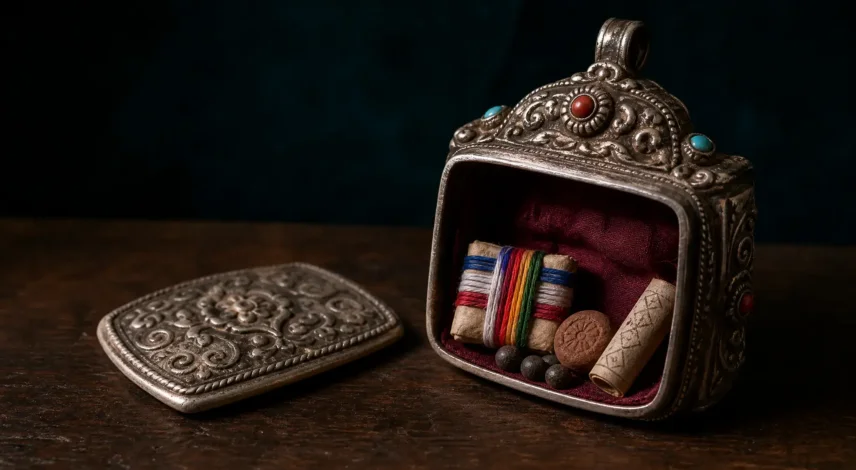
Traditionally, a gau box holds six kinds of sacred contents:
- Mantras and dharanis: Sanskrit syllables or longer formulas written on small pieces of paper, such as Om Mani Padme Hum.
- Sungkhor amulet diagrams: Geometric diagrams of mantras and images, folded and wrapped in cords of five colors.
- Relics: Pearl-like ringsel from cremated teachers, or contact relics such as a scrap of a teacher’s robe.
- Tsatsa clay images: Small sculptures pressed from molds, a practice Tibetans have followed since about the 11th century.
- Blessed pills (rilbu): Sacred pills prepared by lamas, from a tradition that reached Tibet from India starting in the eighth century.
- Deity images and lama photographs: A miniature statue, painting, or photo, usually shown through the front window.
These six groups are our own grouping. Real contents vary by owner and purpose. The Rubin Museum lists miniature statues, photographs of lamas, votive plaques, amulets, relic pills, materials from sacred sites, and cloth that once touched a revered person. A gau used in initiations might hold only one object.

Mantras, Dharanis, and Sungkhor Amulet Diagrams
The most common contents are words: mantras or longer dharanis written on paper, often folded into a sungkhor diagram and wrapped in five-color cords. The Rubin Museum explains that these protective amulets, also called sungwa, are drawn with mantra formulas and images. They are consecrated through contemplative ritual, folded, and handed out for use. Tibetans have traditionally worn them against misfortune during travel, harmful spirits, and other calamities. A sungkhor can sit inside a gau or be worn on its own.
Relics, Tsatsas, and Blessed Pills (Rilbu)
Relics give a gau its weight as a reliquary, from pearl-like ringsel to contact relics. The Rubin Museum’s featured gau, made in Kathmandu in the 2000s, shows how specific the contents can be. It held an amulet diagram in five-color cords and seven small pills. Two of the pills were reddish-brown relics, said to come from Padmasambhava’s circle and once owned by Dudjom Rinpoche (1904-1987).
Tsatsas are clay sculptures of deities, stupas, or auspicious signs. Blessed pills are devotional substances, not everyday medicine, and this guide gives no advice on using them.
Deity Images and Photographs of Lamas
Most gaus show an image through a small front window, such as a buddha statue, a painted deity, or a photograph of the owner’s lama. The window tells you whom the wearer keeps close. The Rubin Museum’s example breaks the pattern, because its window shows the amulet and hides everything else behind it. Modern pendants often paint a deity directly on the front panel, a design you will see again in the pendant section below.
Why “Ten” Matters: How a Prayer Box Carries Blessing
The Tibetan word for a gau’s contents is ten, meaning “receptacle.” The objects are understood to gather the jinlab (blessing) and tu (power) of buddhas, bodhisattvas, and respected lamas. In other words, the box is the vessel, and the contents carry the meaning.
Jinlab and Tu: The Logic of a Receptacle
In this view, a gau works less like a locket and more like a sealed container of transmitted blessing. A lama’s role is to prepare what goes in. The gau in the Rubin Museum’s essay was a personal gift from Tsike Chokling, the Fourth Karma Mingyur Dewe Dorje (1953-2020). He chose its contents himself and consecrated it in Kathmandu for the express purpose of protection.
Physical closeness also matters. In the Rubin essay, relic pills and amulets are both said to work through physical contact. Wearing a gau near the body fits that logic.
Four Tantric Activities: Protection Beyond Luck
Ritual experts who make amulets traditionally frame their aims through four tantric activities: pacifying (zhiwa), enriching (gyepa), subjugating (wangwa), and destroying (ngoncho). Within that framework, protection mainly means quelling adversity. The Rubin Museum adds that Tibetan Buddhism stretches protection to cover karmic obstacles and spiritual obstructions too. One object can therefore serve practical, karmic, and transcendent aims at once.
Gaus have also been worn for long life, personal power (wangtang), and good fortune (lungta). This guide covers only protective and devotional use in the Vajrayana tradition.
Pocket Pendant or Traveling Shrine? Sizes, Shapes, and Symbols
Men’s gaus range from about 1 inch (2.5 cm) to over 14 inches (35 cm) tall, according to the Rubin Museum.
| Style | Height | How it is worn | Typical use |
|---|---|---|---|
| Pendant-size gau | From about 1 in (2.5 cm) | On a cord around the neck, inside clothing | Everyday protection and travel |
| Rubin Museum example (Kathmandu, 2000s) | 3½ × 3⅛ × 1½ in (9 × 8 × 4 cm) | Around the neck | A lama’s gift for protection |
| Large shrine-shaped gau | Up to 14+ in (35+ cm) | Strap over the chest or under the arm | Travel shrine, or centerpiece of a home or temple altar |
Himalayan Art Resources sorts gaus into three size classes, small, medium, and large, and four main shapes: shrine, square, round, and miscellaneous. On our spec sheet, the painted panel of our own Ga Wu box pendant measures 47 × 56.3 mm (about 1.85 × 2.22 in). That sits at the small end of the documented range.
Prefer a leather frame to a metal one? Explore the Tibetan Thangka Buddha pendant in a leather Gawu frame.

Three Parts, Four Shapes: How a Gau Is Built
A complete gau generally has three parts: a metal container, a cloth cover with a buttoned fold, and the contents inside. The container is usually worked in repoussé, a raised-relief technique that hammers the design out from behind. Silver, copper, and brass are common, often set with turquoise and coral.
Shape can hint at the wearer. The Rubin Museum calls its chorten-shaped box a men’s gau, and the V&A explains that the kidney-shaped kerima type was worn mainly by women. Treat shape as a clue, not a rule.
Eight Auspicious Symbols, Crossed Vajras, and the Front Window
The Eight Auspicious Symbols are the most common decorative motif on a gau, according to the Rubin Museum. Boxes for wealthier owners used costlier materials. The Met’s Amulet Box of a Noblewoman, from late 19th or early 20th century Tibet, is gold set with beryl, rubies, emeralds, sapphires, and turquoise. It is 4 inches (10.2 cm) wide, and its two overlaid squares symbolize crossed vajras. The Met adds that such boxes would have held texts consecrated by monks.
Nepal’s Newar jewelers made a close cousin, the jantar. The V&A’s example from the Kathmandu Valley is silver-gilt, covered in stones set in the jarao technique. Jarao sets gems in small metal cells called cloisons and fills the surface with filigree wire.
Does a Tibetan Amulet Box Need a Lama’s Blessing?
In Tibetan tradition, consecration by a lama is how a gau’s contents are made sacred, though modern wearers differ on how much it matters to them. The Rubin Museum’s featured gau was filled and consecrated by Chokling Rinpoche before he gave it to two students. The Met says a noblewoman’s gau would have held texts consecrated by monks.
What Consecration (Rabne) Means
Consecration is the act of inviting a deity to inhabit an image or object so that it becomes sacred. The Rubin Museum’s glossary lists several ways to do it. Examples include dotting the eyes of an image, visualizing the deity’s descent, writing mantras on the back of a thangka, or placing sacred texts inside a statue. Tibetans call the process rab gnas, or rabne.
We cover the ceremony in our guide to Tibetan Buddhist protection amulets and the 3-day rab gnas consecration. PotalaStore says its blessed pieces go through a three-day rab gnas ceremony with the Sera Jhe and Kopan monasteries. That is the store’s own account, not a third-party certification, so check each product page for what applies to a specific piece.
Filling Your Own Gau Respectfully
A short handwritten prayer or a printed mantra card, placed in a clean, dry box, is a modest and respectful way to fill your own gau. Many first-time wearers worry that this is disrespectful. That concern is understandable, and treating the box as sacred already shows care. Practices differ across lineages and families.
We are not religious authorities, and we cannot say whether a self-filled box counts as consecrated. If a blessing matters to you, ask a teacher or a monastery. Relics and blessed pills traditionally come through a teacher, so leave them out unless you have received them.
Choosing a Gau Box Pendant Today: Respect Over Decoration
Choose a gau box pendant by what it can hold and how you will wear it, not only by how it looks. A good pendant opens, names its materials, and shows imagery you can identify.
What to Check Before You Buy
- It opens. A gau is a container, so look for a back panel or lid that opens and closes.
- The size suits daily wear. Pendant-size boxes start near 1 inch (2.5 cm). Heavy boxes pull on a cord and suit a shelf better than a neck.
- The materials are named. Ask whether the metal is silver, copper, brass, or white copper. The phrase “Tibetan silver” often means a base-metal alloy, not sterling silver.
- The imagery is correct. A deity should show the right posture, color, and symbols. Wrong details are a red flag.
- Antiques get extra care. An old gau may still hold contents. Ask the seller, and treat any papers, pills, or relics with respect.
Our 5-point checklist for authentic Tibetan jewelry symbols and materials covers material checks and symbol checks in more depth.

How to Wear and Care for a Gau
Wear a gau close to the heart and above the waist, and keep it dry. One Himalayan Art Resources record notes that a gau was worn on a cord around the neck, tucked inside outer clothing. An occasional splash will not harm a metal box, but soaking can damage the casing, painted finishes, and thangka artwork. Wipe it with a soft, dry cloth. Many practitioners also keep sacred objects off the floor.
Our hand-painted Ga Wu box pendant with an openable silk-lined back follows this format. Its white copper body has a cinnabar-colored finish with coral and turquoise accents. The back panel opens onto a red silk lining, so you can place your own prayer inside and make it your personal portable shrine. Behind the glass sits a thangka painted in mineral pigments, offered in 14 deity variants, so you can choose a figure that matches your intention. At about 1.85 × 2.22 inches, the panel is compact enough for daily wear. It is listed at $68.95 USD as of 10/10/2026.
A modern pendant is a vessel, not a lama-prepared gau. We do not claim that it protects you. Relics and blessed pills traditionally come from a teacher, not from a shop.
Frequently Asked Questions
Yes. Ghau, gau, gao, ga’u, and gawu are different English spellings of one Tibetan word for the same amulet box. The variation comes from romanization, not from different objects.
An amulet is any object worn for protection, while a gau is a container that holds other sacred objects, including amulets such as a folded sungkhor diagram. Our Buddha amulet vs. Gawu box pendant comparison sets the two formats side by side with measured specs.
Customs differ, and no museum source we cite restricts who may wear one. Wearing a gau respectfully means treating it as a sacred object: close to the heart, above the waist, and off the floor. If you want a firm answer for your situation, ask a teacher.
Start simple with a short handwritten prayer, a mantra you know, or a small paper image of a deity or teacher. Keep relics and blessed pills out unless a teacher gave them to you. Choose a box with a back that opens, so you can change the paper as your practice grows.
Carry a Small Shrine Close to Your Heart
In summary, a gau box is a portable shrine whose meaning lives in what it holds. Our hand-painted Ga Wu box pendant comes in 14 deity variants, with a red silk-lined back panel that opens for your own prayer. Explore it at PotalaStore.See the Ga Wu Box Pendant, $68.95
📚 References
- Amulet Box (Gau) with Its Contents: James Gentry’s essay on gau contents, consecration, and the four tantric activities. Rubin Museum of Art, Project Himalayan Art
- Ritual Object: Amulet Box (Ga’u) Main Page: Size, shape, and function classifications for amulet boxes. Himalayan Art Resources
- Amulet Box of a Noblewoman (15.95.97): Catalog record for a Tibetan gold amulet box with materials and dimensions. The Metropolitan Museum of Art
- Amulet box (jantar) and amulet case (ga’u kerima): Records on Newar jarao inlay and the kidney-shaped women’s gau. V&A, jantar and V&A, ga’u kerima