
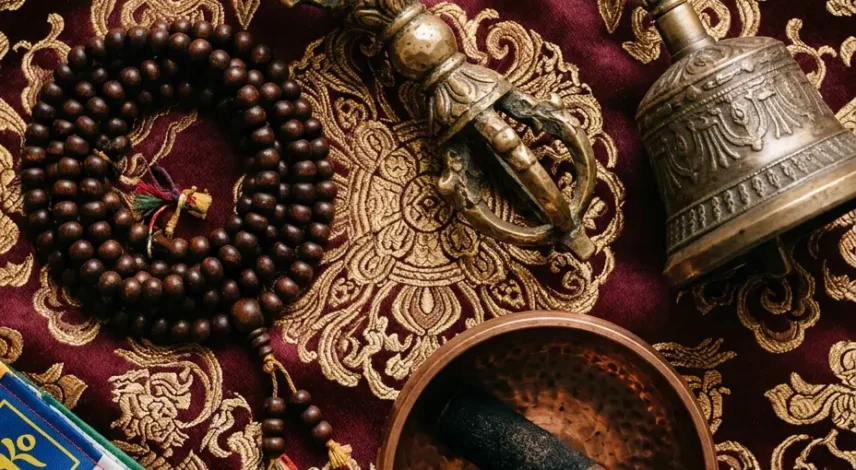

Tibetan ritual objects are working tools of practice, not decorations. Each one, from the vajra and bell to the mala and prayer wheel, has a specific role in Vajrayana Buddhism: making offerings, counting mantras, clearing obstacles, or gathering merit. This guide explains what the main objects are, what they symbolize, and how to use them respectfully.
We wrote it from experience. At Potala Store, we source these pieces directly from artisans across the Kathmandu Valley and from within living Tibetan Buddhist traditions, so we can tell you what separates a genuine ritual object from a decorative copy.
To keep things clear, we group Tibetan ritual objects into three simple families, then walk through the specific tools you are most likely to see, hold, or bring into your home.
A quick note on meaning: The symbolic, spiritual, and energetic qualities described below come from Tibetan Buddhist tradition and practitioner experience, not from scientific or medical evidence. This guide is for education and cultural understanding, and is not a substitute for teaching from a qualified lama or for professional advice.
Table of Contents
What Are Tibetan Ritual Objects?
Tibetan ritual objects are consecrated implements used in Vajrayana Buddhist and Bön practice, including the vajra and bell, phurba, mala, prayer wheel, and offering bowls. Each is traditionally used to support meditation, make offerings, offer protection, or accumulate merit, and each is treated as sacred rather than as decoration.
A working definition
These objects give physical form to inner practice. Vajrayana Buddhism, sometimes called the “diamond vehicle,” leans on ritual, visualization, and symbolic tools more than other Buddhist schools do. A practitioner uses an implement to make an abstract quality, such as compassion or wisdom, into something held in the hand. Many of the same objects also appear in Bön, Tibet’s older spiritual tradition.
Sacred, not decorative
Most ritual objects are blessed in a consecration ceremony before they are used. That is why practitioners keep them clean, place them above the floor, and handle them with care. Treating a phurba or a bell as a shelf ornament misses the point: in tradition these are instruments for practice, and the respect you show them is part of how they work.
The Three Families of Tibetan Buddhist Implements
Tibetan ritual objects fall into three broad families, grouped by what they do:
- Devotional and offering tools: used to make offerings and honor enlightened beings, such as offering bowls, butter lamps, incense, the conch shell, and the singing bowl.
- Tantric and protective implements: used in advanced ritual to transform energy and clear obstacles, such as the vajra and bell, phurba, damaru, kapala, and kangling.
- Mind-training and wearable objects: used in daily practice and carried or displayed, such as the mala, prayer wheel, ghau box, prayer flags, and thangka.
| Object | Tibetan / Sanskrit name | Family | Primary use |
|---|---|---|---|
| Vajra | Dorje | Tantric | Symbol of indestructible method and compassion |
| Bell | Drilbu / ghanta | Tantric | Symbol of wisdom and emptiness |
| Phurba | Kila | Tantric | Ritual peg believed to subdue obstacles |
| Damaru | Damaru | Tantric | Hand drum marking ritual rhythm |
| Mala | Trengwa | Mind-training | Counting mantras (108 beads) |
| Prayer wheel | Mani khorlo | Mind-training | Spinning rolled mantras to spread merit |
| Prayer flags | Lung ta | Mind-training | Carrying prayers on the wind |
| Offering bowls | Yön chab | Devotional | Water offerings on the altar (usually seven) |
| Butter lamp | Chöme | Devotional | Light offering symbolizing wisdom |
| Conch shell | Dung / shankha | Devotional | Proclaiming the Dharma |
Devotional and offering tools
These are the everyday pieces of the altar. Offering bowls, butter lamps, and incense let a practitioner give water, light, and scent to enlightened beings each morning. You can browse these altar pieces in Potala Store’s Tibetan collection, which groups them by use.
Tantric and protective implements
This family is more advanced. The vajra and bell, the phurba, and bone implements like the kapala belong to formal tantric ritual, usually practiced under the guidance of a teacher. Their job is to work with and transform energy rather than simply to make an offering.
Mind-training and wearable objects
These pieces travel with you. A mala rides in a pocket or on the wrist, a small prayer wheel turns in the hand, and prayer flags hang outdoors. They keep practice present through the ordinary parts of the day.
The Bell and Dorje: Wisdom and Compassion

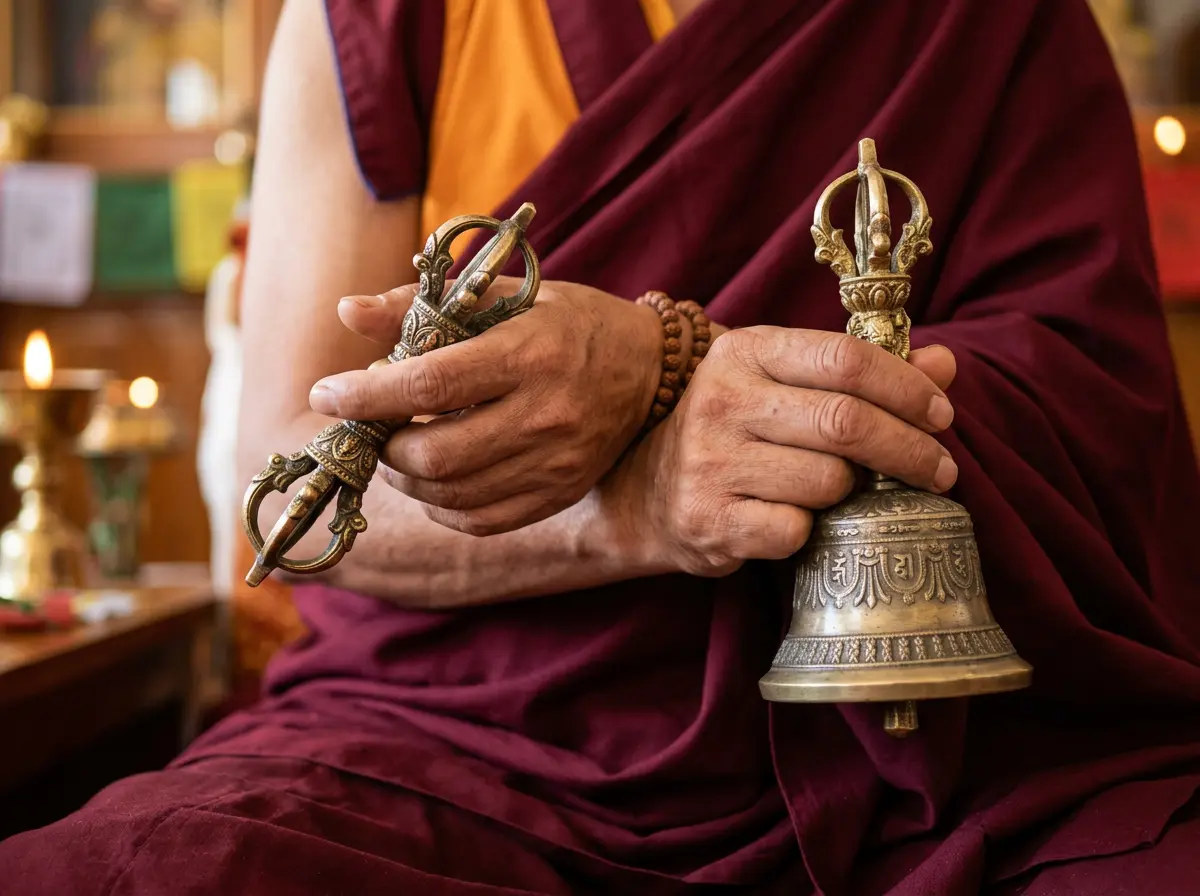
The dorje (vajra) and bell together represent the union of compassion and wisdom, the two qualities Vajrayana Buddhism treats as inseparable on the path to awakening. They are almost always used as a pair, one in each hand.
What the vajra (dorje) symbolizes
The vajra, called dorje in Tibetan, stands for indestructible, diamond-like reality and for skillful method. The most common form is the five-pronged vajra. Its prongs traditionally represent the five elements and the five wisdoms that transform the five poisons of the mind. During ritual it is held in the right hand, the side associated with compassion and method. If you prefer to wear the symbol rather than use a ritual piece, our guide to choosing a dorje or vajra pendant covers the options.
The bell (ghanta): wisdom and emptiness
The bell, or ghanta (drilbu in Tibetan), represents wisdom and the open, empty nature of reality. It is held in the left hand and rung so its sound can stand for emptiness itself. The handle is usually topped with a half-vajra, which visually joins the pair into a single practice. For ritual use, look for matched authentic bell and dorje sets cast and tuned as a pair.
The Phurba and Other Tantric Tools
The Tibetan ritual dagger is called a phurba (Sanskrit: kila), a three-sided spike traditionally used to pin down and subdue the forces that obstruct practice. It is a ritual instrument, not a weapon for actual cutting.
The phurba (kila)
The phurba’s defining feature is its three-sided blade, which represents mastery over the three realms of desire, form, and formlessness. It is closely tied to the wrathful meditational deity Vajrakilaya, and tradition credits Padmasambhava with spreading its practice in the 8th century. In ritual it is believed to nail down obstacles and harmful influences so that practice can continue. Because its symbolism is precise, a phurba is meant for formal practice rather than casual display.
Damaru, kapala, and kangling
Three more implements round out this family. The damaru is a small double-headed hand drum that marks the rhythm of chanting. The kapala (skull cup) and kangling (thighbone trumpet) are made from bone and appear only in advanced tantric practice under a qualified teacher. In tradition they are handled with reverence and serve as direct reminders of impermanence, never as curiosities.
Mala Beads and the Prayer Wheel: Everyday Practice
A mala is a string of 108 beads used to count mantra repetitions, and a prayer wheel is a cylinder of rolled mantras that spreads their blessing when spun. Both turn daily practice into something you can do with your hands.
Mala beads and the meaning of 108
A traditional mala holds 108 counting beads plus one larger “guru” or meru bead that marks the start of the loop and is not counted. You move one bead per repetition of a mantra such as Om Mani Padme Hum, so you can keep count without watching. Why 108? Tradition most often explains it as the 108 defilements a practitioner works to overcome. Other explanations connect the number to the 108 volumes of the Kangyur, the Tibetan Buddhist canon, or to astronomical ratios. A well-made mala keeps its knots even and its beads smooth, so it runs cleanly through your fingers during long recitation. You can compare materials among Tibetan mala prayer beads before you choose one.
The prayer wheel (mani wheel)
A prayer wheel, or mani wheel, holds a tightly rolled scroll printed with mantras, most often Om Mani Padme Hum. Each clockwise turn is traditionally believed to release the merit of reciting every mantra inside. Wheels range from small handheld versions to large temple drums that pilgrims turn as they walk. For daily use at home, browse handcrafted Tibetan prayer wheels sized for the hand.
Offering Bowls, Butter Lamps, and the Home Altar
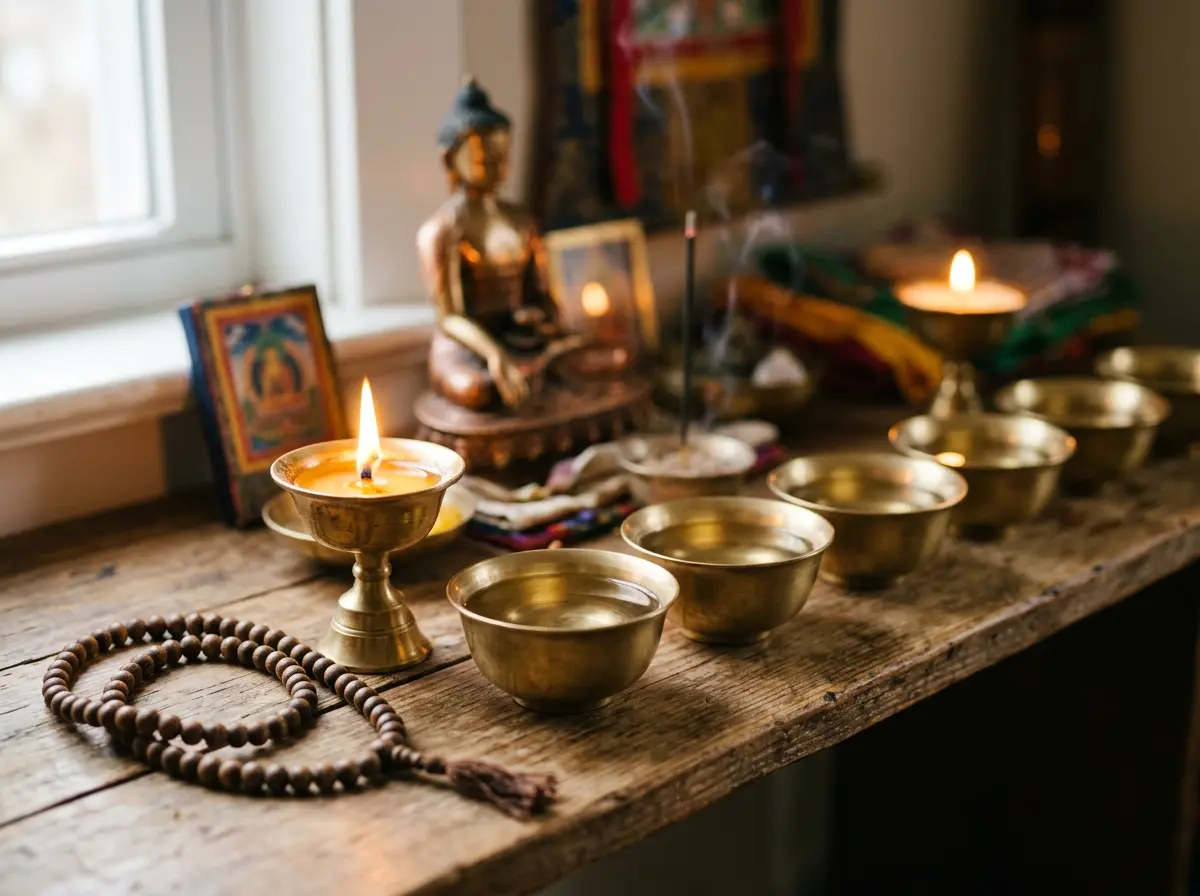
A simple Tibetan altar usually holds a row of seven water bowls, a butter lamp, and a statue or sacred image, arranged to make daily offerings. You do not need a large or expensive setup to begin.
The seven water bowls (yön chab)
Offering bowls are traditionally arranged in a row of seven. You fill them with clean water each morning and empty them at night, wiping them dry. They are usually made of brass, bronze, or silver and measure roughly 3 to 4 inches across. The seven bowls stand for the seven-limb prayer, a sequence that includes offering, prostration, and rejoicing. You can find bowls, lamps, and stands among Tibetan altar and offering pieces.
Setting up a simple, respectful altar
Place your altar above seated eye level and keep it clean and uncluttered. Many practitioners arrange three supports: an image for enlightened body, a text for enlightened speech, and a small stupa for enlightened mind. A Tibetan altar traditionally honors the five senses through light, incense, flowers, sound, and food, so even a modest shrine can feel complete.
Prayer Flags and Other Sacred Symbols
Tibetan prayer flags come in five colors, hung left to right in the order blue, white, red, green, and yellow, so the wind can carry their printed prayers. They are meant for open air, not for indoor decoration on the floor.
The five colors and their order
Each color of a lung ta (wind horse) flag stands for one of the five elements: blue for sky and space, white for air and wind, red for fire, green for water, and yellow for earth. The order matters, so the set reads blue, white, red, green, yellow from left to right. As the wind moves the cloth, it is traditionally believed to spread the goodwill printed on each flag. You can see traditional five-color sets among Tibetan prayer flags.
Hanging flags respectfully
Hang prayer flags with a good intention, in a clean, high place where they will not touch the ground. When they fade, tradition says to burn them or let them break down naturally rather than throw them in the trash, since they carry sacred words. Many families refresh their flags at Losar, the Tibetan New Year. You do not have to be Buddhist to hang them, as long as you do so with respect.
Using Tibetan Ritual Objects Respectfully
You can own and use Tibetan ritual objects respectfully by learning what each one is for, keeping it clean and off the floor, and buying from sources that support the artisans and traditions behind it. The key takeaway is that intention and knowledge are what separate appreciation from appropriation.
Appreciation, not appropriation
Using a mala to steady your meditation, or keeping a blessed image as a sincere reminder, is very different from wearing a sacred implement as a costume piece or trend. The most advanced objects, especially the phurba, kapala, and kangling, belong to formal practice under a qualified teacher and are not meant as home decor. When in doubt, learn the object’s purpose first, then let that guide how you keep and use it.
Choosing authentic, ethically sourced objects
A few practical signals separate a genuine ritual object from a mass-produced copy.
From our sourcing experienceThe clearest tell of a quality vajra or bell is weight and casting. Temple-grade pieces feel dense in the hand, with crisp, well-defined prongs and clean detail, while decorative copies feel light and soft, with blurred edges. Natural materials, hand-finished metalwork, and a seller who can tell you where a piece comes from are all good signs.
This is where sourcing matters. At Potala Store, we work with Himalayan artisans and choose pieces made in the traditional way, so what reaches you is a real ritual object rather than a souvenir.
Bring home an authentic Tibetan ritual object
Explore a curated range of vajras, bells, malas, prayer wheels, and altar pieces, made by Himalayan artisans and shipped worldwide.Browse the Tibetan collection
Frequently Asked Questions
The most common are the vajra and bell, the phurba, the mala, the prayer wheel, offering bowls, the butter lamp, and prayer flags. They fall into three families: devotional and offering tools, tantric and protective implements, and mind-training or wearable objects.
It is called a phurba, or kila in Sanskrit. Its three-sided blade is traditionally used in ritual to pin down and subdue obstacles, and it is closely linked to the deity Vajrakilaya. It is a ritual instrument rather than a practical knife.
Yes, as long as you use them with respect and some understanding of their meaning. Keep them clean and above the floor, and treat them as sacred tools. The most advanced implements, such as the phurba and bone instruments, are meant for formal practice under a qualified teacher.
Look for hand-finished metalwork with crisp detail and real weight, natural materials, and a seller who is transparent about where and how a piece is made. Very light, soft-edged pieces are usually decorative copies rather than ritual-quality objects.
References
- Three-Bladed Ritual Peg (kila / phurba): Museum documentation of a phurba, including the symbolism of its three-sided blade. Rubin Museum of Himalayan Art
- The Vajra (Dorje) as a Symbol in Buddhism: Clear overview of the vajra’s form and its meaning in Vajrayana practice. Learn Religions
- Tibetan Prayer Flags: Guidance on the five colors, their order, and how to hang and retire flags respectfully, from a Tibetan Buddhist nonprofit. Tibetan Nuns Project
- Water Bowl Offerings: Traditional explanation of the seven water bowl offering and its meaning. Lama Yeshe Wisdom Archive