
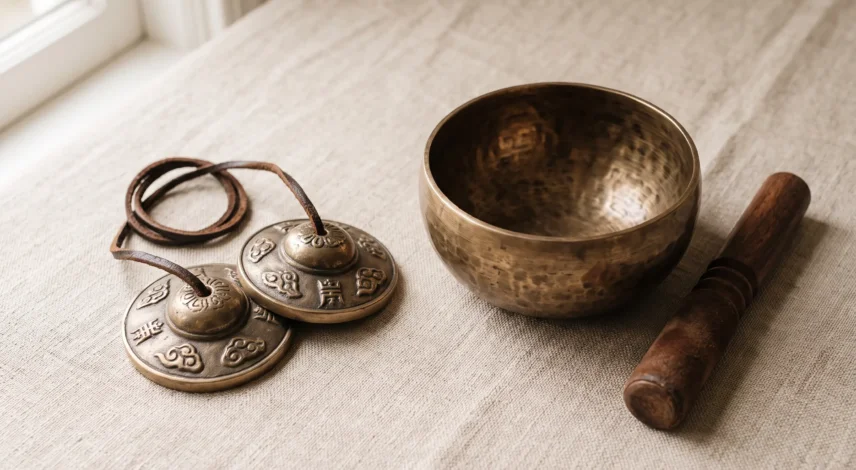

Still torn between tingsha bells and a singing bowl for your meditation practice? You are not alone. It is the most common first-purchase question we hear at PotalaStore. Here is the short answer: choose tingsha bells, a pair of small bronze cymbals struck together for a bright, high-pitched chime, if you want an instant sound cue to open and close a session. Choose a Tibetan singing bowl, a standing bell that produces a deep, sustained tone, if you want immersive sound to sink into.
Many practitioners eventually own both. Our founder, Yang Tso, first met these instruments in Himalayan monastery ritual spaces, not at a yoga retreat, and that background shapes how we source and test every piece. This guide compares sound, playing technique, size, price, and best use, so you can match the right meditation instrument to your practice and skip the expensive guesswork.
Tingsha bells
Instant, no-learning-curve chime for marking transitions. Pocket-sized. Best for focus cues and space clearing.
Singing bowl
Deep, lingering tone you can rest inside. Best for immersive meditation, relaxation, and sound baths.
Both?
Yes, and most sound bath practitioners use them together. See how below.
Table of Contents
What Are Tingsha Bells?
Tingsha bells are two small, thick bronze cymbals joined by a leather cord, struck edge to edge to make a single bright, high-pitched ring that hangs in the air for several seconds. Practitioners use that clear chime to mark the start and end of a session, to signal transitions, and to refocus a wandering mind. The sound sits high, often above 2000 Hz, which is why it cuts cleanly through a quiet room.
You have almost certainly heard one. That crisp, silvery note at the close of a yoga class is usually a pair of tingsha, also spelled ting-sha and sometimes called Tibetan cymbals or meditation chimes.
How Do You Play Tingsha Bells?
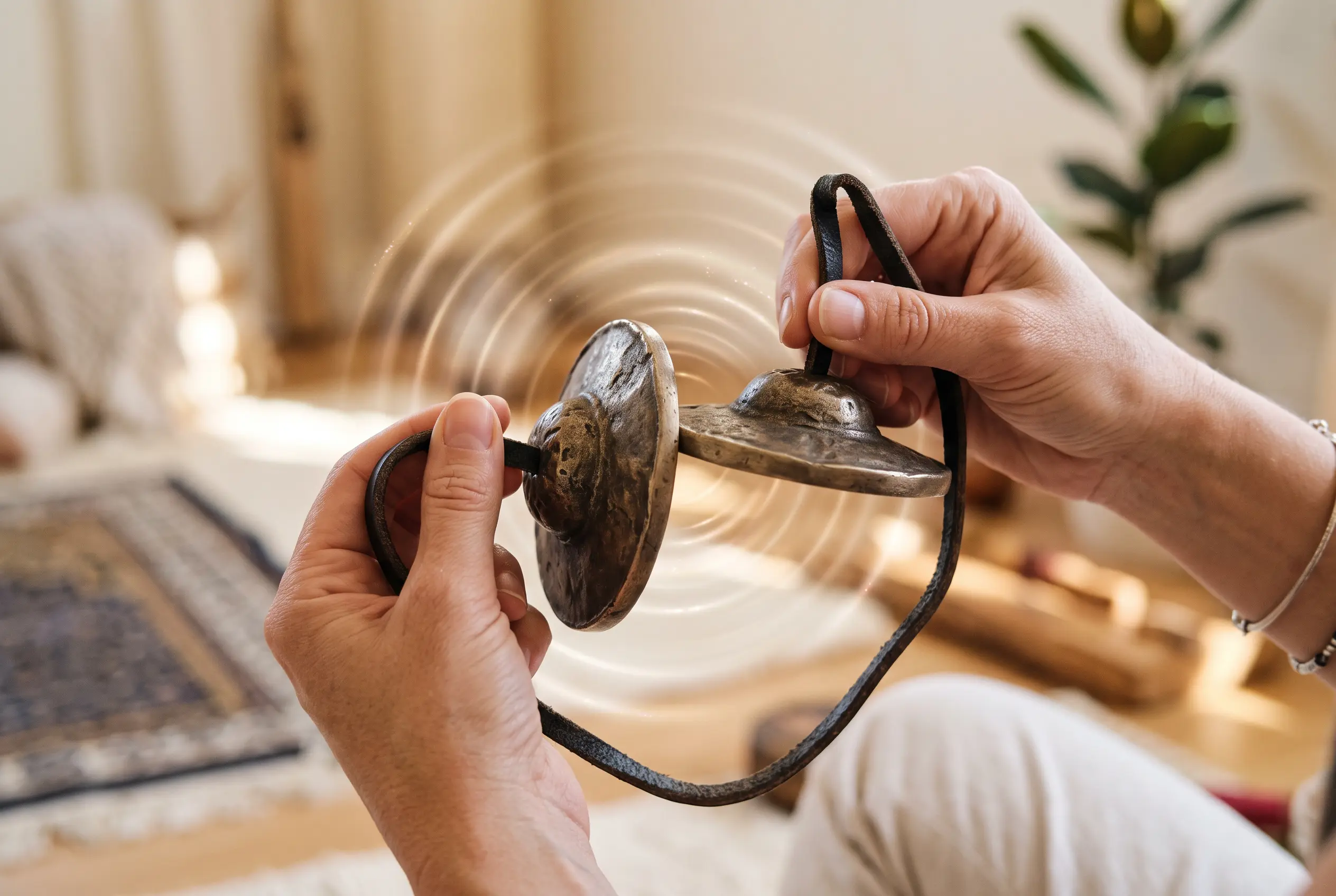
Hold the leather strap so both cymbals hang freely, then bring their edges together with a light glancing tap. Striking flat face to face gives a dull clack, so aim for edge contact. That is the whole technique. There is no rhythm to learn and no surface to master, which is exactly why tingsha suit a complete beginner. In our own testing, the most common first-timer mistake is gripping the cord too tightly, which mutes the ring before it can bloom.
What Are Tingsha Bells Made Of?
Authentic tingsha are cast from a bronze alloy, and the finest pairs follow a seven-metal tradition that blends bronze, tin, zinc, iron, lead, silver, and gold in varying proportions. That mix is what produces the long, layered overtones a stamped-metal souvenir cannot match. Our tingsha are hand-cast in small Himalayan workshops, and every pair is matched by ear so the two cymbals ring in tune rather than clashing. If you want a starting point, browse our handcrafted bronze tingsha bells.
What Is a Singing Bowl?
A singing bowl is a standing bell you either strike or circle with a mallet to release a deep, sustained tone layered with overtones that can ring for many seconds. That long, enveloping sound is what makes a singing bowl the anchor of immersive meditation and sound baths. Where a tingsha delivers one bright pulse, the bowl fills the whole space and keeps giving.
The physics are well documented. In their peer-reviewed study, Terwagne and Bush (2011) describe a singing bowl as a type of standing bell whose rim vibrates in a fundamental mode, with their tested bowl ringing at a fundamental of 188 Hz. Across sizes, most bowls sound their fundamental somewhere between roughly 110 Hz and 660 Hz, far lower than a tingsha. If you want the fuller picture, we cover the science behind sound healing and singing bowls in a separate guide.
How Do You Play a Singing Bowl?
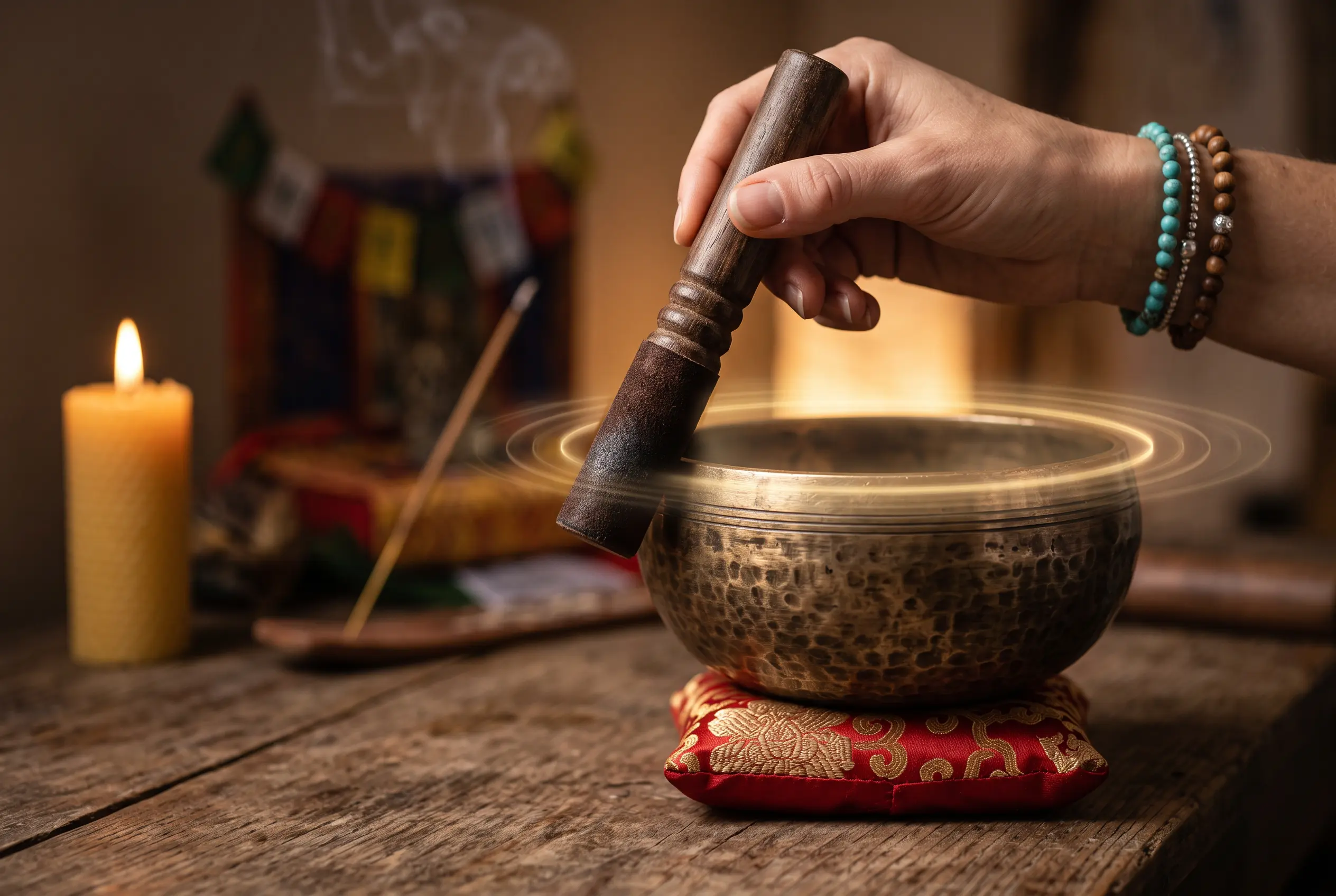
There are two ways. Strike the outside wall with a padded mallet for a clean bell tone, or rest the mallet against the rim and trace slow, steady circles to make the bowl “sing.” Rimming is the part that takes practice. Go too fast or press too hard and the tone chatters and slips. Most people find a smooth, even circle within a few days. That short learning curve is the main trade-off against the instant tingsha chime.
How Do I Choose the Right Size of Singing Bowl?
For a first bowl, a 6 to 8 inch diameter is the sweet spot for solo practice at home. Smaller bowls sit higher in pitch and travel easily; larger bowls, 9 inches and up, produce lower, longer tones that suit group sessions. Size drives pitch, so buy for the sound you want, not just the look. You can compare tones across our authentic hand-hammered Tibetan singing bowls, each recorded so you can hear it before you buy.
Tingsha Bells vs Singing Bowl: The Full Comparison
The core difference: tingsha bells give a short, bright, high-pitched chime for signaling and focus, while a singing bowl gives a deep, sustained tone for immersive meditation. Here is how the two instruments compare on every factor that affects your choice.
| Attribute | Tingsha Bells | Singing Bowl |
|---|---|---|
| Sound & pitch | Bright, high-pitched, above 2000 Hz | Deep, resonant, roughly 110–660 Hz |
| How you play it | Strike two cymbals edge to edge | Strike the wall or rub the rim with a mallet |
| Sustain | Short, clear ring (a few seconds) | Long, layered overtones (10+ seconds) |
| Typical size | 2.5–4 inch pair | 6–8 inch (beginner), up to 10 inch+ |
| Learning curve | None, instant | Moderate, rimming takes a few days |
| Best for | Signaling start/end, transitions, space clearing | Immersive meditation, sound baths, relaxation |
| Portability | Very high, pocketable | Moderate, bowl plus cushion and mallet |
| Price (USD) | $15–$30 entry / $75–$80 premium | $25–$47 entry set / $80–$120 quality |
Which Has the Better Sound for Meditation?
Neither one wins outright, because they solve different problems. Tingsha give you a precise, punctuating sound: a clean bell to open, a clean bell to close, nothing lingering in between. A singing bowl gives you a continuous field of tone you can breathe into for minutes at a time. If your practice is silent sitting with clear bookends, tingsha shine. If your practice is resting inside sound, the bowl wins.
Which Is More Affordable?
Tingsha are usually the cheaper entry point. A serviceable pair runs about $15 to $30, while a good starter singing bowl set lands around $25 to $47. Premium, hand-tuned pieces of either climb higher, roughly $75 to $120, because craftsmanship and alloy quality drive both tone and price. For a small first purchase that still sounds authentic, tingsha are hard to beat.
Not sure which tone suits you? Explore our handcrafted bronze tingsha bells and authentic hand-hammered Tibetan singing bowls side by side, each with a real sound sample.
Which Is Better for Beginners, Tingsha or Singing Bowl?
If you want a win on day one, tingsha bells are the easier start, because there is genuinely no technique to learn. You lift the strap, tap the edges, and you have a beautiful sound. A singing bowl asks for a few days of practice with the rim before it rewards you, but that payoff is a richer, more immersive tone. Neither choice is wrong. It comes down to whether you want instant simplicity or are happy to practice for a deeper sound.
If you are just starting out, do not worry about getting it “perfect.” A slightly uneven bowl circle or a soft first chime is completely normal, and both instruments sound good long before you feel skilled.
Best Pick for Solo Home Practice
For quiet sitting at home, start with tingsha if you mostly need help settling in and marking time. Their bright chime is a reliable focus anchor: one strike to begin, one to return when your attention drifts. If your home practice is more about winding down and relaxing your nervous system, a single 6 to 8 inch bowl is the better companion.
Best Pick for Yoga Teachers and Sound Baths
Teachers and sound practitioners lean toward the bowl as their primary instrument, because a room full of people needs sound that carries and sustains. That said, most keep tingsha in the kit too. We have watched countless instructors use a single tingsha chime to move a class out of savasana without saying a word. For group work, plan on a larger bowl for depth plus tingsha for transitions.
Can You Use Tingsha Bells and a Singing Bowl Together?
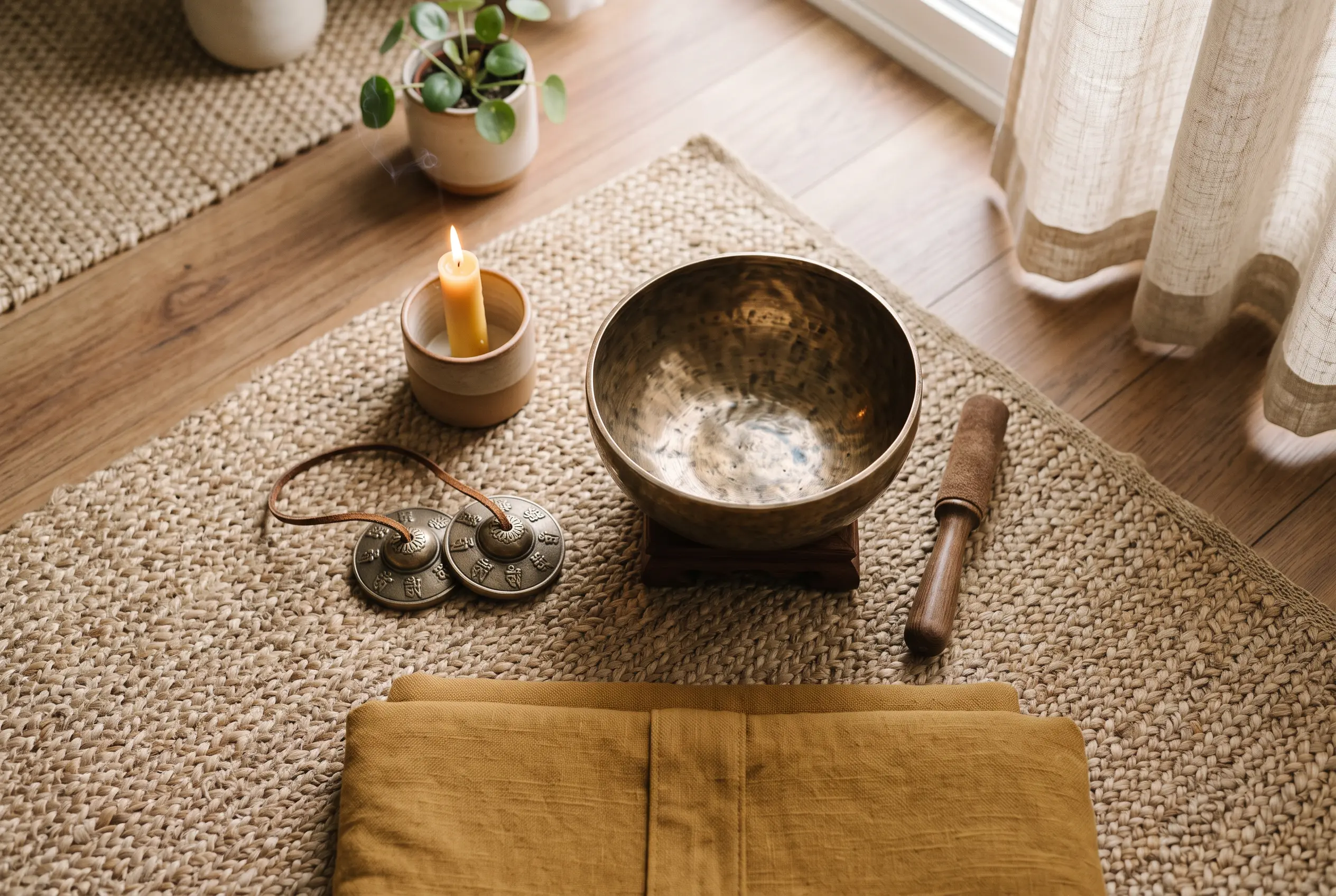
Yes, and most experienced practitioners do. The two are not rivals; they play different roles. Use tingsha to open the session, mark each transition, and close it. Use the singing bowl to fill the space in between with deep, sustained tone. Together they create a clear arc: a bright beginning, an immersive middle, and a clean return.
How to Layer Them in a Sound Bath
Start with a single tingsha chime to signal the beginning and draw everyone’s attention. Move into the bowl, striking and rimming to build a continuous field of overtones for the main stretch. When it is time to surface, let the bowl fade, rest in two to three minutes of silence, then close with one final tingsha ring. That structure works whether you are guiding one friend or a full studio.
What Other Instruments Pair Well?
A gong adds a wall of sound for larger spaces, while a tuning fork offers precise, on-body work that neither cymbal nor bowl provides. If you are weighing the bowl against a fork specifically, we break down how a singing bowl compares to a tuning fork in its own guide. For most home practices, though, tingsha plus one bowl covers nearly everything you will want to do.
Final Verdict: Which Should You Buy First?
Buy tingsha bells first if you want an instant ritual cue and maximum portability. Buy a singing bowl first if sustained, immersive sound is the whole point of your practice. That single question, “what do I want the sound to do,” settles most decisions faster than any spec sheet.
Buy Tingsha Bells If…
- You are a beginner who wants a great sound with zero technique.
- You practice on the go and need something pocket-sized.
- You want a focus cue to open, close, and reset your sitting.
- You are buying a gift and want a small, meaningful piece under $30.
Buy a Singing Bowl If…
- You want immersive sound to relax into for minutes at a time.
- You lead or attend sound baths and need tone that fills a room.
- You enjoy the practice of playing and are happy to learn the rim.
Whichever you choose, insist on authenticity. A real instrument is hand-hammered or hand-cast from a proper bronze alloy, and it should sound alive, not flat. Every piece in our Tibet’s collection of authentic meditation instruments is sourced this way, and each one passes through a traditional rab gnas consecration blessing before it ships, a step Yang Tso witnessed firsthand in the monasteries where she first learned this sound.
Find Your Sound
Hand-tuned, ethically sourced, and blessed in the Himalayan tradition. Hear each instrument before you commit.
Shop Tingsha BellsShop Singing Bowls
A note on sound and wellness: Descriptions of energy, cleansing, and healing here reflect traditional Himalayan belief and how many practitioners report feeling, not proven medical outcomes. Early research on sound meditation is promising but limited. Treat tingsha and singing bowls as a complementary practice that supports relaxation, not as a replacement for professional medical care.
FAQ Common Questions
Tingsha bells are two small cymbals struck together for a short, bright, high-pitched chime, used to mark transitions and focus. A singing bowl is a standing bell struck or rubbed to make a deep, sustained tone for immersive meditation. Tingsha signal; bowls fill the space.
Genuine tingsha are cast from a bronze alloy, and the best pairs follow a seven-metal tradition blending bronze, tin, zinc, iron, lead, silver, and gold. That alloy creates the long, layered overtones that machine-stamped versions lack. Hand-casting and ear-matching also keep the two cymbals in tune.
In traditional practice, the high-frequency chime is believed to break up stagnant energy and reset the atmosphere of a space, which is why many people ring tingsha in corners before meditation. This is a cultural belief rather than a scientific claim, but the clear sound does reliably signal a fresh start.
Look for hand-hammered or hand-cast pieces made from real bronze alloy, ideally with a sound sample so you can judge the tone. At PotalaStore, every tingsha pair and singing bowl is sourced from Himalayan workshops and tone-checked before listing. Browse both collections to compare sounds and find your match.
📚 References
- Acoustics of singing bowls: Peer-reviewed physics of how a bowl’s rim produces its fundamental tone, including a bowl measured at 188 Hz. Terwagne, D. & Bush, J.W.M. (2011), “Tibetan Singing Bowls,” Nonlinearity 24(8). doi.org
- Sound meditation and mood: Observational study of 62 participants reporting reduced tension and improved well-being after singing bowl sound meditation. Goldsby, T.L. et al. (2017), Journal of Evidence-Based Complementary & Alternative Medicine 22(3). journals.sagepub.com
- Tingsha overview: Reference entry on tingsha construction, typical 2.5 to 4 inch sizing, and harmonic bronze alloys. Wikipedia: Tingsha. en.wikipedia.org
- Systematic review (2025): Review of 14 quantitative studies on Tibetan singing bowl intervention, reporting reductions in anxiety and improvements in heart rate variability, while noting study limitations. Lin, F-W. et al. (2025), Healthcare 13(16). pmc.ncbi.nlm.nih.gov