

Pulled the Emperor and wondering whether it means a controlling partner or a big promotion? The Emperor tarot card is card IV of the Major Arcana, and it traditionally stands for authority, structure, stability, and protective leadership. Upright, it asks you to build a plan and stick to it. Reversed, it usually signals authority out of balance: either too much control or not enough.
At Potala Store, we work every day with symbols from spiritual practice, from Tibetan mala beads to crystal bracelets, so we read tarot imagery as a visual language, not a keyword list. This guide covers the Emperor in the Rider-Waite-Smith deck, a clear upright vs. reversed comparison, love, career, and money readings, and a short yes or no answer.
It also adds two things most guides skip: what A. E. Waite actually wrote about the reversed card, and a three-question self-check that shows whether your reversed Emperor is too rigid or too absent.
Table of Contents
What Does the Emperor Tarot Card Mean?
The Emperor tarot card means authority, structure, and stability. As card IV of the Major Arcana, it traditionally represents the father archetype: the part of life that sets rules, builds systems, and holds steady under pressure. Upright, it rewards discipline and a clear plan.
The father figure here is a role, not a gender. Anyone can play it by protecting others, setting boundaries, and taking responsibility. In the Fool’s Journey, the Emperor arrives after the Empress. Where the Fool leaps, the Emperor builds the ground to land on.
The Rider-Waite-Smith deck, illustrated by Pamela Colman Smith, was first published in December 1909 by William Rider & Son of London. Some museum records date the first printing to 1910. The Emperor himself is much older and appears in decks since the 15th century, including the Visconti-Sforza and Marseille decks.
Is the Emperor a Good Card to Get?
In most readings, the Emperor is a positive card. It points to earned success, steady progress, and security you build on purpose. The catch is effort: it rewards structure and follow-through, not luck, so it reads best when a plan is already in motion.
The warning side appears when the card lands reversed, which we cover below. For the meaning of every other card, see our guide to tarot card meanings for all 78 cards.

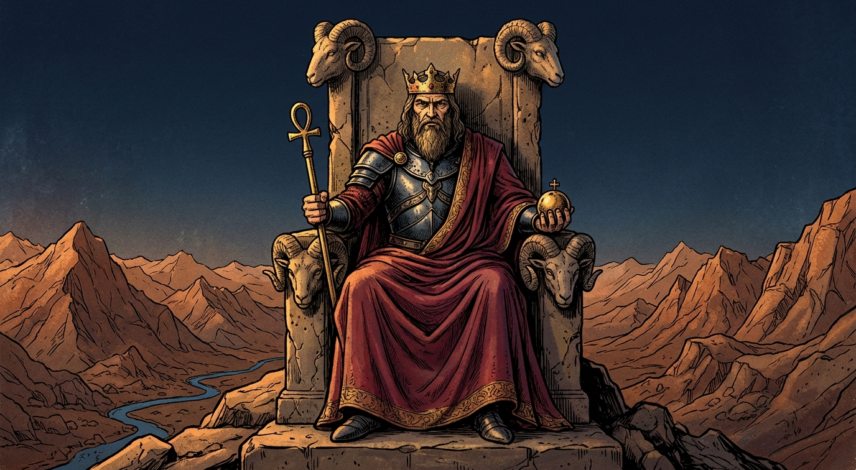
Reading the Throne: 6 Symbols in the Rider-Waite-Smith Card
Six details carry most of the Emperor’s meaning:
- Stone throne: permanence and rules that outlast any one mood.
- Ram heads: the symbol of Aries, the zodiac sign linked to the Emperor, and a sign of drive and leadership.
- Ankh scepter: the Egyptian symbol of life, held in his right hand as creative authority.
- Orb: the world he governs, held in his left hand.
- Armor under a red robe: readiness to defend, with red echoing action and Mars.
- Barren mountains and a small river: hard terrain, with a thin stream of feeling beneath the hard shell.
Look for the river. Most people miss it, and it is the one detail that softens the whole card.
Upright vs. Reversed at a Glance
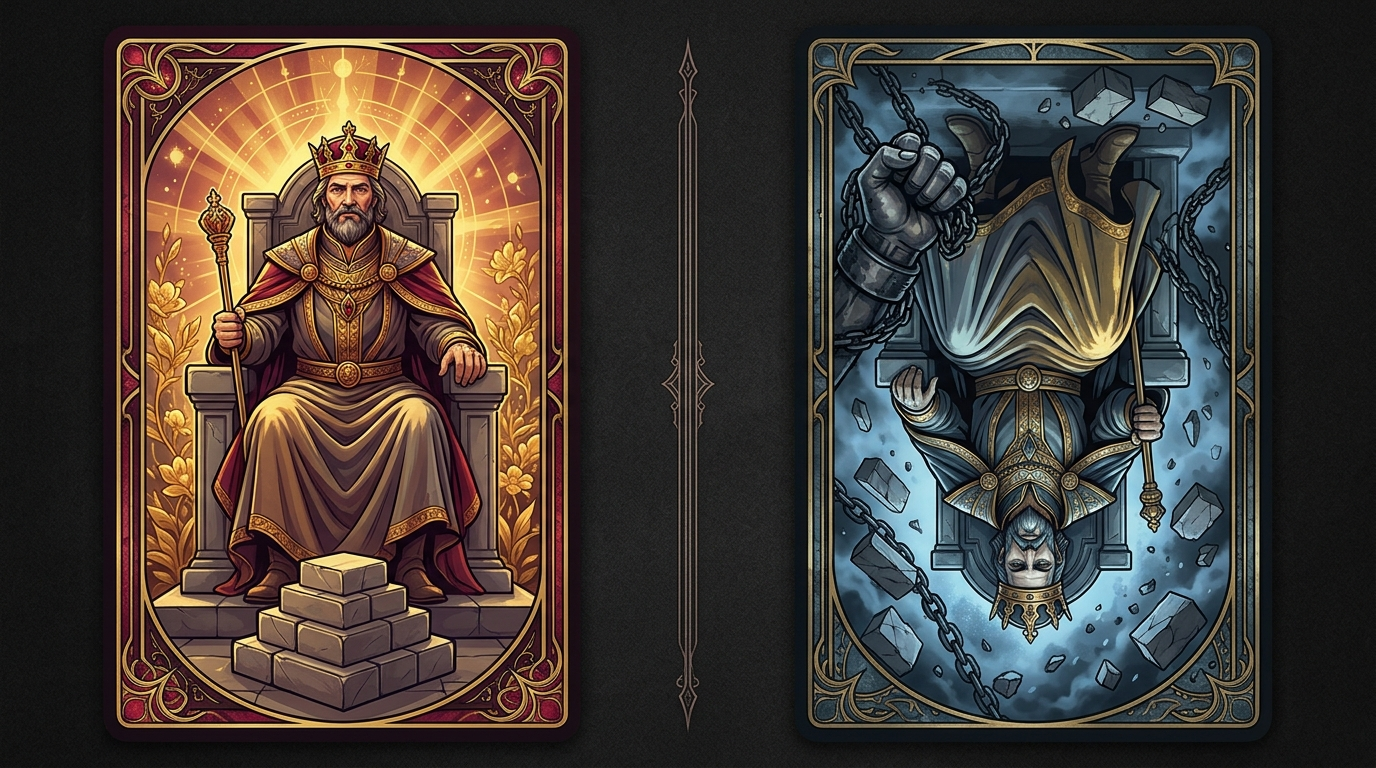
Upright, the Emperor signals grounded authority; reversed, it signals authority out of balance. That means clear rules and steady leadership on one side, and rigid control or collapsed structure on the other. The table compares both positions.
| Feature | Emperor Upright | Emperor Reversed |
|---|---|---|
| Core theme | Grounded authority | Authority out of balance |
| Keywords | Stability, structure, protection, discipline | Domination, rigidity, lack of discipline, immaturity |
| Best advice | Build a plan and commit to it | Loosen your grip, or take ownership |
| Overall energy | Steady, protective, ordered | Tense, stuck, or unanchored |
The Emperor Upright Meaning
Upright, the Emperor is a call to build. It favors clear plans, consistent routines, and leadership that protects rather than dominates. It often appears when a project, budget, or relationship needs firmer footing.
One common reading is that to rule is also to serve. A good leader protects the people who depend on the structure. In practice, that means fair rules, clear boundaries, and showing up when you said you would.
What Does the Emperor Reversed Mean?
The Emperor reversed usually points to authority out of balance. It can describe control that has turned rigid or domineering, or the opposite: weak boundaries and avoided responsibility. Most readers treat it as a prompt to rebuild healthy structure, not a prediction.
- Too much control: rigidity, inflexibility, micromanaging, or domination of other people.
- Too little structure: a lack of discipline, missed deadlines, and boundaries that never hold.
- Conflict with authority: a power struggle with a boss, parent, or partner.
- A harsh inner critic: tyranny turned inward, where your own rules leave no room to rest.
Reversed readings vary by deck, reader, and the cards around them, so treat this list as a starting point.
A note on safety: If this card echoes a relationship where you feel controlled or unsafe, trust that feeling over any card. In the U.S., the National Domestic Violence Hotline is free, confidential, and open 24/7: call 1.800.799.SAFE (7233) or text START to 88788 (thehotline.org).
Too Rigid or Too Absent? How to Read the Reversed Emperor
The reversed Emperor has two faces, and context tells you which one you are seeing. One is too much authority: rigid rules, micromanaging, and control that crowds people out. The other is too little: procrastination, no boundaries, and a role nobody is willing to own.
Most beginners only learn the tyrant version. Then they feel confused when the card shows up during a stretch of procrastination. Both readings are real, and the two sections below help you tell them apart.
What Waite Actually Wrote in 1910
In The Pictorial Key to the Tarot, Arthur Edward Waite listed the reversed Emperor as “benevolence, compassion, credit; also confusion to enemies, obstruction, immaturity.” That is softer than the modern tyranny label. It suggests a ruler whose firmness has loosened, not one who rules too hard.
Most modern guides lean the other way and read the card as excessive control or rigidity. Both traditions exist. Waite’s list is one historical source, not the final word, and decks and readers differ.
A 3-Question Self-Check
Ask yourself three questions and answer them honestly. Then use the pattern of your answers to see which face of the card applies.
- Am I holding on so tightly that others have stopped contributing? A yes points to rigidity.
- Am I avoiding a decision that is mine to make? A yes points to absence.
- Is someone else’s authority limiting me unfairly? A yes points to an outside power struggle.
Journal one sentence for each answer, then pick one small structure to change this week. Our gentle suggestion: start with a morning routine you can keep for seven days.
If your answer points to absence, a physical anchor can help. Browse grounding pieces for building better structure in our Attract Success collection.
Emperor Card in Love, Career, and Money
Across love, career, and money, the upright Emperor favors commitment, leadership, and disciplined planning. Reversed, it warns about control: a partner who decides everything, a boss who micromanages, or a budget so rigid, or so absent, that it stops working for you.
| Area | Upright | Reversed |
|---|---|---|
| Love | A committed, reliable partner; trust that builds slowly | A power imbalance, or a partner who is controlling or distant |
| Career | A leadership role, a promotion, systems that work | A micromanaging boss, rigid policies, or dodged responsibility |
| Money | Budgets, long-term planning, disciplined saving | Spending with no plan, or a budget that no longer fits your life |
The Emperor in Love and Relationships
In love, the upright Emperor describes a steady, committed partner who shows care through reliability rather than grand gestures. For singles, it can point to someone serious and consistent. Reversed, it often flags an unequal dynamic where one person’s need for control crowds out the other.
Some readers also take the card to describe a relationship that has moved past uncertainty into stable commitment. In a love reading, ask whether the structure feels protective or confining. Your own experience matters more than the card.
The Emperor in Career and Money
At work, the upright Emperor is a strong sign for leadership roles, promotions, and projects that need systems. With money, it favors budgets and long-term discipline over windfalls. Reversed, it can point to rigid management, a micromanaging boss, or spending without a plan.
Some guides add a health reading to this card. Treat it as a prompt to review your routines, not a diagnosis. For health or money decisions, use the card as a reflection prompt and talk to a qualified professional.
Is the Emperor a Yes or No Card?
Upright, the Emperor is a yes, especially for questions about career, commitment, and anything you are willing to plan and work for. In love it is a steadier, conditional yes. Reversed, it leans no or “not yet,” usually until the structure behind the question is sound.
It rarely means never. More often, it means “not like this.”
When the Emperor Says Yes
The Emperor’s yes is strongest when your question involves something you can build: a promotion, a contract, a commitment, or a long-term plan. It reads as “yes, if you do the work,” not “yes, it will simply happen.” Topics like career, contracts, and property fit this card best.
How to Ask the Emperor a Yes or No Question
Keep the question specific and about your own actions. A one-card daily draw takes about two minutes.
- Write the question down. Make it about what you will do, such as “Should I apply for this role?”
- Shuffle and draw one card. Note whether it lands upright or reversed.
- Read the answer as a next step. If the Emperor is upright, ask what structure would make the yes real. If it is reversed, ask what needs fixing first.
For more layouts, see our guide to beginner tarot spreads, starting with a one-card daily draw.
Emperor vs. Empress vs. Hierophant: Pairings and Correspondences
The Empress nurtures what grows, the Emperor builds the structure that protects it, and the Hierophant teaches the rules of institutions. Together, these three cards show three kinds of authority: natural, worldly, and spiritual. Reading the Emperor next to its neighbors makes its role clearer, and the journey starts with the Fool tarot card meaning, card 0.
| Card | Number | Role | Type of authority | Core question |
|---|---|---|---|---|
| The Empress | III | Nurtures and creates | Natural | What can I help grow? |
| The Emperor | IV | Protects and organizes | Worldly | What structure do I need? |
| The Hierophant | V | Teaches and upholds tradition | Spiritual | Which tradition or teacher guides me? |
The Emperor’s Element, Planet, and Zodiac at a Glance
The Emperor corresponds to Aries, a cardinal fire sign ruled by Mars, and to the number 4, the number of foundations. In the Golden Dawn system it carries the Hebrew letter Heh. Aleister Crowley later swapped it to Tzaddi, which is why some decks disagree.
| Correspondence | The Emperor |
|---|---|
| Number | 4 (card IV) |
| Element | Fire |
| Planet | Mars |
| Zodiac sign | Aries (03/21 to 04/19) |
| Hebrew letter | Heh (Golden Dawn); Tzaddi (Crowley) |
Grounding Stones for Emperor Energy
Many readers like a small physical reminder of the Emperor’s steadiness. Gold tiger eye is traditionally associated with willpower and confidence, and carnelian is the classic Aries stone. Treat either as a reminder of your intention, not something that changes outcomes.
The Gold Tiger Eye Bracelet from Potala Store uses Grade AAA natural tiger eye with a moving golden band, and it costs $43.95 at the time of writing. It gives you something to touch when you commit to the plan the Emperor asked for. That is the whole job of a reminder piece.
Carnelian can push Aries energy toward restlessness, so we suggest pairing it with a grounding stone such as hematite. If you prefer a fire-red tone, the Red Agate Good Fortune Bracelet and the Tiger Eye Fortune Lucky Bracelet are two other options. For more stones by sign, see our Aries birthstone guide to lucky gems.
Want a reminder you can wear while you build your plan? Shop the Gold Tiger Eye Bracelet.
The Takeaway
The key takeaway: upright, the Emperor tarot card means build it; reversed, it means rebalance it. Either way, the card is about how you hold power. It asks whether your structure protects you and the people around you, or whether it has turned into a cage or a ruin.
⚠️ Important Note: This guide reflects traditional tarot symbolism and interpretation, not scientific fact. Tarot is a tool for reflection. For decisions about health, money, safety, or relationships, please consult a qualified professional.
Keep your intention close. Explore Potala Store’s crystal collection and find a piece that fits the plan you are building.Shop Crystals
Frequently Asked Questions
The Emperor corresponds to Aries (roughly 03/21 to 04/19), ruled by Mars and linked to the Fire element. That is why ram heads decorate his throne.
Not usually. Upright, it points to stability and commitment. Reversed, it flags a power imbalance worth discussing honestly, which is a warning sign rather than a verdict.
As feelings, the upright Emperor suggests someone protective and serious about you who may show it through actions more than words. Reversed, those feelings can come out as control or emotional distance.
Not necessarily. It asks you to rebalance authority, whether that means loosening control or finally taking responsibility. Try the 3-question self-check above, then pick one small structure to put in place this week.
📚 References
- A history of tarot cards: Overview of the Rider-Waite-Smith deck and its first publication, from a leading design museum. Victoria and Albert Museum
- The Pictorial Key to the Tarot, Part 3: A. E. Waite’s original upright and reversed meanings for the Emperor. Wikisource
- Encyclopedia entry: Emperor: The Golden Dawn correspondence of the Emperor to Heh and Aries. Llewellyn Worldwide
- The Emperor (tarot card): Overview of the card’s history, astrological link, and upright and reversed meanings. Wikipedia