

How to Find Your Spirit Animal: A Step-by-Step Guide to Meeting Your Animal Guide
 by Yang Tso
0 comments
by Yang Tso
0 comments
Your spirit animal isn’t something you pick from a list. It reveals itself through recurring signs, dreams, quiet reflection, and meditation. If you feel drawn to a particular animal but aren’t sure whether that connection means anything, this guide shows you how to find your spirit animal step by step, and how to honor it once you do.
A spirit animal is a symbolic animal guide, believed in many traditions to reflect your inner qualities and offer guidance. People also call it a power animal, a totem, or an animal spirit guide. You don’t need to be religious to explore one. Many people simply use it as a mirror for self-reflection and a way to notice patterns in their lives.
At Potala Store, a Tibetan family-run shop rooted in Himalayan tradition, we approach animal symbolism with both curiosity and respect. That shapes this guide in two ways. First, you get practical, grounded methods instead of vague mysticism. Second, we’re honest about the term’s Indigenous roots, and we show you how to explore it without appropriating another culture’s sacred practices.
Here’s the short version. Pay attention to the animals that keep showing up, meditate to meet the one your intuition recognizes, learn what it represents, then find small ways to carry its qualities into daily life. The rest of this guide expands each step.
Table of Contents
What Is a Spirit Animal? Meaning, Origins, and Common Misconceptions
A spirit animal is a symbolic animal that represents your inner qualities and offers guidance, often revealed through signs, dreams, or meditation rather than chosen deliberately. In many traditions, it acts as a personal guide or messenger. The most common misconception is that your spirit animal is simply your favorite animal.
Your favorite animal is a conscious preference. A spirit animal is something you notice appearing in your life, sometimes a creature you would never have picked. That element of surprise is often part of the point. A spirit animal reveals itself to you, which means it can carry a lesson you didn’t know you needed.
Spirit Animal vs. Totem Animal vs. Power Animal: What’s the Difference?
These three terms are used loosely in everyday speech, but they mean different things. Here’s a quick comparison.
| Term | What it refers to | Best described as |
|---|---|---|
| Spirit animal | A personal animal guide that reflects your individual nature | Your soul’s mirror |
| Totem animal | An animal tied to a family, clan, or group identity and ancestry | A shared, ancestral emblem |
| Power animal | An animal whose strengths you call on for a specific need or season | A source of borrowed strength |
Where the Idea Comes From: Native American Roots and Global Traditions
The term “spirit animal” has roots in Native American and Indigenous spirituality, though its exact origin is debated. The broader beliefs behind it appear across cultures worldwide. Two of these ideas are worth knowing.
Animism is the belief that animals, plants, and natural objects each hold a distinct spiritual essence. Totemism is the belief that a person or group shares a kinship or mystical bond with a particular animal or plant. Both stretch back to the earliest forms of human spirituality, long before the modern quiz-culture version.
How Tibetan Buddhism Views Sacred Animals
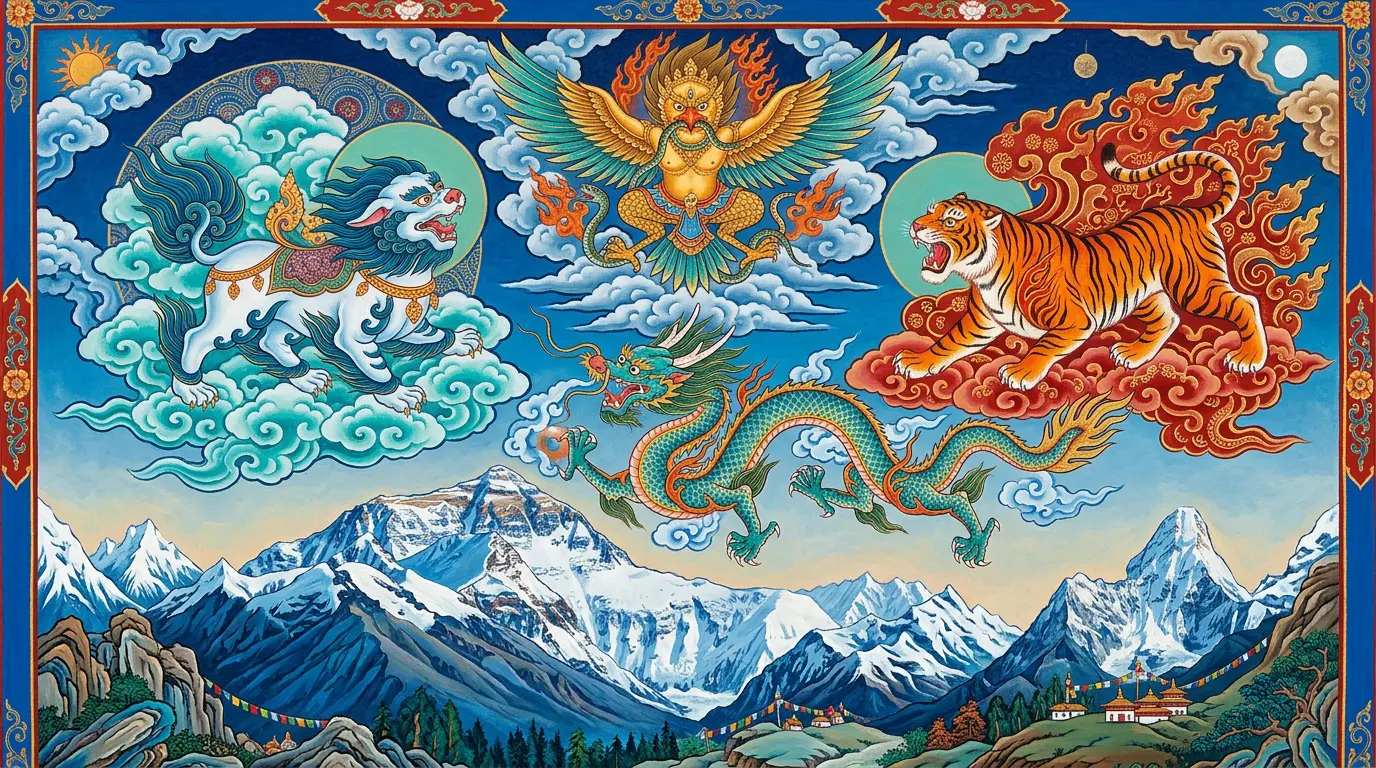
Tibetan Buddhism holds its own rich tradition of sacred animals, separate from the Native American concept. The best-known are the Four Dignities, four animals that each represent a quality a practitioner cultivates on the path.
The Snow Lion represents fearless, unconditional joy. The Tiger embodies confidence and disciplined awareness. The Garuda symbolizes fearless transformation and the burning away of obstacles. The Dragon carries gentle power and mastery over change. If you feel drawn to Eastern symbolism, these four offer an authentic path that doesn’t borrow from Indigenous American practice. You can see a related animal symbolism in how the Chinese zodiac assigns personality traits to each animal year.
How Do You Know What Your Spirit Animal Is?
There’s no single test for finding your spirit animal. It usually reveals itself through a mix of recurring signs, vivid dreams, and honest reflection over time. Watch for these four signals:
- Recurring encounters: The same animal keeps appearing in real life, photos, conversations, or media.
- Vivid dreams: A specific animal shows up clearly in your dreams and stays with you the next morning.
- A strong emotional pull: You feel an unexplained, magnetic connection to one particular creature.
- Lifelong presence: An animal has crossed your path since childhood in ways you still remember.
There’s no wrong answer here, and no deadline. When I first tried this, the animal that kept surfacing wasn’t the one I expected, and that surprise turned out to be the real message. Give it time, and let the pattern come to you.
Pay Attention to Recurring Signs and Synchronicities
Synchronicities are meaningful coincidences, and they’re often the first sign. Notice when one animal shows up repeatedly across unrelated moments in a single week. A hawk on your morning walk, then a hawk on a friend’s shirt, then a hawk documentary. Repetition is the signal worth tracking.
Notice the Animals in Your Dreams: A Simple Journaling Method
Dreams are one of the clearest channels, and a short journaling habit makes the pattern visible. Keep a notebook by your bed and write down any animal that appears in your dreams. Do this every morning for two to four weeks. A recurring dream animal often reveals the guide your waking mind keeps overlooking.

Reflect on Your Lifelong Connections to Certain Animals
Your history holds clues that recent signs can miss. Think back to a childhood favorite, a beloved pet, or a wild animal you always seemed to cross paths with. An animal that has quietly followed you for years is a strong candidate worth sitting with.
A Simple Meditation to Meet Your Animal Guide
Set aside 5 to 10 minutes in a quiet space, and this five-step visualization will help you meet the animal your intuition recognizes. Meditation works because it lowers the mental noise that usually drowns out subtle impressions.
Before You Begin: Setting Your Space and Intention
Meditation quiets the mind so your intuition can recognize the animal that appears. Reduce distractions first. Silence your phone, dim the lights, and sit somewhere you won’t be interrupted. Many people open the practice with a Tibetan singing bowl to open your meditation, a hand-hammered metal bowl that produces a sustained tone to mark the start of stillness. If you want to build a dedicated practice space, you can explore our authentic Tibetan meditation tools.
The 5-Step Guided Visualization to Meet Your Animal
Follow these five steps in order. The whole practice takes about 5 to 10 minutes.
- Settle in: Sit comfortably and take five slow, deep breaths to relax your body.
- Set your intention: Silently ask, in your own words, to meet your spirit animal.
- Picture a natural place: Imagine walking into a forest, a mountain trail, or a quiet shoreline.
- Let an animal appear: Don’t force it. Notice which creature approaches or catches your attention.
- Observe and thank it: Watch its behavior, receive any impression, then journal about the experience afterward.
What to Do If No Animal Appears
If nothing appears the first time, that’s completely normal. It took me three separate sessions before anything came through clearly. Don’t force an answer or grab the first animal you think of. Rest, then try again in a few days with a relaxed and open mind.
Common Spirit Animals and Their Meanings
Most guides describe 15 to 18 core spirit animals, each linked to a specific quality and message. Here are ten of the most common, grouped by the trait they’re believed to carry.
| Spirit Animal | Core Quality | Its Message to You |
|---|---|---|
| Wolf | Instinct & loyalty | Trust your intuition; balance independence with connection |
| Bear | Strength & grounding | Set healthy boundaries, and rest when you need to |
| Tiger | Confidence | Act with courage and disciplined focus |
| Owl | Wisdom & insight | Look beyond the obvious; trust what you sense |
| Elephant | Memory & patience | Move forward with steady, calm strength |
| Turtle | Endurance & peace | Slow down and trust the natural pace of things |
| Butterfly | Transformation | Embrace change; you’re meant to evolve |
| Eagle | Vision & freedom | Rise above the details and see the bigger picture |
| Fox | Adaptability | Move with cleverness and flexibility |
| Deer | Gentleness & intuition | Lead with empathy without losing your footing |
Strength and Protection Animals
The Wolf, Bear, Tiger, and Lion belong to this group. They tend to appear when you’re building courage, defending a boundary, or stepping into a leadership role. Their shared message is to stand firm in your own power.
Wisdom and Intuition Animals
The Owl, Elephant, and Turtle carry this energy. They often surface during seasons of learning, patience, or slow decision-making. Each one reminds you to trust inner knowing over outside pressure.
Transformation and Freedom Animals
The Butterfly, Eagle, Horse, and Fox point toward change and movement. They tend to arrive at turning points, when you’re leaving something behind or opening a new chapter. Their message is to trust the process of becoming.
How to Honor and Work With Your Power Animal
Once you’ve met your spirit animal, honoring it means carrying its energy into everyday life through small, consistent practices. This is where most people fall short, and where the real value lives.
Many people meet their animal, feel inspired for a week, then forget about it. The quality they connected with fades back into the noise of a busy schedule. The people who actually benefit build small, physical reminders into their routine. That habit is the bridge between a one-time insight and a lasting practice.
Carry Its Energy: Wearable Reminders and Meaningful Objects
A wearable reminder keeps your animal’s quality within reach all day. Mala beads, a string of 108 beads used for meditation and mantra counting, work well because each touch anchors you back to the trait you’re cultivating. If your animal is the Tiger or the Lion, a Tiger’s Eye bracelet for courage and confidence carries that same steady energy, since Tiger’s Eye is a golden-brown quartz long associated with bravery. The object itself isn’t the magic. It’s the daily prompt to stay in the quality you’re calling in.

Create a Space for Your Animal Guide
A small altar gives your spirit animal a physical home in your space. You don’t need anything elaborate to start. A single blessed animal figure for your altar or desk works as a daily visual anchor. Seeing it each morning keeps the quality you want present, whether that’s the Owl’s calm insight or the Bear’s grounded strength.
Everyday Practices to Stay Connected
Three simple habits keep the connection alive. First, a short morning greeting: name your animal and its quality as you begin the day. Second, focused meditation on that trait, using a traditional 108-bead mala to keep count of your breaths or mantras. Third, a brief evening reflection: notice where that quality showed up in your day. None of this requires belief in the supernatural. It functions as a mindfulness practice on its own terms.
Exploring Animal Symbolism Respectfully
You can explore animal symbolism meaningfully without appropriating another culture’s sacred practices. A little awareness goes a long way, and it makes your own practice more grounded.
Understanding Cultural Appropriation Concerns
The term “spirit animal” comes from Native American and Indigenous traditions, where it carries deep and specific meaning. Educators at the Smithsonian’s National Museum of the American Indian have pointed out that casual, meme-style use of the term can trivialize generations of Indigenous belief. Knowing this history is the first step toward engaging with the idea respectfully rather than carelessly.
Finding an Authentic Path That Honors Tradition
You don’t need to borrow another culture’s ceremonies to connect authentically. A respectful approach means learning what animals represent within your own heritage, or exploring a tradition you have a genuine relationship with. For those drawn to the East, Tibetan Buddhism offers its own centuries-old animal symbolism, like the Four Dignities, that you can engage with directly and honestly. At Potala Store, that Himalayan tradition is where our own understanding of sacred animals begins.
Bring Your Spirit Animal Into Daily Practice
Explore authentic Tibetan mala beads, healing crystals, and blessed pieces to carry your animal’s energy with you, handcrafted in the Himalayan tradition and shipped worldwide.Shop Meditation Tools
Frequently Asked Questions
Yes. Many traditions hold that you can have several animal guides at once, or different ones across life stages. One may reflect your core nature, while others appear during specific seasons of your life.
Recurring encounters, in real life, dreams, or media, are usually read as a nudge to pay attention. Look at the qualities that animal represents, and consider how they apply to what you’re navigating right now.
Yes. Your primary animal may stay consistent, but new guides can emerge as your circumstances and growth shift. Nothing here is fixed, and a new animal doesn’t cancel out an old one.
No. Many people engage with it purely as a tool for self-reflection and noticing personal patterns. This is a self-reflection practice, not a clinical or diagnostic tool, so treat your animal as a meaningful mirror rather than a fixed label.
A gentle note: The information here about spiritual and energy properties reflects traditional beliefs and personal experience, not scientific evidence. It’s meant for reflection and self-discovery, and it shouldn’t replace professional medical or mental-health advice.
📚 References
- The Term “Spirit Animal” and Cultural Respect: Perspective from Renee Gokey of the Smithsonian’s National Museum of the American Indian on the term’s Indigenous roots and respectful use. Discover Magazine
- Totemism: Overview of the belief in kinship between humans and a spirit-being such as an animal or plant, across cultures. Encyclopaedia Britannica
- Animism: Background on the belief that animals, plants, and natural objects each hold a spiritual essence. Encyclopaedia Britannica