

White Tara (Sitatara) is the female Buddha of long life, compassion and healing in Tibetan Buddhism, and her seven eyes, her mantra and her place among the three long-life deities carry most of her meaning. This guide gives you the mantra word by word, shows where each eye sits, and explains why some images show fewer than seven.
At PotalaStore, we checked every claim against museum collection records on Himalayan Art Resources and the Rubin Museum of Art, and we flag the points where sources disagree.
The short version:
- Meaning: a peaceful white form of Tara, associated with long life, health and wisdom.
- Seven eyes: three on the face and one on each palm and sole, read as all-seeing compassion.
- Mantra: Tara’s root mantra plus a request to increase long life, merit and wisdom.
Important note: This guide describes traditional Tibetan Buddhist beliefs for cultural and educational purposes. It is not medical advice, and it does not promise any health or lifespan outcome.
Table of Contents
Who Is White Tara in Tibetan Buddhism?
White Tara (Sitatara, Tibetan Drolma Karmo) is a peaceful white form of Tara, the female Buddha known as “she who saves,” and Tibetan Buddhists traditionally turn to her practice for long life, health and wisdom in schools both old and new. Himalayan Art Resources (HAR) is an online archive of Himalayan art from collections such as the Rubin Museum’s. It classes her practice under Kriya tantra and calls her a longevity-bestowing emanation of Green Tara.
HAR also states that every school of Tibetan Buddhism practices her. That breadth explains why her image appears on thangkas, in shrine rooms and on jewelry.
What Does the Name Sitatara Mean?
Sitatara joins the Sanskrit word sita, meaning “white,” to Tara, “she who saves” or “she who carries across.” Tibetans call her Drolma Karmo, often rendered in English as the White Liberator. Some paintings label her Chintachakra, the Wish-Fulfilling Wheel form.
Was Tara Born from Chenrezig’s Tears?
One popular account says Tara arose from a tear shed by Avalokiteshvara, known in Tibetan as Chenrezig, the bodhisattva of compassion whose mantra is Om Mani Padme Hum. Britannica relays that a lotus rose from the lake the tear formed and opened to reveal the goddess.
A second account, noted by HAR, says that as a young bodhisattva Tara promised to always appear in a female form. The two stories describe one figure, so you will meet both in Tibetan sources.
Why Does Sitatara Have Seven Eyes, and Do All Images Show Them?
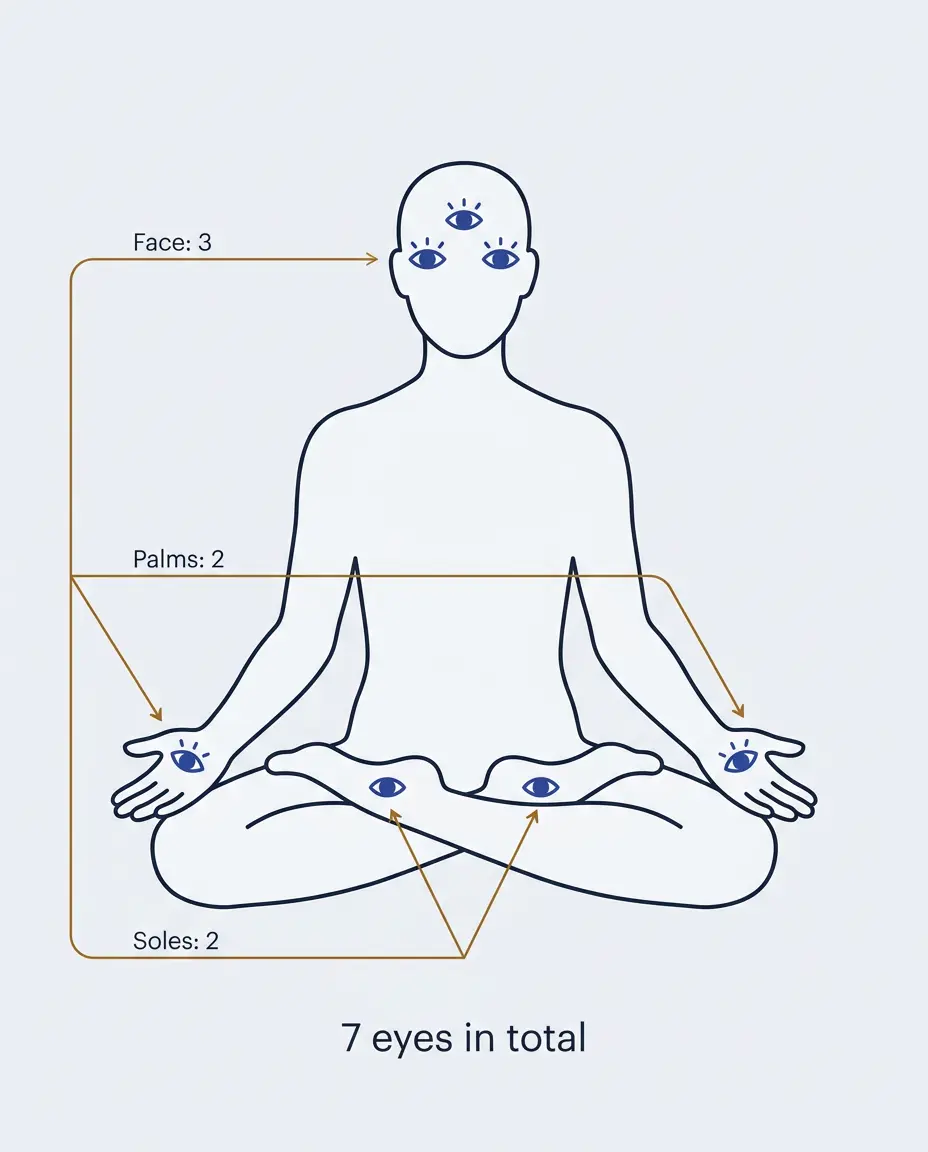
White Tara’s seven eyes are the two ordinary eyes and a third on the forehead, plus one eye on each palm and each sole, and tradition reads them as all-seeing compassion, though Himalayan Art Resources documents two-eyed and three-eyed White Tara images as well.
HAR describes a 20th-century Gelug painting from the Rubin Museum collection with one face and two hands. It shows three eyes on the face and one on each palm and sole, for a total of seven.
Where Are the Seven Eyes Located?
Seven eyes appear in three places on the figure.
- Face: three eyes, the two ordinary eyes plus one on the forehead.
- Palms: one eye in each hand, two in total.
- Soles: one eye on each foot, two in total.
Why Does White Tara Have Seven Eyes?
In Tibetan tradition, the seven eyes stand for wisdom that sees suffering in every direction, which is why teachers speak of her all-seeing compassion. Britannica notes that Tara shown with eyes on her palms and soles is called Tara of the Seven Eyes, a form popular in Mongolia.
Popular explanations add a gentler reading. They link the palm eyes to giving and the sole eyes to walking toward those in need. That reading is interpretive, not canonical.
Why Do Some Images Show Only Three Eyes?
Lineages describe White Tara differently. HAR’s Forms and Types page lists three iconographic types: two eyes, three eyes and seven eyes. Another HAR entry describes a nearly identical form with two eyes on the face and none on the forehead, palms or soles.
HAR’s lineage notes are not fully consistent. One list gives the Atisha tradition seven eyes, while a separate HAR news post places a form without extra eyes under the Atisha tradition. Treat any rule that ties one lineage to one eye count with caution.
An image with fewer than seven eyes is therefore not automatically wrong. Ask the seller which documented form the artist followed.
What Does the White Tara Mantra Mean, Word by Word?
The White Tara mantra, OM TARE TUTTARE TURE MAMA AYUR PUNYE JNANA PUSHTIM KURU SVAHA, extends Tara’s root mantra with a request to increase long life (ayur), merit (punya) and wisdom (jnana), and Tibetan practice recites it with a mala to count repetitions.
OM TARE TUTTARE TURE MAMA AYUR PUNYE JNANA PUSHTIM KURU SVAHASanskrit-style transliteration, 11 wordsOM TARE TUTTARE TURE MAMA AYUR PUNE GYANA PUNTIN KURU SOHATibetan-style rendering
| Word | Traditional meaning |
|---|---|
| OM | Sacred syllable standing for the body, speech and mind of a Buddha |
| TARE | Liberation from samsara, the cycle of suffering |
| TUTTARE | Liberation from the eight dangers |
| TURE | Liberation from illness, read as physical and mental affliction |
| MAMA | “My” or “mine,” the practitioner |
| AYUR | Long life |
| PUNYE | Merit |
| JNANA | Wisdom |
| PUSHTIM | Increase |
| KURU | “Make it so” |
| SVAHA | “Hail” or “may blessings be upon” |
Buddhist teacher Thubten Chodron explains that the added words ask for an increase in life, merit and wisdom. Merit matters here because, as she explains, the request is not only for a long life in this lifetime but for the merit needed to gain realizations.
How Do You Pronounce the White Tara Mantra?
In the Tibetan way of saying it, TARE sounds like TAH-ray, TUTTARE like too-TAH-ray and TURE like TOO-ray. You will see several spellings, because Sanskrit and Tibetan renderings differ.
| Meaning | Sanskrit-style spelling | Tibetan-style rendering |
|---|---|---|
| Long life | AYUR or AYUH | AYUR |
| Merit | PUNYA or PUNYE | PUNE |
| Wisdom | JNANA | GYANA |
| Increase | PUSHTIM or PUSTIM | PUNTIN |
| Closing seal | SVAHA | SOHA |
A few lineages add the syllable YE before SOHA, so follow the version your teacher gives you.
Can You Chant the Mantra for Someone Else?
Yes. MAMA means “my,” and teachers replace it with another name to direct the request to that person. Thubten Chodron gives the example of saying guru in place of mama when practicing for one’s teacher. Practitioners also substitute the name of a parent or friend.
Some teachers reserve the long form for people who have received White Tara empowerment. They point everyone else to the shorter OM TARE TUTTARE TURE SOHA. The FAQ below covers this question.
A Simple Mala Routine for the Mantra
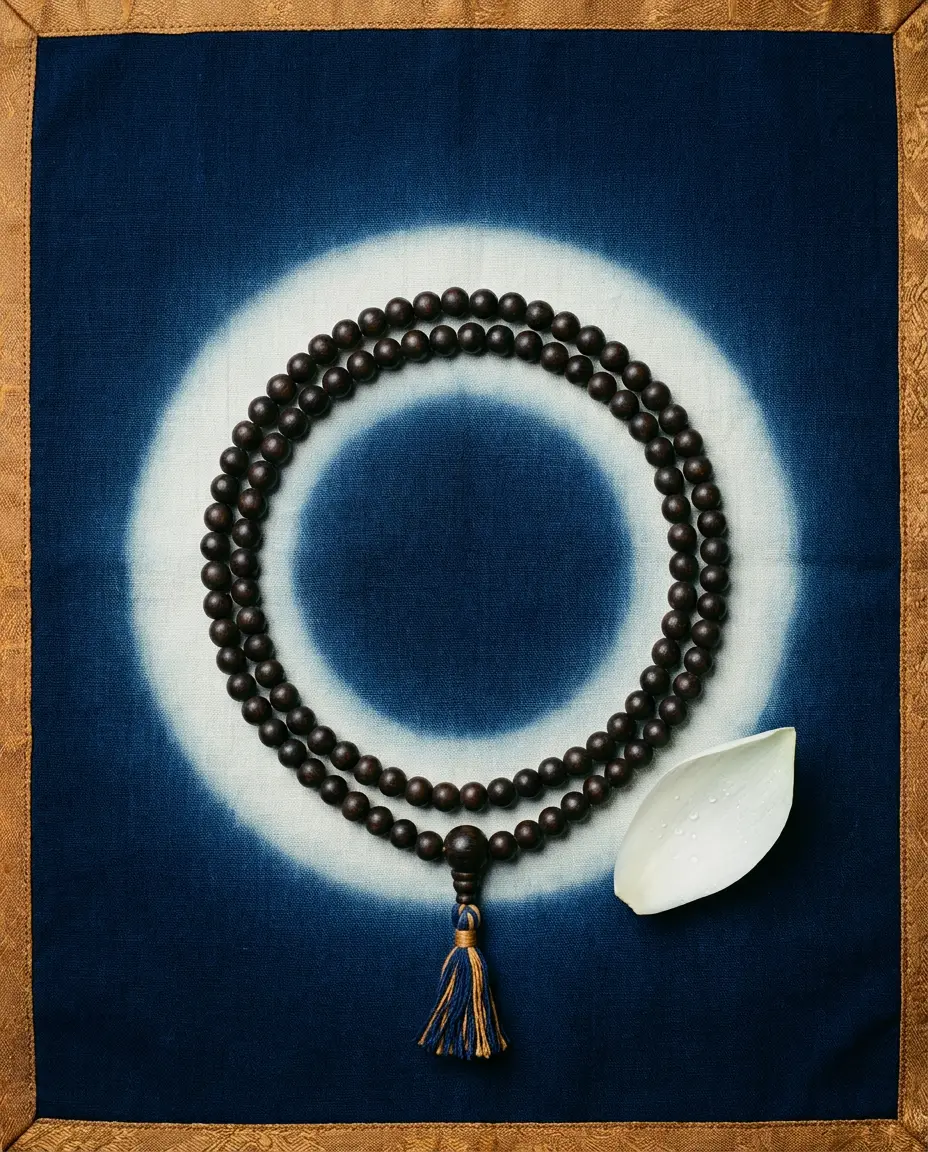
- Start at the guru bead: hold the mala in your left hand and begin at the larger marker bead.
- Move clockwise: recite the mantra once per bead.
- Stop at the guru bead: a full 108-bead mala then marks 108 recitations.
The Tibetan Nuns Project gives this left-hand, clockwise guidance for holding a mala. A 27-bead wrist mala is one quarter of 108, so four rounds complete the same cycle. Our comparison of a 27-bead wrist mala versus a full 108-bead mala shows which format suits your practice.
If you want the count to take care of itself, try our 108 Mala Beads Bracelet. It has 108 beads plus a guru bead, 8 mm (0.31 in) wood beads and an elastic cord. One round equals 108 recitations, so your attention stays on the mantra instead of the tally. It costs $25.95 as of 11/20/2026.
Why Is the White Liberator Called a Long-Life Deity?
In Tibetan Buddhism, White Tara is one of the three long-life deities, a group that also includes Amitayus and Ushnishavijaya, and her practice is traditionally offered to help remove obstacles to a long life that can be used for spiritual practice. HAR’s long-life deities page calls these three the most prominent and best known of the long-life deities.
Amitayus, Ushnishavijaya and the Three Long-Life Deities
You can tell the three apart by color, faces and arms. Amitayus is red, with one face and two arms. White Tara is white, also with one face and two arms. Ushnishavijaya is white, with three faces and eight arms.
On our Amitayus pendant, the Longevity Buddha holds a vase of nectar, the attribute most often linked to him.
What Does “Long Life” Mean in Buddhist Practice?
In Buddhist practice, long life is requested alongside merit and wisdom so that life serves the path to awakening, not as a goal on its own. Wildmind’s commentary and Thubten Chodron’s teaching both read the mantra this way. HAR adds that tantric theory draws only an imprecise line between long-life and healing practices.
Is White Tara Only for Old People or the Sick?
No. Tibetan sources associate White Tara with increasing life span, removing sickness and growing merit and wisdom, so people of any age may turn to her practice. One HAR entry for a Karma Kagyu painting links her to increasing life span and removing sickness, yet the mantra asks for merit and wisdom as well.
Many readers reach this page while a loved one is unwell. We encourage you to see the practice as spiritual support offered alongside medical care, never instead of it.
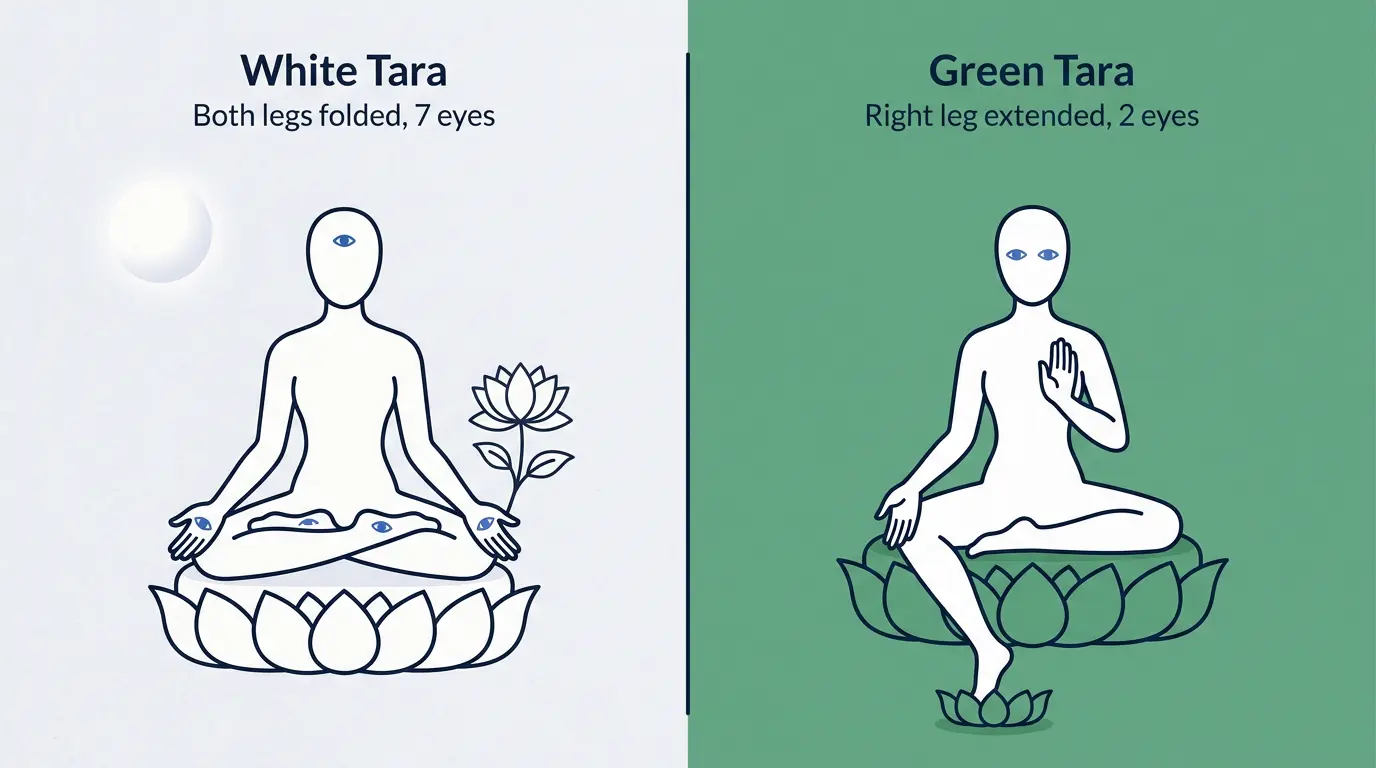
What Is the Difference Between White Tara and Green Tara?
The quickest way to tell them apart is posture and eyes: White Tara sits in vajra posture with seven eyes and is associated with long life, while Green Tara extends her right leg, has two eyes and is associated with swift protective action.
| Feature | Green Tara | White Tara |
|---|---|---|
| Body color | Green | White, like an autumn moon |
| Posture | Right leg extended, foot stepping off the lotus | Seated in vajra posture on a lotus and moon disc |
| Eyes | Two | Seven in the common form |
| Association | Swift protection and help | Long life, health and wisdom |
| Mantra | OM TARE TUTTARE TURE SOHA | Root mantra plus MAMA AYUR PUNYE JNANA PUSHTIM KURU SVAHA |
How Do You Tell Them Apart in a Painting or Statue?
Look at the legs first and the hands second. A Green Tara pendant usually shows her right foot stepping off the lotus, while White Tara keeps both legs folded and carries eyes in her palms and soles.
Britannica adds a symbolic contrast. It describes their lotus symbols as one full-blown and one closed, and says together they stand for compassion that works day and night. If an image mixes both sets of markers, ask the seller which tradition the artist followed. For the Green Tara side, see our guide to Green Tara’s extended-leg posture and pendant symbols.
Can I Pray to Both Green and White Tara?
Yes. Tibetan Buddhism honors many forms of Tara, and Britannica notes that her forms multiplied to a traditional 108, with temple banners often showing 21 Taras around a central Green Tara. Many practitioners work with both at different times, calling on Green Tara for swift help and White Tara for long life.
How Do You Choose an Authentic Long-Life Image?
Before you buy a White Tara image, check four things: the eye count against a documented form, the vajra seated posture, a white body holding a white utpala flower, and a seller who names the materials, the workshop or region, and the return terms.
- Eye count: match the image to a documented form of two, three or seven eyes, and ask which one the artist followed.
- Posture: HAR describes White Tara seated in vajra posture on a lotus seat and moon disc, with a peaceful, youthful appearance.
- Hands and flower: HAR describes the right hand in the gesture of supreme generosity and the left holding a white utpala at the heart.
- Seller: look for named materials, a named workshop or region, real photos and clear returns. Our five-point Tibetan jewelry authenticity checklist explains each point.
What Can You Buy Today?
PotalaStore does not currently list a White Tara piece. When we reviewed our catalog for this guide, we found no White Tara pendant, thangka or statue, and we would rather say so than relabel another deity.
What we do carry from the same long-life family is the Amitayus (Longevity Buddha) style of our hand-painted 3D thangka pendant. It costs $68.95 as of 11/20/2026 and sits in a leather Ga Wu box on an adjustable hand-knotted cotton cord.
- 3D thangka pendant: the raised, hand-painted portrait shows fine detail, so you can read the image at close range. It works as a quiet daily reminder of long-life practice or as a gift.
- Ga Wu box pendant: our Ga Wu box thangka pendant measures 1.85 x 2.22 inches (47 x 56.3 mm) and comes in 14 deity styles. Confirm the deity on the product page before you order.
Our return window is 60 days. You can browse more Tibetan Buddhist jewelry and ritual items in our Tibet category.
Respectful Ways to Display or Wear a Long-Life Image
Tibetan Buddhists traditionally keep sacred images clean and placed high, never on the floor. A pendant can be worn close to the heart as a reminder, provided you treat it with the same care.
If you are choosing a gift for an aging parent, a short card explaining the image matters as much as the object.
Frequently Asked Questions About White Tara
Teachers differ. Some say anyone may recite it with respect, while others reserve the long form for those who have received White Tara empowerment and point everyone else to the shorter OM TARE TUTTARE TURE SOHA. If it matters to you, ask a qualified teacher.
No. Kwan Yin (Guanyin) is the East Asian form of Avalokiteshvara, the bodhisattva from whose tear Tara is said to have arisen in one popular account. They are related figures with separate iconography, so judge an image by its markers rather than its listing title.
Practitioners often choose 21 or 108 recitations, and 108 equals one round of a full mala. These counts are traditional guidelines rather than rules, and your teacher may suggest a different number.
Our hand-painted thangka pendants include an Amitayus (Longevity Buddha) style, a companion of White Tara among the three long-life deities. Compare the styles in our thangka collection and confirm the deity on each product page before you choose.
In summary, White Tara is the white, seven-eyed Tara of Tibetan Buddhism, honored for long life, merit and wisdom, with a mantra that names those three requests. The key takeaway for buyers is simple: check the eye count against a documented form, confirm the deity on the listing and read the return terms.
Explore long-life imagery
PotalaStore’s hand-painted thangka collection includes an Amitayus (Longevity Buddha) style, a companion of White Tara among the three long-life deities.
References
- White Tara iconography and classification. A Rubin Museum of Art painting entry describing the seven eyes, the Kriya tantra classification and practice across all schools. Himalayan Art Resources, item 51
- White Tara forms and types. Two-, three- and seven-eyed iconographic types, lineage notes and iconographic details. Himalayan Art Resources, Forms & Types and Three Iconographic Topics
- The three long-life deities. Amitayus, White Tara and Ushnishavijaya, with their colors, faces and arms. Himalayan Art Resources, Long-life Deities
- Tara in Buddhist tradition. Origin accounts, Sitatara, Tara of the Seven Eyes and the traditional 108 forms of Tara. Encyclopaedia Britannica, “Tara”