
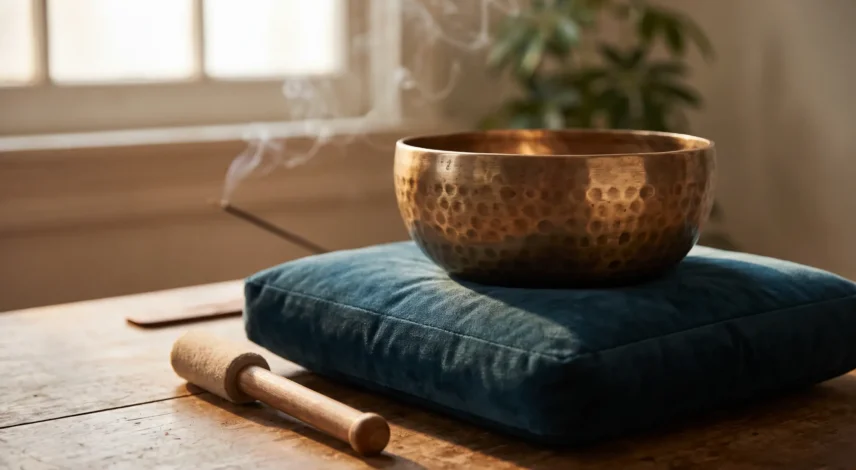

Struggling to pick a Tibetan singing bowl that sounds right when every listing claims to be “authentic”? Choose by purpose first, then run five checks: size, alloy, craftsmanship, sustain, and price. A Tibetan singing bowl is a bell-metal standing bell from Nepal and the Himalayas, struck or rimmed with a mallet for meditation. For most first-time buyers, a medium, hand-hammered bowl is the safest start.
At Potala Store, we source singing bowls from metalworking workshops in the Kathmandu Valley. Our founder, Yang Tso, first met them at puja ceremonies in Tibetan monasteries. The mistake we hear about most is buying on looks alone: an ornate etching or a “Full Moon” label, then a bowl that barely sings. Etching is surface work. It does not change the sound.
Want to compare as you read? Browse our handcrafted Tibetan singing bowls collection.
Singing bowls are traditionally used for meditation and relaxation. They are not medical devices, and nothing in this guide is health advice.
Table of Contents
What Should You Look for When Buying a Tibetan Singing Bowl?
Look for five things when buying a Tibetan singing bowl: a size that fits your purpose, a bell-bronze or traditional alloy, visible hand-hammer marks, a long, layered sustain, and a price that matches the craftsmanship. Define how you will use the bowl first, because purpose decides which check matters most.
- Size: match it to where and how you will play.
- Alloy: bell-metal bronze is the benchmark.
- Craftsmanship: hand-hammered marks beat machine-spun smoothness.
- Sustain: the tone should bloom, then fade slowly.
- Price: it should fit the size and the work involved.
Start With Your Purpose
Your purpose narrows the field faster than any other factor. Use this table as a starting point.
| Your purpose | Start with | Why |
|---|---|---|
| Daily meditation at home | Medium bowl, 6–7 in | Easy to play, fuller tone |
| Opening and closing a session | Small bowl, 4–6 in | Clear, bright bell signal |
| Group sound bath or yoga class | Large bowl, 10+ in | Fills a room |
| Altar, desk, or travel | Small bowl, about 3–5 in | Portable, fits small spaces |
| A meaningful gift | Small bowl, about 4–5.5 in | Fits any home |
The Five Checks That Shape a Bowl’s Voice
Each check changes what you actually hear. Size sets the pitch range, while alloy and hand hammering shape the overtones. Sustain shows how long the bowl holds its vibration. Price is your reality check, so it should match the other four.
If one check fails badly, such as a thin, short tone, do not let a beautiful design talk you out of it.
What Can a Singing Bowl Realistically Do?
A singing bowl is a mindfulness tool, not a treatment. Bowls are traditionally used to mark the start and end of meditation and to create a calm pause in your day.
In a 2017 observational study at UC San Diego, 62 adults (mean age 49.7) reported significantly less tension, anger, fatigue, and depressed mood after a bowl session. That study had no control group. A 2020 systematic review by Stanhope and Weinstein found only four eligible studies and said it could not yet recommend singing bowl therapies. It also called for stronger study designs.
A 2025 review of 19 clinical studies is more hopeful. It concluded that bowls may have potential to ease anxiety and depression and to improve sleep. The evidence is promising, but it is still unfinished.
For the bigger picture, read about what sound healing is and where Tibetan singing bowls fit.
What Size Singing Bowl Is Best for Beginners?
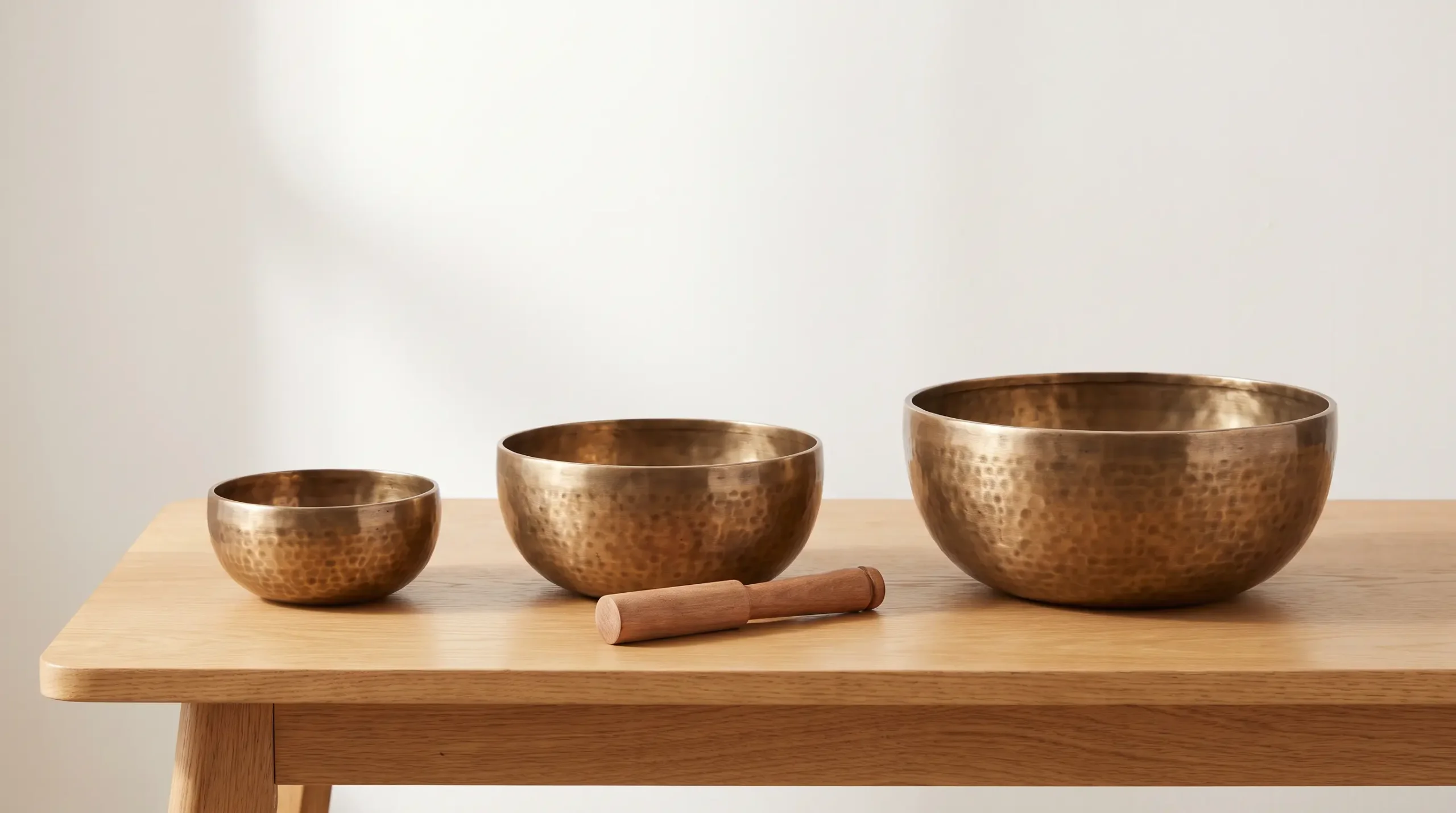
A medium bowl, roughly 6 to 7 inches across, is the usual recommendation for beginners because it balances volume, sustain, and ease of play. Smaller 4 to 6 inch bowls suit travel and quick session bells, while bowls over 10 inches fill a room but weigh several pounds.
Sellers do not draw size lines in the same place. Himalayas Shop points beginners to small bowls of 4.5 to 6 inches. Instruments du Monde calls 4.75 to 8 inches the all-purpose middle and treats anything above 8 inches as large. The overlap sits near 6 inches, which makes it a sensible middle ground.
Don’t worry about finding a “perfect” size. Choose 4 to 5.5 inches if you want portability and the lowest price, or 6 to 7 inches for a fuller tone. One bowl you enjoy is enough to start a steady practice, and you do not need a seven-bowl set.
Small Bowls (4–6 Inches)
Small bowls are light, portable, and bright. Sound Therapy Shop lists its 5 to 6 inch bowls at 1.2 to 1.6 lb, so you can hold one in your palm. The trade-off is less sustain and volume, so do not expect a room-filling hum from a palm-sized bowl.
Medium Bowls (7–10 Inches)
Medium bowls are the all-rounders. They respond well to both striking and rimming, and they work for meditation, yoga, and personal sound practice.
Weight climbs fast with diameter. Sound Therapy Shop lists 6 to 7 inch bowls at 1.7 to 2 lb and 8 to 9 inch bowls at 2.9 to 3.2 lb. Hold one for a minute before you commit, because a heavy bowl gets tiring in your hand.
Large Bowls (10+ Inches)
Large bowls give deeper tones, stronger vibration, and longer sustain, which suits group sessions and a sound bath. They need more storage space and often a larger mallet.
Bigger usually means deeper, but not always. Wall thickness, alloy, and shape also move the pitch, which is why a recording of the exact bowl beats a size guess.
Bell Bronze, Copper, or Seven Metals: Which Himalayan Bowl Material Sounds Best?
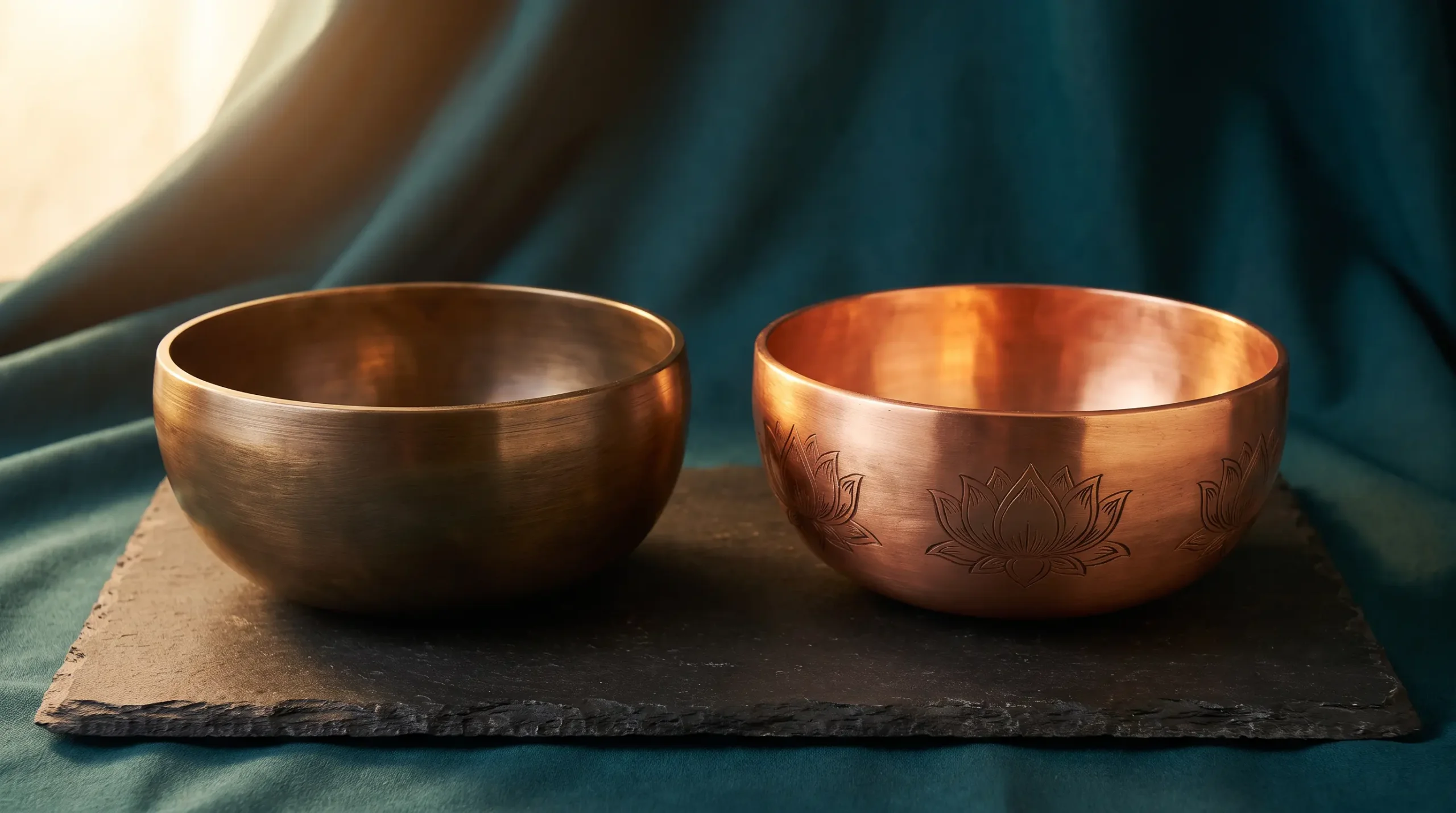
Bell-metal bronze, typically about 78% copper and 22% tin by mass, is the benchmark alloy for handmade singing bowls, prized for warm tones and long sustain. Copper and brass bowls cost less and can sound pleasant, but they usually give fewer layered overtones than a well-hammered bronze bowl.
Bell-Metal Bronze: The Benchmark
Bell metal belongs to the same family as temple bells and gongs. It is durable and resonant, and its tin content adds material cost, which is one reason good bronze bowls cost more than brass ones.
Bronze for bowls can also carry small amounts of zinc, iron, silver, gold, or nickel, according to a peer-reviewed physics study by Terwagne and Bush. The core is still copper and tin.
Copper and Brass: Friendlier Prices, Simpler Voice
Brass and other cheaper alloys are common in machine-made bowls. They are affordable, but they may lack the depth of bronze.
We will be straight with you. Our hand-etched Om Mani Padme Hum bowl is pure copper, not bell bronze, and all three bowls we list today are copper. It is a lovely starter or altar piece. It is not a sound-bath instrument.
The Seven-Metal Story: Tradition vs. Evidence
Many sellers describe a sacred alloy of seven metals: gold, silver, mercury, copper, iron, tin, and lead. Lab evidence is thin. Bodhisattva, a long-time bowl dealer, reports finding only one factory in 27 years that could supply an analysis showing seven metals.
Even the history is debated. Wikipedia’s entry on standing bells says that making bowls specifically to be sung, rather than struck like bells, is believed to be a modern phenomenon. Treat the seven-metal story as tradition, and ask the seller for the actual alloy.
How Can You Tell If a Singing Bowl Is Real?
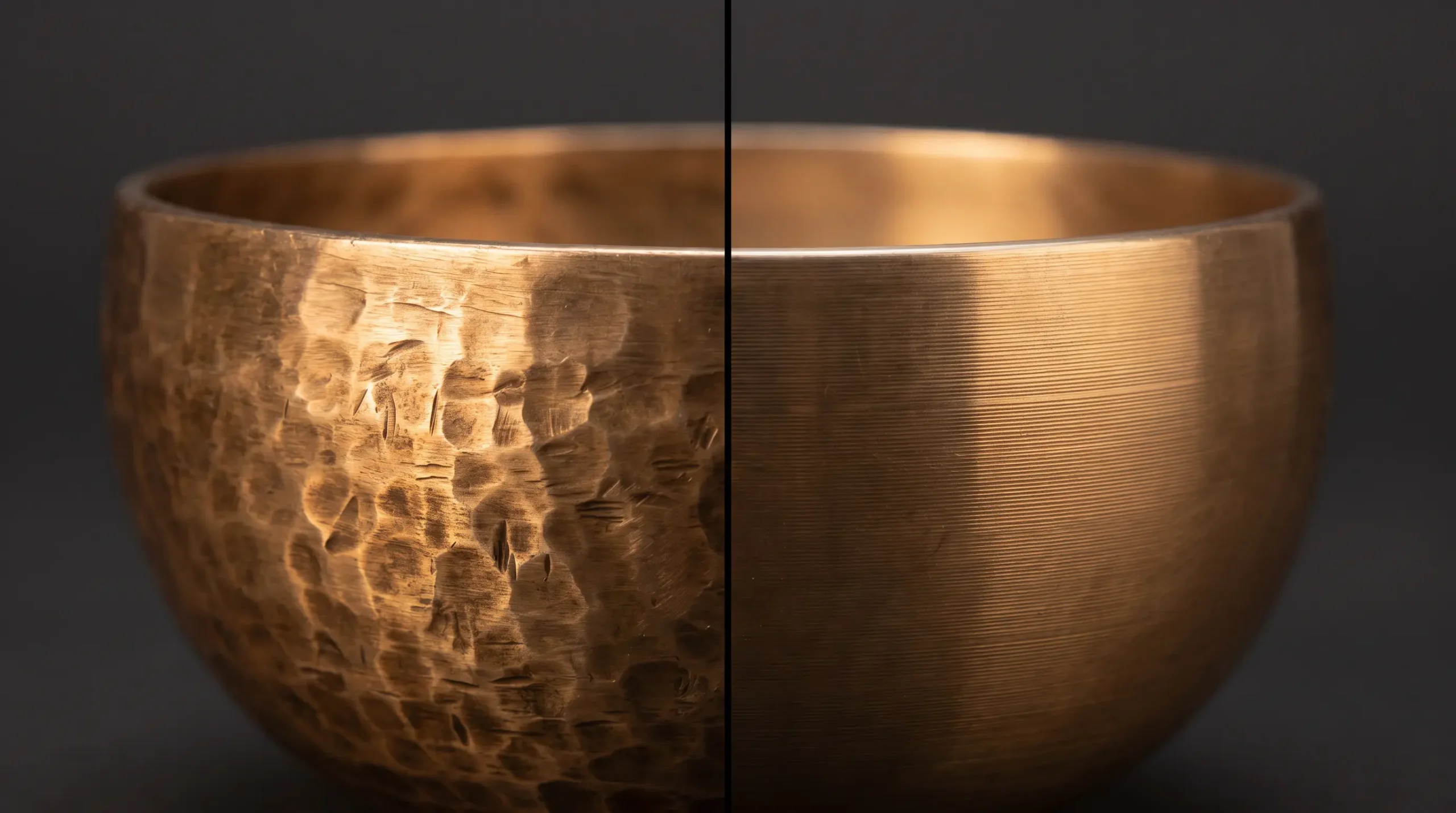
A genuine hand-hammered singing bowl shows uneven hammer dimples, slight variations in wall thickness, and a rich, layered tone that blooms and fades slowly. Perfectly smooth walls, lathe lines, or a single thin note that dies quickly usually point to a cast or machine-spun bowl.
Hand-Hammered vs. Machine-Made at a Glance
| Feature | Hand-hammered | Machine-made |
|---|---|---|
| Surface | Irregular dimples you can see and feel | Smooth and uniform, sometimes with lathe lines |
| Sound | Layered overtones, longer sustain | Simpler tone, shorter sustain |
| Designs | Hand-engraved, slightly uneven | Often cast or stamped |
| Price | Higher | Lower |
| Best for | Meditation and sound practice | Decoration and souvenirs |
Our 5-Minute Strike Test
You need the bowl, a wooden mallet, a phone stopwatch, and a quiet room. Total time: about 5 minutes.
- Set up (1 minute): Place the bowl on its cushion on a flat surface.
- Strike and time it (1 minute): Tap the outer wall with the padded end of the mallet and start the stopwatch. A good bowl rings for at least 15 to 20 seconds. In a 2023 lab study, a 10.2 inch Nepalese bowl rang for about 50 seconds.
- Rim the bowl (30 seconds): Circle the rim slowly with the bare wood end. Listen for a steady “sing” with no rattle, and lighten your pressure if it buzzes.
- Inspect (1 minute): Tilt the bowl toward a light. Look for irregular hammer dimples or fine, even lathe lines.
- Decide (1–2 minutes): Strike once more, close your eyes, and ask whether you would enjoy this sound every day. If the answer is no, send it back.
You can also read the shorter version of this check as the 5-minute singing bowl strike test in our Buddhist ritual items guide.
What Does a Bowl’s Frequency Really Tell You?
A singing bowl typically sounds between about 110 Hz and 660 Hz on the fundamental, and its overtones can reach the 800s or 900s. No bowl plays just one frequency. A peer-reviewed physics study measured one bowl with a 188 Hz fundamental. A 2023 study of a 10.2 inch (260 mm) Nepalese bowl found a fundamental of 482.61 Hz.
That gap shows why a note label alone is a weak guide. The second bowl also produced a gentle “wah-wah” beat frequency of 6.68 Hz, which faded over about 50 seconds. Listen to a recording of the exact bowl you plan to buy.
To see how bowls differ from single-pitch tools, read our singing bowl vs. tuning fork comparison.
How Much Does a Good Tibetan Singing Bowl Cost?
Expect to pay under $60 for a basic small metal bowl and $60 to $230 for a wide range of quality handmade bowls, with prices climbing as diameter grows. Be skeptical of an 8 inch hand-hammered bowl with detailed engraving priced under $60, because that combination is rarely realistic.
| Budget | What you typically get |
|---|---|
| Under $60 | Small metal bowls, often machine-made or simple copper |
| $60–$230 | The widest choice of quality handmade bowls |
| $230+ | Larger diameters, heavier hand-hammered bowls, premium finishes |
Matching Potala Store Bowls to Your Budget
These are the three singing bowls Potala Store lists today, with prices as shown on 11/12/2026. Check each listing for variants, diameter, and weight before you choose.
- Under $50: Our Om Mani Padme Hum copper singing bowl ($40.95 to $46.95) is hand-etched pure copper and ships with a wooden mallet. You can start playing on day one, and the low price lets you test whether a bowl fits your routine before you spend more. The mantra etching also suits an altar or desk.
- Under $75: The handmade 8 cm copper singing bowl set ($69.95, regularly $75.95) is a palm-sized bowl of about 3.1 inches, with a wooden striker and a red-gold brocade ring cushion. Strike it once to open your meditation and once to close it, right at your desk.
- Investment piece: The Lunar Rainbow Full Moon singing bowl ($289.95 to $499.95) is hand-hammered copper from Nepal, engraved with mantra script and a longevity symbol, and comes with a mallet and cushion. It is built for a dedicated home practice, and the price range reflects its size options.
Choosing a Singing Bowl as a Gift
If you are buying for someone else, a smaller bowl is the kinder choice. It fits any shelf and does not demand a big commitment. For a housewarming, a bowl around 4 to 5.5 inches is a safe pick.
Shopping during Black Friday or the holiday season? Add a short card that explains the strike, so the gift gets played instead of just displayed.
Tibetan Singing Bowl FAQs
Use chakra notes as a loose guide only. Handmade bowls sound several overtones at once, and sources do not agree on one frequency per chakra. Choose a tone that feels steady and pleasant to you.
Neither is better. Crystal bowls give a purer, single tone, while hand-hammered metal bowls give layered overtones and carry the Himalayan craft tradition. Crystal is also more fragile, so metal suits travel and daily handling.
Yes. Many people strike a bowl once to open and once to close a short daily meditation. Keep the bowl on its cushion, keep it dry, and wipe it with a soft cloth.
Pick one small or medium bowl with a mallet and cushion, then learn two moves: the strike and the rim. Our strike vs. rim method in our meditation starter kit guide explains both. Then browse the collection and compare sizes.
In summary, the best Tibetan singing bowl is the one that passes all five checks and that you would happily strike every morning. Run the 5-minute test, trust your ears over the label, and pick a size that fits your space.
Ready to hear the difference?
Use the five checks, run the 5-minute test, and choose the bowl you would strike every morning. Compare sizes, alloys, and prices side by side.Shop Tibetan singing bowls at Potala Store
Disclaimer: This article is for general information only. Singing bowls are traditionally used for meditation and relaxation and are not a substitute for professional medical or mental health care. If you have a health condition, talk to a qualified provider.
📚 References
Research
- Mood and tension after singing bowl meditation: Goldsby TL, Goldsby ME, McWalters M, Mills PJ. “Effects of Singing Bowl Sound Meditation on Mood, Tension, and Well-being: An Observational Study.” Journal of Evidence-Based Complementary & Alternative Medicine, 2017;22(3):401–406. A 62-participant observational study with no control group. PubMed Central
- Systematic review of health effects: Stanhope J, Weinstein P. “The human health effects of singing bowls: A systematic review.” Complementary Therapies in Medicine, 2020;51:102412. Four eligible studies, with a call for stronger designs. PubMed
- Newer systematic review: Cai Y, et al. “Therapeutic effects of singing bowls: A systematic review of clinical studies.” Integrative Medicine Research, 2025. Nineteen clinical studies and a cautious conclusion about potential benefits. ScienceDirect
- Bowl acoustics, fundamental and beat frequency: Kim S-C, Choi M-J. “Does the Sound of a Singing Bowl Synchronize Meditational Brainwaves in the Listeners?” International Journal of Environmental Research and Public Health, 2023;20(12):6180. Source for the 260 mm bowl, 482.61 Hz fundamental, and 6.68 Hz beat. PubMed Central
- Physics of Tibetan singing bowls: Terwagne D, Bush JWM. “Tibetan singing bowls.” Nonlinearity, 2011;24(8):R51–R66. Covers the bowl’s vibration modes and typical bronze alloy. IOPscience
Reference works and seller guides
- Standing bell history: Wikipedia, “Standing bell.” Background on bowls made to be sung versus struck. Wikipedia
- Bell metal composition: Wikipedia, “Bell metal.” Source for the classic copper and tin ratio. Wikipedia
- Seven-metal claims: Bodhisattva, “Exploring the Differences between Tibetan and Crystal Singing Bowls.” bodhisattva.com
- Size ranges used by sellers: Himalayas Shop, How to Choose a Singing Bowl, and Instruments du Monde, Tibetan Singing Bowl Size. Bowl weights are from Sound Therapy Shop product listings.