
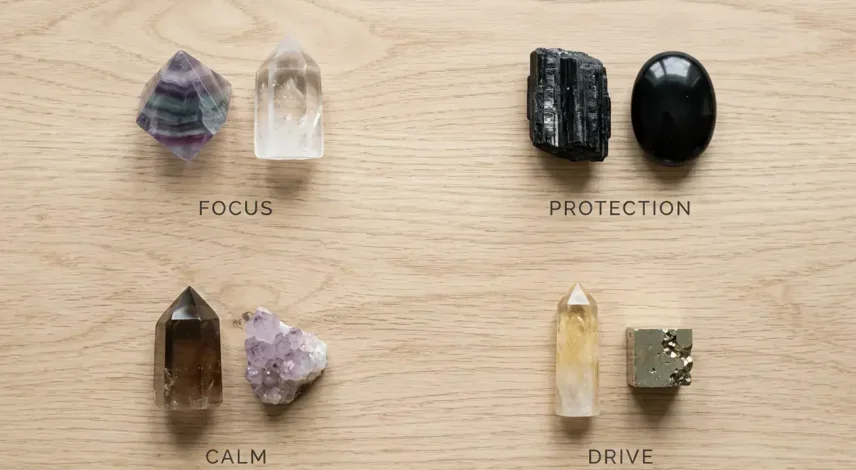

The best desk crystal is the one that matches your main work challenge: fluorite or clear quartz for scattered focus, black tourmaline for a draining office, citrine or pyrite for drive, and smoky quartz or amethyst for calm. Pick for the problem in front of you, not the prettiest stone in the shop.
You want a stone that actually helps you concentrate, and one that doesn’t look out of place next to your monitor. That is the real question most people are asking. For over a decade, Potala Store has worked alongside Himalayan artisans and monastery communities, and every piece in our monk-blessed crystals collection ships with a free Reiki blessing. This guide maps the top desk crystals to the work problem each one traditionally addresses, shows you where to place them, and covers a lower-key option for when a shared or formal office makes a crystal on display feel awkward.
Table of Contents
How to Choose a Desk Crystal (Start With Your Work, Not the Stone)
Choose a desk crystal by naming your biggest work frustration first, then pick the stone traditionally linked to it. Scattered attention, a draining open office, low confidence before a big meeting, and afternoon stress each point to a different stone. Working backward from the problem beats grabbing whatever looks nice, because a stone you actually reach for is worth more than a “perfect” one that sits ignored.
Size and durability matter more than people expect. For a desk, smaller is usually better: a tumbled stone, a palm stone, or a small tower reads as intentional decor rather than a display. Hardness decides how you store it. Fluorite sits at just 4 on the Mohs hardness scale, so it scratches easily and should stay away from harder stones, keys, and metal desk clutter. Quartz and tourmaline sit at 7 and shrug off daily desk life.
One more thing worth knowing before you buy: a blessed stone and an unblessed one look identical, so the difference is what it means to you. Every Potala Store piece passes through a monastery blessing before it ships, which many customers say makes the object feel like a genuine anchor rather than a paperweight.
Match the Stone to Your Work Challenge
This quick reference pairs the most common desk-crystal goals with a traditional pick and where to put it. Each section below expands on the “why.”
| Work challenge | Crystal | Best desk placement |
|---|---|---|
| Scattered focus | Fluorite, Clear Quartz | In your sightline, beside the monitor |
| Draining, noisy office | Black Tourmaline, Black Obsidian | At the desk edge, facing the door |
| Afternoon stress | Smoky Quartz, Amethyst | Within arm’s reach to hold |
| Low drive or confidence | Citrine, Pyrite, Tiger Eye | Far-left wealth corner |
Size, Shape, and Hardness for a Real Desk
Form changes how a stone fits your workspace, and price scales with size. A tumbled stone lives in a pocket or drawer, a palm stone is made to be held during a rough moment, and a tower stands upright as a visual focal point.
| Form | Typical price (USD) | Best for |
|---|---|---|
| Tumbled stone | $4–$8 | Holding, low-key desks, keeping in a drawer |
| Palm stone | $10–$20 | Grounding during tense calls |
| Tower | $10–$105 | An intentional focal point on the desktop |
| Cluster or raw piece | Varies | Radiating energy across the whole workspace |
New to crystals? You do not need to get the ritual right. Once you have picked one, here is how to actually put it to work:
- Place it where you will see it. Just below and to the right of your monitor works well, in the natural sightline for a quick break.
- Hold it and name one priority. Before your first task, pick it up, take a breath, and state the one thing you want to finish first.
- Reach for it instead of your phone. When your hand drifts toward the scroll, roll the stone between your fingers for ten seconds instead.
If you are still deciding where to begin, our 10 best crystals for beginners guide is a gentler starting point before you narrow down to a desk stone.
If Your Focus Keeps Scattering: Fluorite and Clear Quartz

When your focus keeps scattering across too many open tabs, two desk stones are traditionally recommended:
- Fluorite: often called the “Genius Stone,” it is linked to structured thinking and mental organization.
- Clear quartz: the all-purpose amplifier, used to hold a single intention while you work.
Fluorite is a banded calcium fluoride crystal that forms in purple, green, blue, and clear layers. Across Chinese, European, and North American traditions, fluorite is the stone people reach for when focus keeps scattering, which is why practitioners recommend it for studying, planning, and organizing. Rainbow fluorite is the most popular desk variety because the color banding gives your eyes something worth resting on between screen sessions. Remember the hardness of 4, and keep it clear of harder desk objects.
Clear quartz is pure silicon dioxide and the most common crystal on Earth. It is also piezoelectric, the same property that lets quartz keep time in your watch and computer. In nearly every tradition it is described as an amplifier, meaning it is used to intensify whatever intention you bring to it. In practice, that translates to holding the stone while stating a single work goal, so the crystal becomes a physical cue for the task. The banded color in fluorite and the tiny inclusions inside clear quartz both make good ten-second visual resets that pull your attention back.
A quick honesty note from selling these for years: a flawless, perfectly clear, very cheap “quartz” point is often just smelted glass. Natural quartz almost always shows small inclusions or veils inside when you hold it up to your desk lamp.
Fluorite, the “Genius Stone” for Mental Clutter
Keep a fluorite octahedron or polished piece where you can see it, and let the color banding serve as your micro-break object. Its traditional link to structured thinking makes it the classic pick for deep-work blocks, and its calm visual weight gives scattered attention a place to reset without the jittery edge of another coffee.
Clear Quartz, the All-Purpose Focus Amplifier
If you are not sure what you need, clear quartz is the safe starting point, and it pairs well with any other stone you add later. Prefer to wear your focus stone rather than display it? Our gold Buddha mantra bracelet with 8mm crystal beads keeps clear crystal on your wrist through back-to-back meetings, no desk space required.
If Your Office Feels Draining: Black Tourmaline and Black Obsidian
Black tourmaline is the stone traditionally kept near a computer as an EMF and boundary buffer. In open-plan offices, where anyone can see and interrupt you, practitioners place it at the edge of the desk or facing the door to mark where their focus space begins and distractions end.
Black tourmaline has the most complex chemistry of any common desk stone. It is both piezoelectric and pyroelectric, generating a tiny electrical charge under pressure or a change in temperature. Those are measurable physical facts, and they sit underneath the old folk reputation of tourmaline as an energetic filter. Dutch traders in the 1700s even called warmed tourmaline “aschentrekker,” the ash puller, because it attracted ash from their pipes.
Black obsidian is natural volcanic glass, traditionally used to absorb negativity and surface hidden truths during deep emotional work. It is a grounding, understated choice for a chaotic workspace, and it looks intentional rather than flashy on a desk.
Here is the honest limit. In our experience, customers describe black tourmaline as a steadying background presence, not a jolt you will feel. Potala Store does not currently stock a single-stone black tourmaline piece, so our closest everyday-protection picks sit in the Attract Protection collection. For a fuller breakdown, see our guide to the best crystals for protection from negative energy.
Black Tourmaline, the Boundary and EMF Stone (and Its Honest Limits)
Set a raw, striated tourmaline piece at the outer edge of your workspace, facing the room. At a hardness of 7, it handles daily desk life without damage, and the triangular cross-section is visually distinctive. Treat it as a perimeter marker for your attention rather than a device that will change how you feel in an instant.
Black Obsidian, Grounding for a Noisy Workspace
Black obsidian absorbs negative energy within arm’s reach of your keyboard, which is why it is a common pick for a desk near heavy foot traffic or constant notifications. Its glassy black surface stays discreet in a corporate setting while giving your workspace a grounded, settled edge.
If Stress Builds by Afternoon: Smoky Quartz and Amethyst
When tension builds through back-to-back meetings, smoky quartz is the stone traditionally held to ground and release it. Where tourmaline creates a boundary against outside distraction, smoky quartz addresses the internal noise of unread emails and looming deadlines.
Smoky quartz gets its warm brown color from natural radiation acting on aluminum in the crystal lattice, and that color is stable. Smoky quartz holds its color in daylight, so it stays safe on a sunny windowsill where amethyst would slowly fade. Holding a cool, heavy, polished piece and noticing its weight and texture redirects attention from stress toward simple sensory input, a technique borrowed straight from grounding practice.
Amethyst is a calming purple quartz used for clarity and steadier decisions. It is the “take a breath before you reply to that email” stone, useful when work turns emotionally charged and you would rather respond than react. A small cluster radiates energy outward into the space and doubles as genuinely pretty desk decor.
A mistake we see often: people leave amethyst on a bright windowsill for months, and the purple dulls because amethyst fades under sustained sunlight. Smoky quartz does not have that problem, so it is the safer pick for a desk that catches direct light. If restless hands are part of your stress response, a stress relief spinner gives them something to do during a tense call.
Smoky Quartz, Grounding and Light-Stable Near a Window
Keep a polished smoky quartz point on your desk surface, within arm’s reach for the moments you need to hold something solid. Its warm brown tone complements most office palettes without drawing attention, and its light stability makes it one of the few stones that stays put on a sunlit sill.
Amethyst, Calm Before You Hit “Reply”
Amethyst supports clearer thinking when a workday turns reactive, which makes it a steady companion for anyone who manages people or difficult conversations. Place a small cluster where you can glance at it before responding to a charged message, and let the pause it prompts do the work.
If You Need Drive and Momentum: Citrine, Pyrite, and Tiger Eye

For confidence and momentum, three desk stones stand out: citrine for drive, pyrite for nerve, and tiger eye for decisions. Each targets a different part of getting started on work you have been avoiding.
Citrine has been called the “Merchant’s Stone” for over a century, and the practice of keeping it near a till or cash register is remarkably consistent across cultures. Placed in the far-left wealth corner of your desk, citrine is the traditional choice for projects that need sustained motivation rather than a quick spark. One buying note that saves disappointment: natural citrine is a pale, honey-yellow color and is genuinely uncommon, while most bright-orange “citrine” on the market is heat-treated amethyst. Our natural citrine money and wealth crystal tower is unheated, keeps that genuine pale-honey color with its natural feather inclusions, and is blessed by monastery monks before it ships. Standing upright, it directs energy upward from the wealth corner, which gives your money or goal focus a bright, visible anchor all day rather than a number buried in a spreadsheet.
Pyrite forms near-perfect natural cubes of iron disulfide, and its metallic gleam is traditionally linked to confidence and decisive action. Keep a pyrite cube where you see it, and hold it before an important negotiation or presentation to settle the nerves that make you hold back. It doubles as the most reliable conversation starter on any desk.
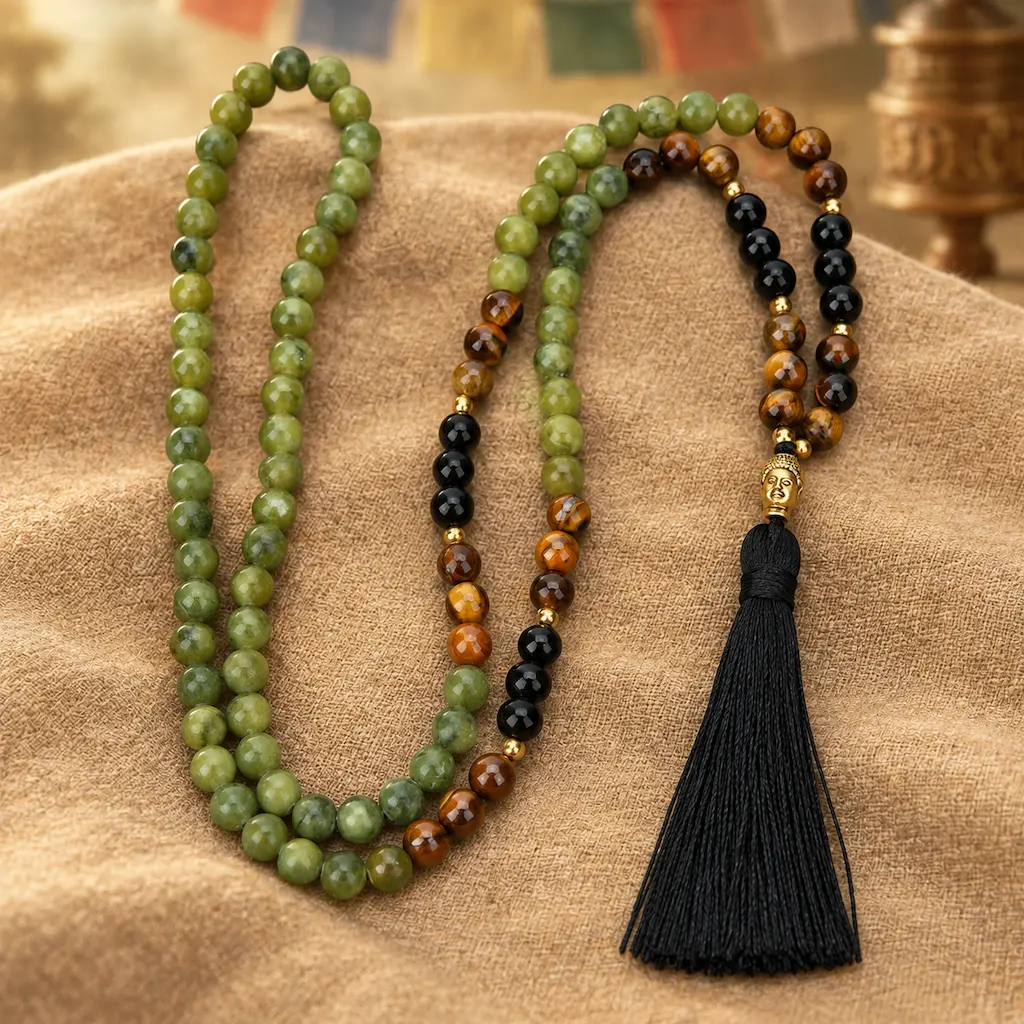
Tiger eye shows chatoyancy, a moving band of light across its surface, and Potala Store’s version uses 10mm beads. Where fluorite is for analysis and citrine is for motivation, tiger eye is traditionally the stone for the decision itself, the moment you have three good options and need to commit to one. Rolling a polished piece between your fingers is exactly the kind of tactile grounding that helps with decision anxiety, and our 10mm tiger eye fortune bracelet lets you carry that steady, decisive feeling into every meeting without putting anything on a shared desk. To browse more stones traditionally tied to drive and achievement, explore the Attract Success collection.
Citrine, the “Merchant’s Stone” (Natural vs. Heat-Treated)
Natural citrine carries a pale champagne-yellow tone, so if a stone is a deep burnt orange over a white base, it almost certainly started life as Brazilian amethyst. Both are beautiful, and both are fine to keep on a desk. Knowing which one you are buying simply means you pay the right price and get the color you expected.
Pyrite, Confidence Before the Big Meeting
Pyrite exudes confidence when it is visible and within reach, so keep a cube front and center rather than tucked in a drawer. Hold it for a moment before a challenging call to activate its traditional link to assertiveness and initiative.
Tiger Eye, for Decisions You Keep Putting Off
Tiger eye supports practical judgment when you are weighing trade-offs, which is its specific traditional strength. Keep a tumbled piece or wear it as a bracelet, and reach for it when a choice you have been avoiding finally needs a decision.
Where to Place a Crystal on Your Desk (Feng Shui Basics)

In feng shui, the far-left corner of your desk, seen from your chair, is the traditional wealth corner, where citrine and pyrite are often placed. The second key spot is the command position, meaning a place where you can see the door, which is where grounding stones like black tourmaline and smoky quartz tend to go.
Form guides placement too. A tower directs energy upward and works as a focal point, a cluster radiates energy outward across the whole workspace, and a palm stone is meant to be picked up and held. A simple, balanced desk setup uses three stones with different jobs: one grounding stone at the edge, one calming stone within reach, and one clarity stone in your sightline.
You do not have to believe in feng shui for this to help. Treat the placement as a consistent spot your eyes land on when you look up from the screen, and the visual cue does its job either way. If you want to map the corners properly, a feng shui Bagua map shows exactly where the wealth and career areas fall on your desk. For a ready-made wealth-corner piece, our blessed chakra money tree ornament is designed to sit in that far-left area.
The Wealth Corner and the Command Position
The wealth corner sits at the far-left of your desk from where you sit, and it is the traditional home for abundance stones like citrine. The command position is any spot where your back is not to the door, and grounding stones placed there reinforce a sense of steadiness and control over your workspace.
Tower, Cluster, or Palm Stone: Which Form for Which Spot
A tower stands upright and anchors a corner as a visual focal point, so it suits the wealth corner or the back of your desk. A cluster radiates outward and works best in an open central spot, while a palm stone belongs within arm’s reach so you can actually hold it during the day.
Prefer Not to Display One? Wear It Instead
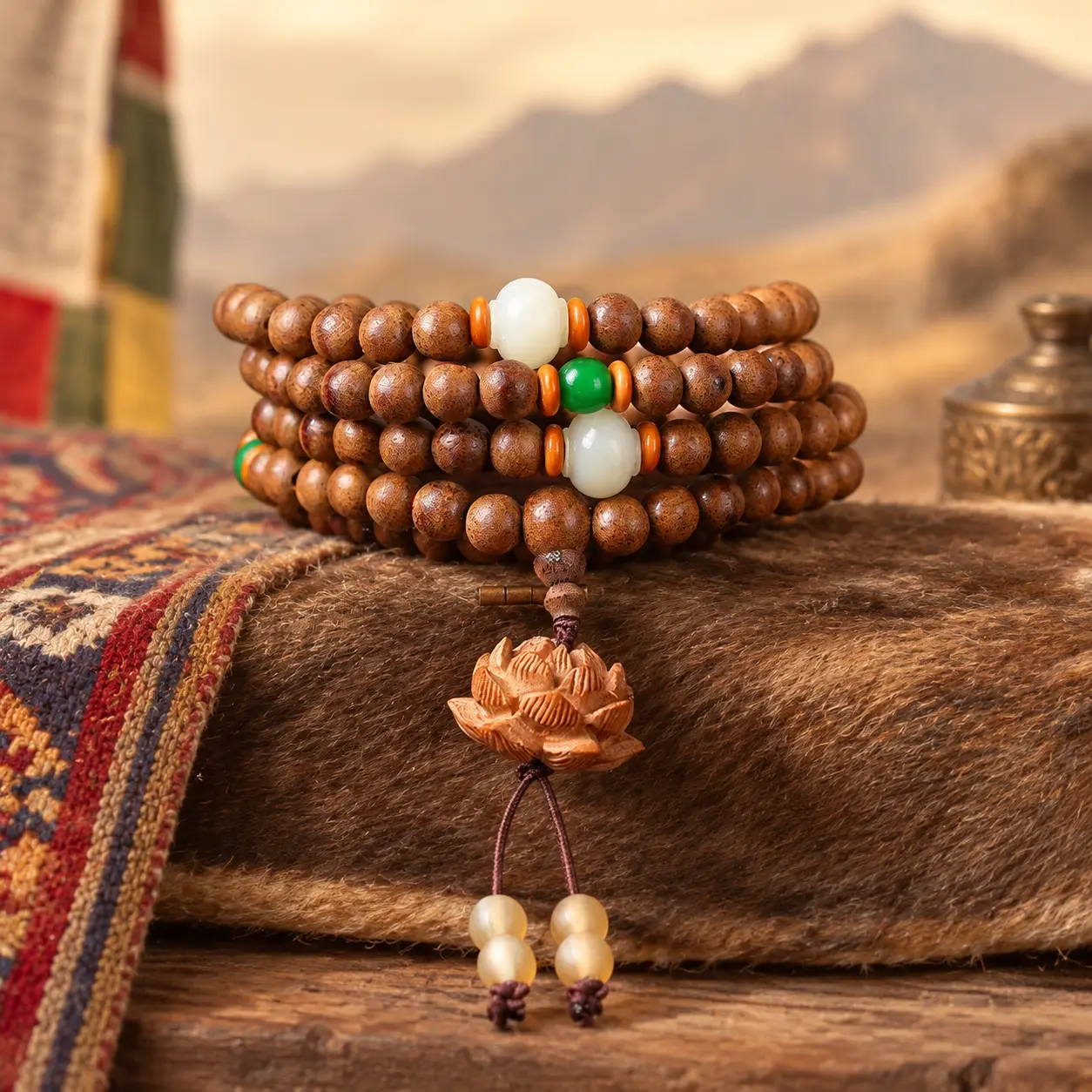
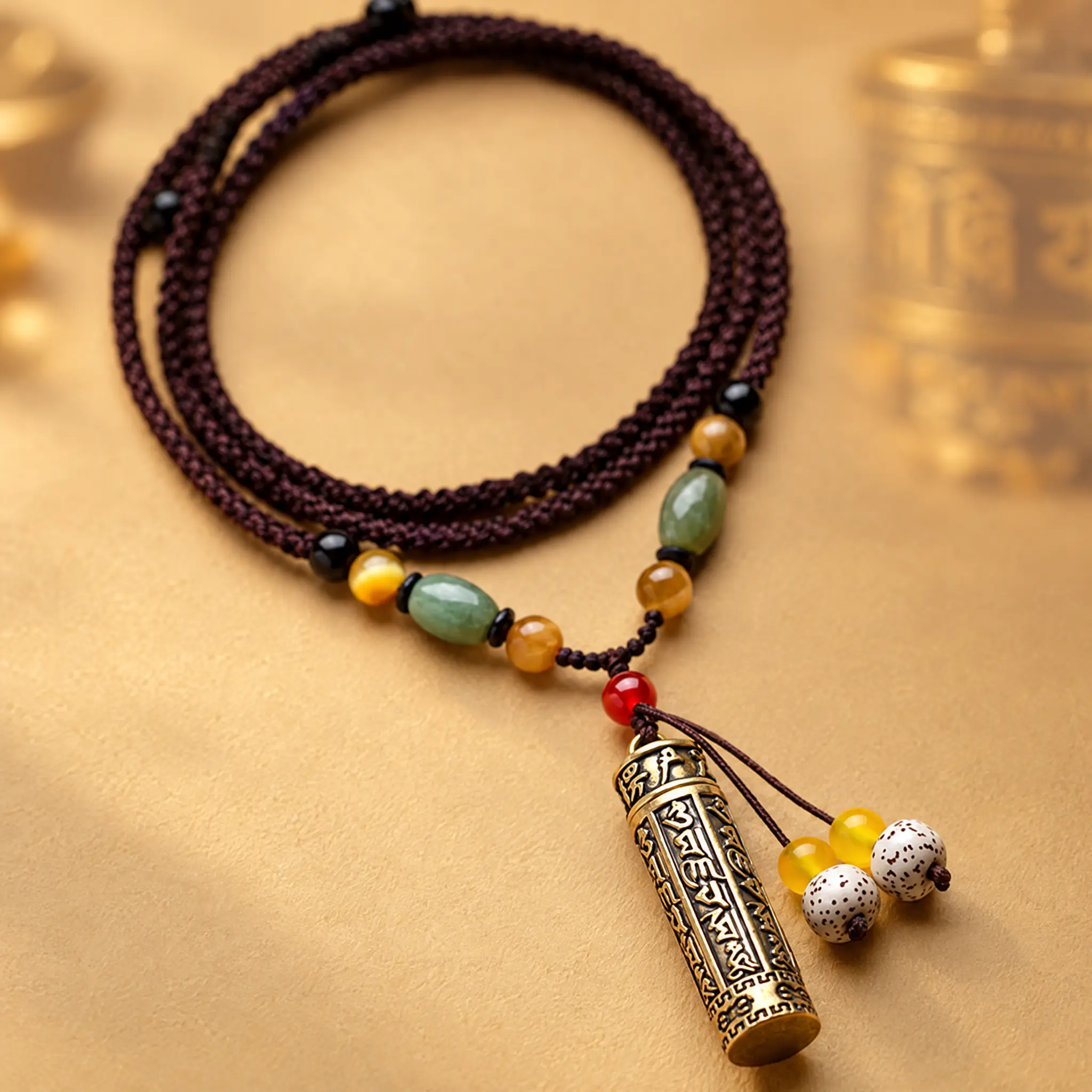
If a shared or formal desk makes a crystal on display feel awkward, wear one instead. A bracelet keeps the stone with you all day, with nothing to explain to a curious coworker. This is the most discreet option for open offices and client-facing roles, and it means the stone travels between meetings with you.
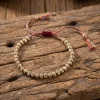
Traditionally, a crystal bracelet is worn on the left wrist to draw energy inward and on the right wrist to send that energy outward into the world. Bead size is a comfort and visibility choice: 8mm beads are the everyday-comfortable standard, while 10mm reads a little bolder. Match the stone to the same needs covered above, so tiger eye supports decisions and clear crystal supports focus, worn rather than placed.
From selling in real workplaces, we have found a bracelet draws far fewer questions than a stone sitting on a shared desk, which matters in a formal office. It also solves a common gifting problem. You do not want to hand a colleague something that reads as too witchy, and a simple beaded bracelet is the safer, more giftable pick. Our Piyao jade bracelet is a discreet, wearable option, and if you are unsure which stone fits, our guide to which crystal bracelet is right for you walks through it by intention.
Why a Bracelet Works at a Shared or Formal Desk
A bracelet keeps your chosen stone with you without claiming any desk space, so it suits hot desks, client meetings, and conservative offices. It carries the same traditional properties as a loose stone while staying completely unremarkable to anyone who notices it.
Left Wrist or Right Wrist? (And Bead Size)
Wear the bracelet on your left wrist to absorb a stone’s properties inward, following the traditional idea of the left as the receiving hand. Choose 8mm beads for all-day comfort under a shirt cuff, or 10mm if you want the stone to be a visible part of your look.
The takeaway: match one desk crystal to your biggest work challenge, keep it where your eyes land, and wear it as a bracelet if a shared office makes a display feel out of place. The stone is a cue for your attention, not a substitute for good work habits.
Set Up Your Desk With Intention
Every Potala Store crystal is Himalayan-sourced and ships monk-blessed with a free Reiki blessing. Find the stone that fits how you actually work.Shop the Crystals Collection Find Your Fit
⚠ Important note: The information about spiritual and energy properties on this page reflects traditional beliefs and customer experiences, not scientific or medical fact. Crystals are not a substitute for professional medical or mental-health care, and nothing here is intended to diagnose, treat, or cure any condition.
Frequently Asked Questions
Crystals are not a substitute for good work habits. Many people find that keeping one specific stone on the desk works as a visual anchor, a small cue to pause, reset, and refocus during a hectic day. Think of it as a focus prompt, not magic.
It depends on your main challenge: fluorite or clear quartz for scattered focus, black tourmaline for a draining office, citrine or pyrite for drive, and smoky quartz or amethyst for calm. If you want one all-purpose starting point, clear quartz is the safe pick.
The simplest method is to rest them on or beside a selenite plate overnight. Desk crystals, especially protective stones, pick up a lot over a workweek, so cleansing every week or two is a good habit. A soft, dry cloth also keeps them free of dust and hand oils.
Yes, and the trick is discretion. A small tumbled stone, a polished tower, or a crystal bracelet reads as intentional desk decor rather than anything witchy. If you would rather not display one at all, wearing a bracelet keeps the stone with you with zero explanation.
📚 References
- Gemstone Properties and Hardness: Education on gemstone identification, durability, and the Mohs hardness scale. Gemological Institute of America (GIA)
- Tourmaline, Piezoelectric and Pyroelectric Behavior: Overview of tourmaline mineralogy and its documented electrical properties. Encyclopaedia Britannica
- Mineral Data for Fluorite, Quartz, and Citrine: Reference database for crystal chemistry, formation, and localities. Mindat.org
- Workplace Wellness and Biophilic Design Trends: Research on natural objects and well-being in work environments. Global Wellness Institute