
Manjushri, Medicine Buddha or Avalokiteshvara: Which Pendant for Study, Health or Compassion?
 by Yang Tso
0 comments
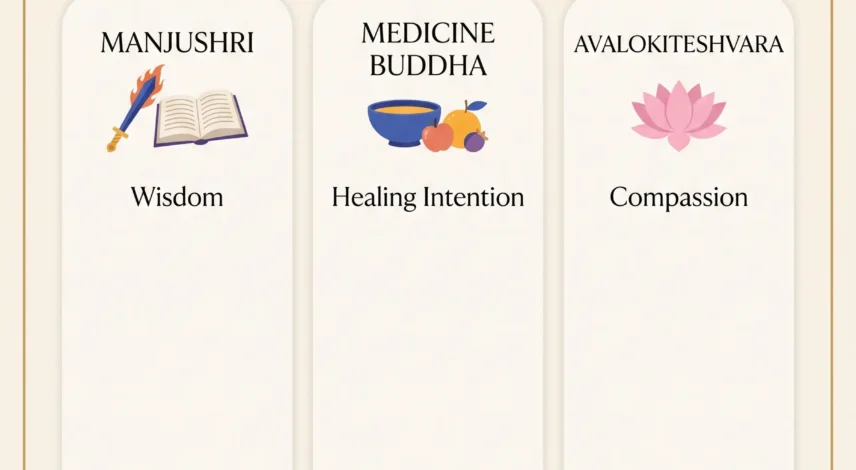
Manjushri suits study and clear decisions, the Medicine Buddha holds a health intention, and Avalokiteshvara stands for compassion. That is the short answer if you are choosing a Tibetan Buddhist pendant among these three figures for meditation, school, caregiving or a gift.
Shoppers often hold two thangka pendants side by side and ask, “Aren’t these the same Buddha?” They are not. At PotalaStore, we hear that question often, so this guide matches each figure to a real need instead of just listing symbols.
By the end, you can recognize each figure in 10 seconds and choose with three simple questions. One caution first: a Medicine Buddha pendant symbolizes a healing wish and is not a medical treatment.
Table of Contents
Manjushri vs. Medicine Buddha vs. Avalokiteshvara: Which Pendant Fits Your Intention?

Choose Manjushri for study and decisions, the Medicine Buddha for a health intention, and Avalokiteshvara for compassion; the table below shows how they differ.
Quick Comparison Table: Wisdom, Healing, Compassion
| Feature | Manjushri | Medicine Buddha | Avalokiteshvara |
|---|---|---|---|
| Best for | Study, writing, big decisions | A health intention for yourself or a loved one | Kindness, patience, emotional resilience |
| Core quality | Wisdom (prajna) | Healing as an aspiration | Infinite compassion |
| Figure type | Bodhisattva | Buddha | Bodhisattva |
| Key symbol | Flaming sword and Perfection of Wisdom sutra on a lotus | Lapis-blue body, medicine bowl, myrobalan fruit | Lotus, crystal mala, four arms or a thousand arms |
| Mantra | Om A Ra Pa Tsa Na Dhih | Tayata Om Bekandze Bekandze Maha Bekandze Radza Samudgate Soha | Om Mani Padme Hum |
| Who it suits | Students, writers, professionals facing choices | Caregivers, healthcare workers, people supporting someone through illness | Anyone in a season of burnout, grief or heavy responsibility |
| Variant name on the thangka pendant | Manjushri Bodhisattva | Medicine Buddha | Four-Armed Avalokiteshvara |
See all three on one piece: The Tibetan Thangka Buddha Pendant Necklace lists each figure among its 16 hand-painted variants. Price checked on 10/28/2026: $68.95, down from $93.95.
How Can I Tell Which Buddha Is on My Pendant?
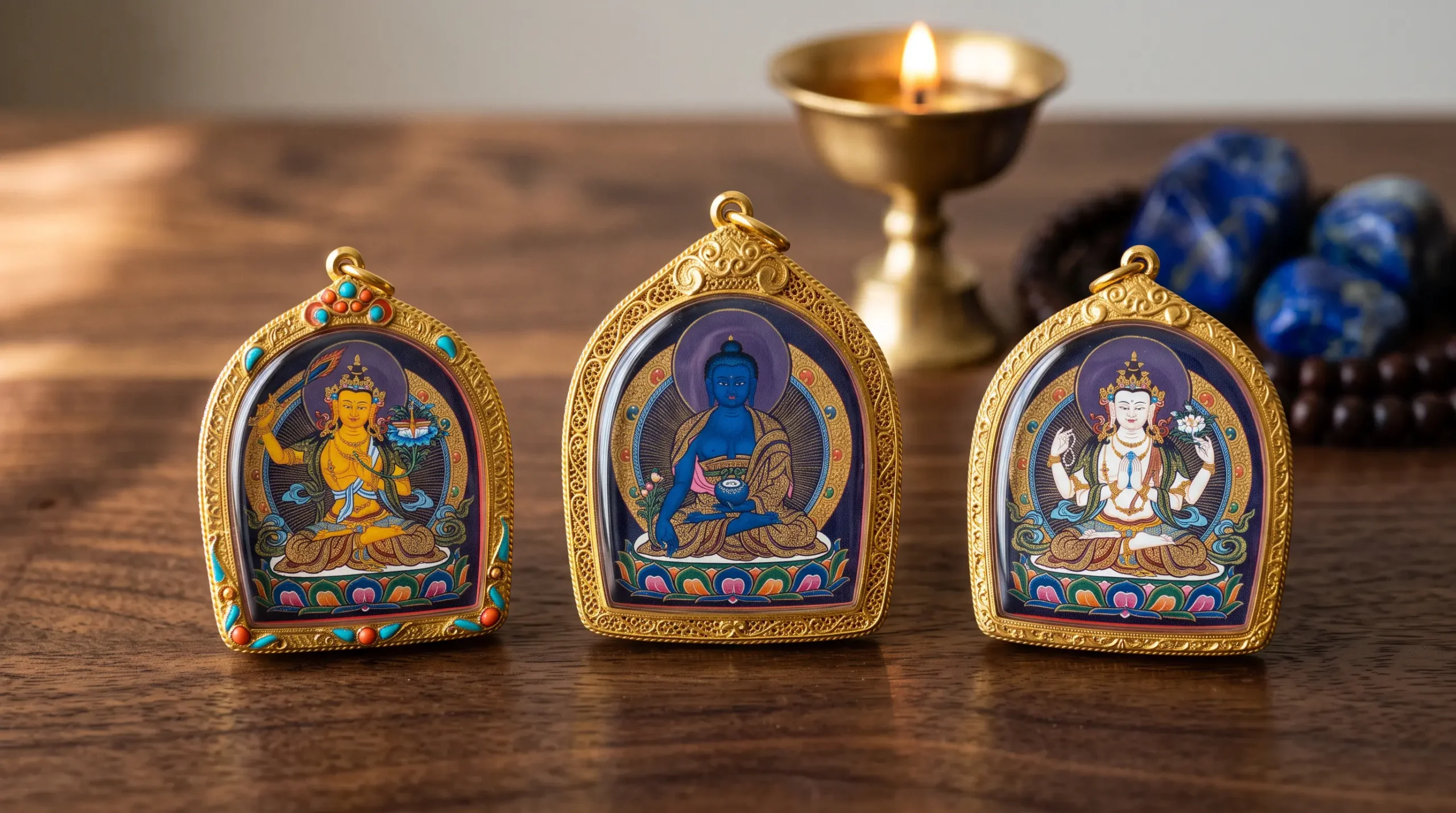
Look at the hands first: a sword means Manjushri, a bowl means the Medicine Buddha, and a lotus or extra arms usually mean Avalokiteshvara.
Body color confirms it. A seated blue figure is the Medicine Buddha. A pale, four-armed figure is Chenrezig, the Tibetan form of Avalokiteshvara.
Tibetan tradition groups Manjushri and Avalokiteshvara with a third figure, Vajrapani, as the Lords of the Three Families, which stand for wisdom, compassion and power. The Medicine Buddha sits in a different category because he is a Buddha, not a bodhisattva. To compare them in person, open the hand-painted 3D Thangka Buddha pendant and switch between variants.
Manjushri: The Bodhisattva of Wisdom Behind Study and Clear Decisions
A Manjushri pendant represents wisdom: the bodhisattva raises a flaming sword to cut through confusion and holds the Perfection of Wisdom (Prajnaparamita) sutra on a lotus, which makes him the traditional choice for students, writers and anyone facing a big decision.
The Sword and the Sutra: Reading Manjushri’s Iconography
Manjushri’s right hand lifts a flaming sword that cuts through ignorance. His left hand supports a lotus carrying the Prajnaparamita sutra, the text on perfect wisdom. Tibetans call him Jampelyang.
His mantra, Om A Ra Pa Tsa Na Dhih, ends on the syllable Dhih, which practitioners traditionally chant to sharpen understanding. The Rubin Museum of Himalayan Art holds a Manjushri from Situ’s set of the Eight Great Bodhisattvas, which shows how central he is to Tibetan art.
Which Buddha Pendant Is Best for Studying?
For students, writers and anyone facing a big decision, Manjushri is the traditional choice, as a focus cue and not a shortcut to an A.
Picture finals week. You touch the pendant, name your intention for the session, and start a 25-minute study block. The sword imagery gives that small ritual a clear meaning: cut the distraction, keep the task.
That cue makes starting easier on days when you do not feel like it. No pendant raises a test score, so treat it as a reminder and keep doing the work.
Pros and Limits of a Manjushri Pendant
- Pro, clear imagery: The sword and sutra are easy to explain and easy to remember.
- Pro, graduation gift: The meaning fits exams, new jobs and career changes.
- Limit, wisdom over comfort: If you need emotional support more than clarity, Avalokiteshvara may fit better.
- Limit, no shortcut: A pendant supports focus. It does not replace studying.
What Does a Medicine Buddha Pendant Mean?
A Medicine Buddha pendant carries the image of Bhaisajyaguru, the blue Buddha of healing in Tibetan Buddhism, and traditionally expresses a wish for health and care rather than a medical claim. He is painted deep blue and holds a medicine bowl.
Blue Body, Medicine Bowl, Myrobalan: What the Image Shows
The Medicine Buddha, called Bhaisajyaguru in Sanskrit and Sangye Menla in Tibetan, is painted the deep blue of lapis lazuli. His left hand supports a bowl of healing nectar. His right hand holds a myrobalan fruit, which Tibetan medical tradition regards as a universal remedy.
Tibetans also call him Menla Gyelpo, the King of Medicine. The Rubin Museum describes an 18th-century Mongolian copper-alloy sculpture of him and notes that traditional Tibetan doctors often keep his image in their homes and offices as the source of their knowledge.
The Medicine Buddha Sutra records his Twelve Vows to relieve suffering. His mantra, Tayata Om Bekandze Bekandze Maha Bekandze Radza Samudgate Soha, is traditionally recited for the benefit of the sick.
Who Wears a Medicine Buddha Pendant?
Caregivers, nurses and people supporting someone through illness often choose the Medicine Buddha as a daily reminder of patience and care. If someone you love is sick, this pendant can be a way to carry your wish for them.
It does not change a medical outcome. Many wearers describe it as a quiet anchor during long hospital days. For a wider look at protective jewelry in Tibetan practice, read our guide to Tibetan Buddhist protection amulets and their meanings.
What a Medicine Buddha Pendant Can’t Do
A Medicine Buddha pendant is not a treatment and does not replace medical care. In Tibetan practice, healing is an aspiration you hold, not a promise the jewelry makes.
⚠️ Important Note: The meanings described here come from traditional Tibetan Buddhist beliefs, not scientific evidence. This content is for educational purposes and should not replace professional medical advice. If you or someone you love is unwell, please talk to a licensed clinician.
Avalokiteshvara: Compassion, Chenrezig and Guanyin Explained
Avalokiteshvara is the bodhisattva of infinite compassion, known as Chenrezig in Tibet and Guanyin in China, and an Avalokiteshvara pendant is traditionally worn as a reminder to meet suffering with kindness.
Chenrezig, Guanyin, Kannon: Is Guanyin the Same as Avalokiteshvara?
Yes. Avalokiteshvara is the Sanskrit name, Chenrezig the Tibetan name, and Guanyin the Chinese form of the same bodhisattva of compassion, called Kannon in Japan. Guanyin is a bodhisattva, not a Buddha.
Britannica describes him as the bodhisattva of infinite compassion and mercy, among the most popular figures in Buddhist legend. He reached Tibet in the 7th century. Tibetan tradition regards each Dalai Lama as his successive rebirth.
His six-syllable mantra, Om Mani Padme Hum, is among the most widely recited in Tibetan Buddhism. The Metropolitan Museum of Art presented him with Manjushri and Vajrapani in its exhibition on bodhisattvas of wisdom, compassion and power, and noted that the three played an essential role in bringing Buddhism to Tibet.
Four-Armed vs. Thousand-Armed: Which Form Should I Choose?
Four-Armed Chenrezig is the classic Tibetan form; the Thousand-Armed form pictures help reaching out in every direction.
In the four-armed form, two hands join at the heart in a prayer gesture (mudra) around a wish-fulfilling jewel. The other two hold a crystal mala and a white lotus. Our thangka pendants show the Four-Armed form, and the Citrine Guardian Buddha pendant shows Thousand-Armed Guanyin.
Who Should Wear Avalokiteshvara?
Burned-out nurses, social workers and people moving through loss often pick Avalokiteshvara for the kindness it symbolizes. Think of the pendant as a reminder to be as patient with yourself as you are with others.
It suits anyone carrying heavy responsibility for other people. It is not a substitute for counseling or medical care.
Choose Your Deity in 3 Questions: Goal, Season of Life, Recipient
Ask these three questions:
- What do you need most right now? Focus and clear decisions point to Manjushri. A health intention points to the Medicine Buddha. Steadier kindness points to Avalokiteshvara.
- What season of life are you in? Exams or career moves suit Manjushri. Caring for someone who is ill suits the Medicine Buddha. Burnout or grief suits Avalokiteshvara.
- Is it for you or a gift? Match the gift to the recipient’s current need, and choose a listing that names the figure so they know who it is.
Which Buddha Pendant Is Right for You?
Pick the figure tied to what you will actually do each day. If you study every night, choose Manjushri. If you spend your days caring for someone, choose the Medicine Buddha. If you spend them supporting others, choose Avalokiteshvara.
When two figures both feel true, choose the one you would be glad to be reminded of at 7 a.m. on a hard morning.
Should I Match My Pendant to My Zodiac Instead?
You can, and zodiac matching is a separate tradition. In the Chinese zodiac system, Manjushri guards the Rabbit and Thousand-Armed Avalokiteshvara guards the Rat, but the Medicine Buddha is not one of the eight guardian Buddhas.
If your birth year points to a different figure, our guide to your Guardian Buddha by birth year explains the full pairing.
Thangka, Ga Wu Box or Carved Crystal: Which Style Fits Daily Wear?
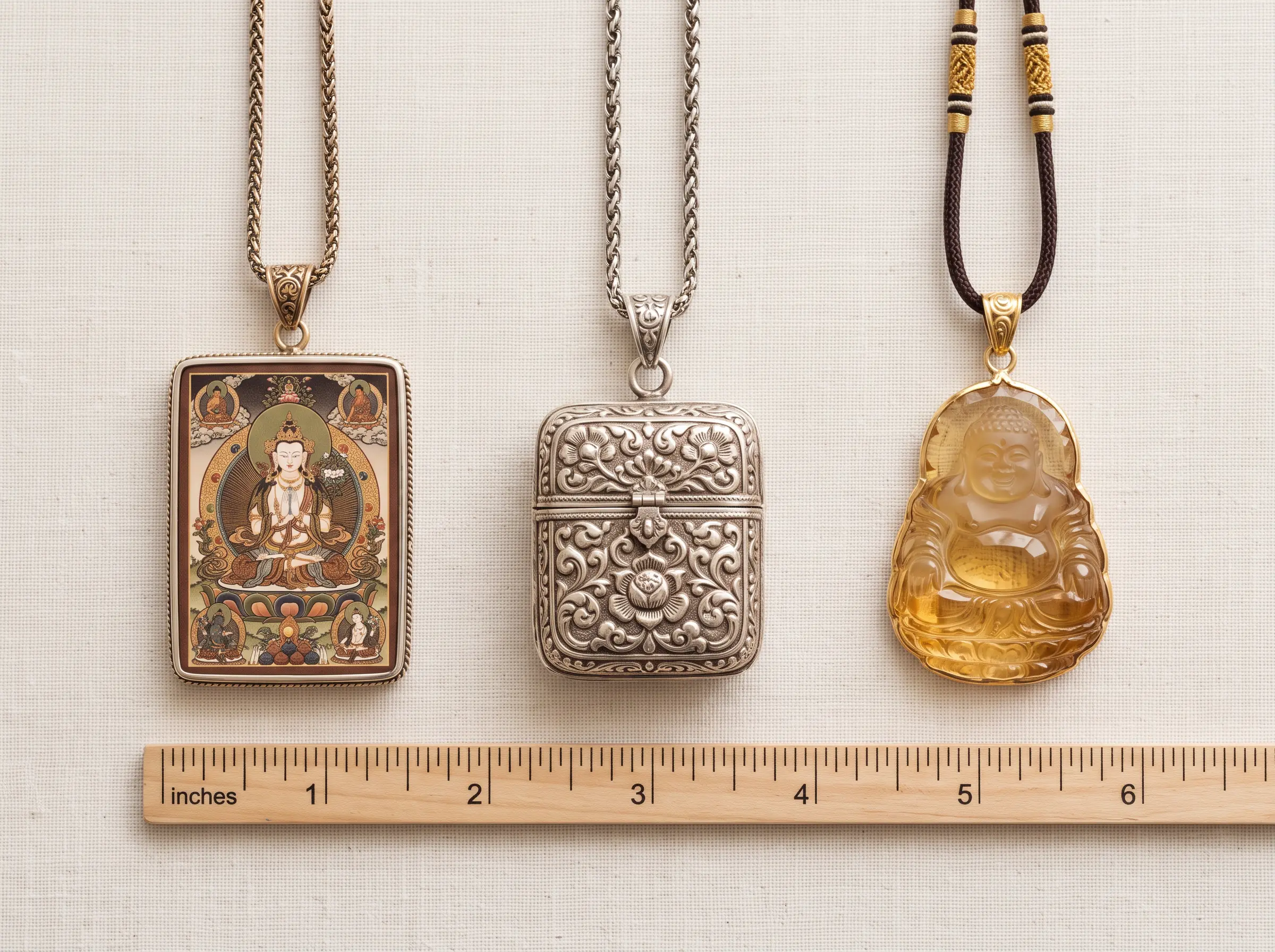
A thangka pendant shows the painting itself, a Ga Wu box is a compact amulet-box shape, and carved crystal costs less. Prices below were checked on 10/28/2026.
| Style | Format and size | Price | Variants | Figures available |
|---|---|---|---|---|
| 3D Thangka pendant | Hand-painted image in a leather Gawu-style frame | $68.95 (list $93.95) | 16 | Manjushri, Medicine Buddha, Four-Armed Avalokiteshvara |
| Ga Wu Box pendant | White copper and cinnabar box, 1.85 × 2.22 in (47 × 56.3 mm) | $68.95 | 14 | Same three figures |
| Citrine Guardian Buddha | Carved citrine, about 2.0 × 1.2 in (5 × 3 cm), 27.6 in (70 cm) chain | $32.95 | 8 | Manjushri and Thousand-Armed Guanyin; no Medicine Buddha |
On a budget, or born in a Rabbit or Rat year, the Citrine Guardian Buddha Necklace is the lowest-cost option here. It does not include the Medicine Buddha, so pick a thangka or Ga Wu piece for that figure.
For everyday wear: The Hand-Painted Thangka Ga Wu Box Pendant Necklace measures 1.85 × 2.22 inches, so it sits neatly under a shirt collar at the office. PotalaStore lists a 60-day return window on that page, which lets you check the figure in person. Confirm current terms on the listing before you order.
Is It Disrespectful to Wear a Buddha Pendant If I’m Not a Buddhist?
Wearing a Buddha pendant is generally considered respectful when you know who the figure is and treat the piece with care. Respect comes from how you wear it, not from your religion. Traditions differ, so ask a teacher if you are unsure.
How Do I Wear a Buddha Pendant Respectfully?
- Wear it above the waist: Keep it on your chest or neck, never on a belt or ankle.
- Keep it off the floor: Set it on a clean, raised surface when you take it off.
- Leave it out of the bathroom: Remove it before showering or using the toilet.
- Learn who the figure is: Knowing the name and meaning is the heart of respect.
Can I Wear a Buddha Pendant Every Day?
Yes, you can wear a Buddha pendant daily; just take it off for showering, swimming and sleeping. Water and friction wear down paint, frames and cords.
A chain length of 18 to 24 inches (46 to 61 cm) sits at the collarbone or upper chest. The 27.6-inch (70 cm) citrine chain hangs lower on the chest.
In summary, choose Manjushri for study, the Medicine Buddha for a health intention, and Avalokiteshvara for compassion. Wear your Tibetan Buddhist pendant with respect, and remember that it is a reminder, not a cure or a guarantee.
Ready to Choose Your Figure?
Compare thangka, Ga Wu box and crystal styles in one place, and find the figure that fits your intention. PotalaStore carries all three in hand-painted pendant form.Shop Tibetan Buddhist pendant necklaces →
Frequently Asked Questions
No, but many Tibetan Buddhists prefer a consecrated piece. The traditional consecration rite is called rab gnas. Check each listing for what the seller states about consecration.
Yes. Keep deity pendants from knocking against each other, and consider pairing one figure with a mantra piece. Many people choose one deity pendant for daily wear and keep others for specific occasions.
No. Buying one for yourself with a clear intention is common. Choose the figure that matches what you need, and treat the pendant respectfully.
No. It is a symbol of a healing intention, not a medical treatment. Please rely on licensed clinicians for any health concern.
📚 References
- Medicine Buddha Bhaisajyaguru: Object record for an 18th-century Mongolian copper-alloy sculpture, with notes on the bowl, the myrobalan fruit and the figure’s role in Tibetan medicine. Rubin Museum of Himalayan Art
- Manjushri (From Situ’s set of Eight Great Bodhisattvas): Museum record of Manjushri in Tibetan painting tradition. Rubin Museum of Himalayan Art
- Avalokiteshvara: Encyclopedia entry on the bodhisattva of compassion, his spread into Tibet and his link to the Dalai Lamas. Source: Encyclopaedia Britannica (Readers may search britannica.com for the “Avalokiteshvara” entry.)
- Bodhisattvas of Wisdom, Compassion, and Power: Exhibition at The Met Fifth Avenue, 03/27/2021 to 10/30/2022, on Manjushri, Avalokiteshvara and Vajrapani. Source: The Metropolitan Museum of Art (Readers may search metmuseum.org for the exhibition page.)