
Om Mani Padme Hum Bracelet: Meaning, Which Wrist to Wear It On, and How to Choose Yours
 by Yang Tso
0 comments
An Om Mani Padme Hum bracelet is a Tibetan Buddhist mantra bracelet that keeps the six-syllable mantra of compassion on your wrist. Choose with confidence once you know what the mantra means, which wrist suits it, and how each style carries the words. At PotalaStore, we compared four of our bracelets on fit, price and how the mantra is added. It is easy to buy one for the look and only later wonder what it says. The short answer: wear it on your left wrist, and start with a red knotted cord.
The bottom line:
- Wrist: left to receive, right to share. Either one is respectful.
- First bracelet: a red knotted cord from $34.95.
- Starter routine: recite the mantra 21 times each morning, about 2 minutes.
Table of Contents
What Is an Om Mani Padme Hum Bracelet?
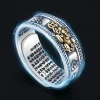
An Om Mani Padme Hum bracelet carries the six-syllable mantra of Avalokiteshvara, the bodhisattva of compassion, on your wrist. The mantra appears as an engraving, inside a tiny prayer wheel, or as a prayer recited while each knot is tied. Wearers use it as a daily cue for meditation and compassion.
In Buddhism, a bodhisattva is a being who vows to reach enlightenment for the sake of others. A mantra is a sacred phrase repeated in prayer or meditation.
Jewelry that carries a mantra belongs to the wider family of mantra jewelry for protection and meaning. Unlike a piece made for one goal, such as wealth or love, this bracelet expresses compassion itself. The prayer-wheel version borrows from Tibetan prayer wheels, which store a rolled scroll of the six syllables inside, according to the Bowers Museum.
The six-syllable mantra of compassion
Om Mani Padme Hum is the mantra of Chenrezig, the Tibetan name for Avalokiteshvara. Tibetan Buddhists regard the Dalai Lama as an emanation of Chenrezig. The Pluralism Project at Harvard University notes that it is very often the mantra written on prayer wheels.
The Isabella Stewart Gardner Museum translates it as hail to the jewel in the lotus. You will hear it as om mah-nee pad-may hum in Sanskrit and om mani peme hung in Tibetan.
Some listings call this the “Six True Words” bracelet, after the Chinese name 六字真言. A few also translate the word 咒 as “curse,” when it means mantra. For the full background, read Om Mani Padme Hum meaning.
What each syllable means
The Dalai Lama explains the mantra in four parts: OM, MANI, PADME and HUM.
| Syllable | Tibetan script | What it stands for |
|---|---|---|
| OM | ཨོཾ | The opening sacred sound. Its three letters, A, U and M, stand for body, speech and mind. |
| MANI | མ་ཎི | The jewel: compassion, love and the wish to awaken for the sake of others. Teachers call this the “method.” |
| PADME | པ་དྨེ | The lotus: wisdom. |
| HUM | ཧཱུྃ | Indivisibility: compassion and wisdom joined as one path. |
MANI is two syllables (MA and NI) and PADME is two (PAD and ME). That makes six syllables in all.
What the Dalai Lama says about practicing it
In Kindness, Clarity, and Insight, the 14th Dalai Lama teaches that reciting works best alongside reflection on its meaning. His words: “while you are doing it, you should be thinking on its meaning.”
He describes the six syllables as one path where compassion and wisdom work together. On that path, he teaches, ordinary body, speech and mind can be transformed into those of a Buddha. A bracelet gives you a reason to pause and reflect on that each time you notice it.
Which Wrist Should You Wear It On?

Wear your Om Mani Padme Hum bracelet on your left wrist to receive its blessing. Wear it on your right wrist to share compassion with others. Most people choose the left, and neither is a strict rule, so either wrist is respectful.
Left wrist: the receiving side
The left wrist is the more common choice. Many Tibetan jewelry guides, including ours, call the left side, closest to the heart, the receiving side. Choose it if you want the bracelet to remind you to slow down and recite. If you are right-handed, it also stays clear of your writing hand, so the cord snags less at a desk.
Right wrist: the sharing side
The right wrist suits you when your intention is to give compassion rather than collect it. Caregivers, teachers and volunteers can wear it there as a cue to stay patient. Either way, the habit of noticing the bracelet and reciting matters more than the wrist. For how colors, knots and materials add meaning, see our guide to Tibetan bracelet symbols and materials.
Not sure which wrist? Try this
- Want calm and focus: start on the left wrist.
- Want a cue to act with patience: start on the right wrist.
- Still undecided: wear it on the left for a week, then switch if it feels wrong.
Red Cord, Beads or Mala: How to Choose Your Style

Choose by how you will use the bracelet, not by looks alone. A mala is a string of 108 prayer beads used to count recitations. This table compares our four styles, with prices checked on 11/06/2026.
| Style | How the mantra is carried | Best for | Fit | Price |
|---|---|---|---|---|
| Red knotted cord | Engraved on a curved metal tube | A first bracelet and gifts | Listed length 8.6 in (21.8 cm), sliding knot | $34.95 |
| Five-color knotted cord | Recited by the artisan as each knot is tied, per the product page | A minimalist cord | Wrists of 6.7 to 7.5 in (17 to 19 cm) | $35.95 |
| Gold-tone beaded bracelet | Tibetan-script mantra engraved on barrel beads | Dressier everyday wear | Adjusts from 7 to 11 in (18 to 28 cm) | $102.95 |
| 108-bead wrist mala | 108 beads for counting recitations | A daily counting practice | Wraps the wrist four times; pick a size on the product page | $66.95 |
Sale prices change, so confirm the current price on each product page. You can also browse every style in PotalaStore’s Tibetan bracelet collection.
Our four picks, by what you need

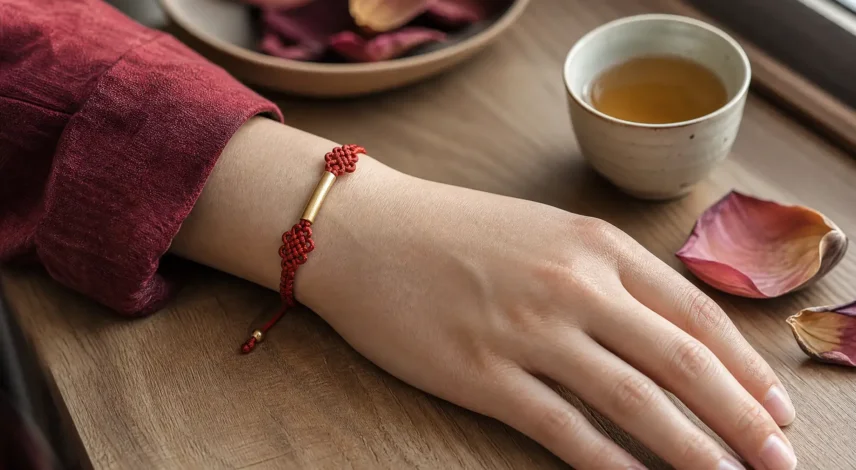
The red knotted cord with an engraved metal tube.

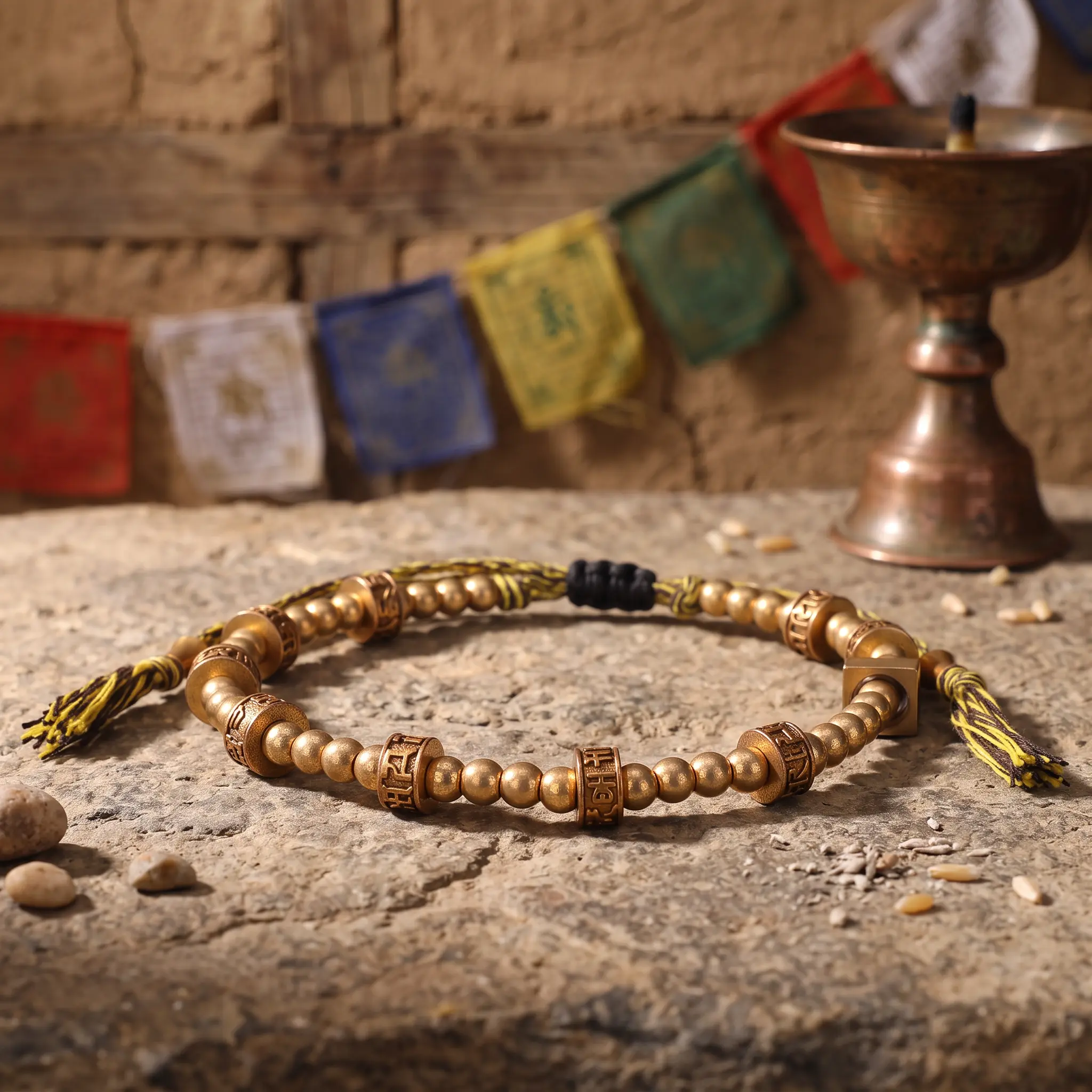
The gold-tone bracelet with engraved mantra beads.
- Best first bracelet: the Tibetan Lucky Bracelet (Om Mani Padme Hum). A red knotted cord holds an engraved metal tube with the mantra, and a sliding knot closes it without a clasp. That means less guesswork on size. It costs $34.95, the lowest of the four.
- Best for the knot-tied tradition: the Lucky Buddhist Monk Bracelet. Its product page says the artisan recites the mantra as each five-color knot is tied on red silk cord. The sliding closure fits wrists of 6.7 to 7.5 inches (17 to 19 cm). It costs $35.95.
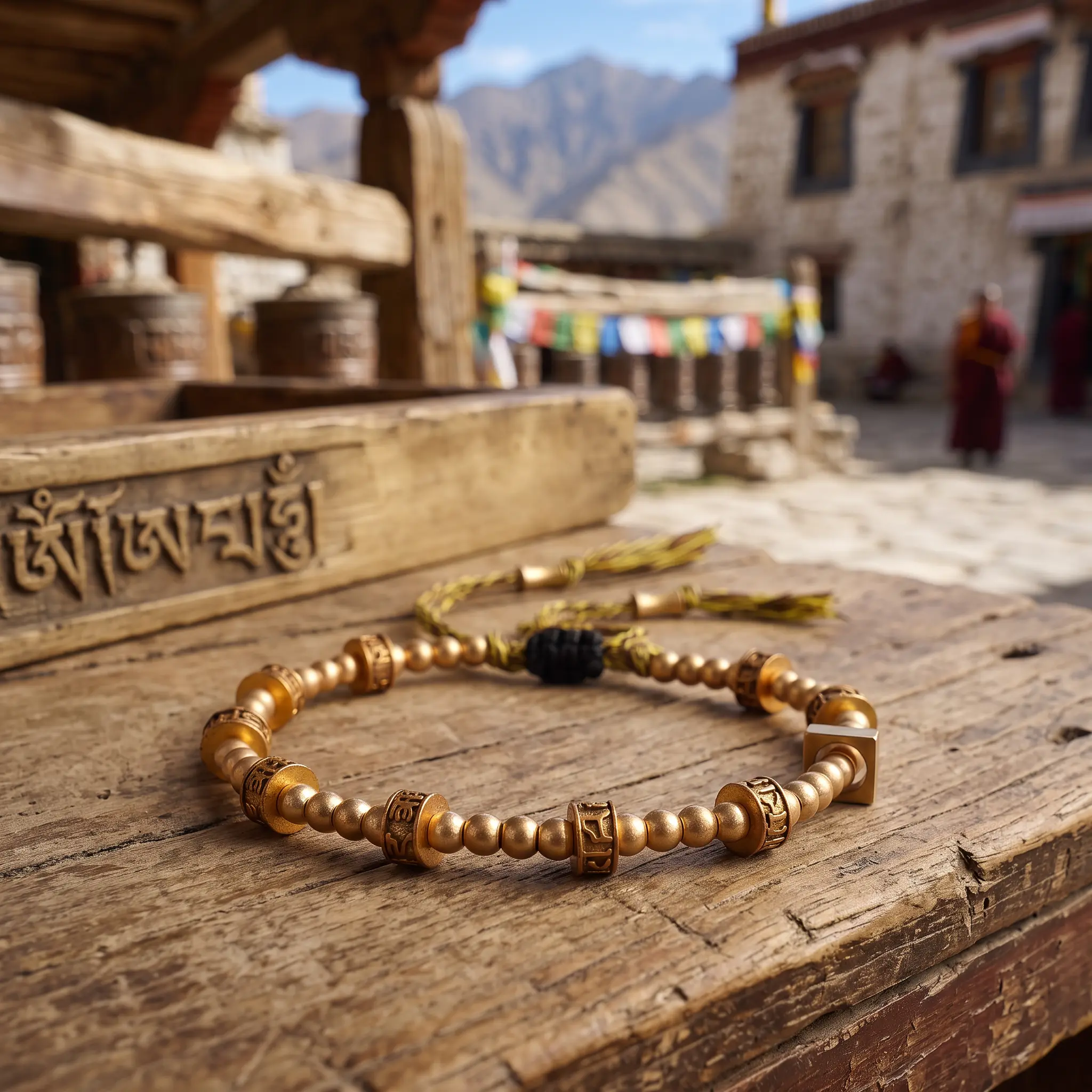
- Best for dressier everyday wear: the adjustable gold-tone Om Mani Padme Hum bracelet. Gold-tone alloy beads sit on a woven two-tone cord, and several barrel beads carry the mantra in Tibetan script. Engraved beads sit between smooth round ones, so your fingers can find them by touch. It slides from 7 to 11 inches (18 to 28 cm), so it fits most wrists. At $102.95, the extra cost buys the finish and the wider size range, not a different mantra.
- Best for counting recitations: the 108-bead peach wood and bodhi seed mala bracelet. It wraps your wrist four times, so one pass through every bead counts a full round of 108. Read why a mala has 108 beads if you want the background. It costs $66.95.
We noticed that price follows the finish, not the mantra. The two red cords cost within $1.00 of each other, while the gold-tone bracelet costs about three times as much. Adjustment ranges also differ: 6.7 to 7.5 inches on the Monk Bracelet versus 7 to 11 inches on the gold-tone one. Measure your wrist first. A four-wrap mala also sits bulkier on the wrist than a single cord, so skip it if you want something slim.
Buying a gift? Choose a sliding-knot design, because it forgives a wrong size guess better than a fixed-size bead bracelet. You do not want to give a bracelet that will not close.
Five checks before you buy
- Count the syllables. You should find six: OM, MA, NI, PAD, ME and HUM, in Tibetan script or Roman letters.
- Read the material line. Sterling silver is stamped .925, while “alloy” means a mixed-metal base. Ask the seller if a listing does not say.
- Match the size range to your wrist. Measure with a soft tape and add about half an inch (1.3 cm) for comfort.
- Ask how it closes. A sliding knot adjusts to your wrist, while a fixed clasp does not.
- Skip big promises. Walk away from any seller that promises to cure illness or guarantee luck.
What a Mantra Bracelet Can and Cannot Do
A mantra bracelet works as a reminder, not as a treatment. It can cue you to pause, breathe and recite, but it cannot treat a medical condition or guarantee any outcome.
What it can do: a daily cue
Each time you notice the bracelet, it can prompt a short practice. Touch a bead, say the mantra once, and take one breath. Repeating that cue builds a habit, and the habit does the work. Many practitioners report feeling calmer when they pair the cue with the recitation.

A two-minute starter routine
- Put it on (10 seconds). Slide it onto your left wrist and set one simple intention, such as patience.
- Touch the bracelet (5 seconds). Let that touch mark the start of a short pause.
- Recite 21 times (about 90 seconds). Say the mantra softly, and think about compassion as you go. A 108-bead mala lets you count a full round instead.
- Take one slow breath (10 seconds). Then carry on with your day.
What it cannot do
It cannot treat, cure or prevent illness, and it cannot promise luck, money or protection. Teachers such as the Dalai Lama stress practice and understanding over the object itself. If you have a health concern, talk with a doctor, and wear the bracelet as a symbol alongside that care.
Important note: The information about spiritual and energy properties is based on traditional beliefs and user experiences, not scientific evidence. This content is for educational purposes and should not replace professional medical advice.
How to Wear and Care for It Respectfully
Treat your bracelet as sacred text you wear. Learn what it says, keep it clean, and take it off before sleeping, bathing or using the bathroom.
If you are not Buddhist
You do not need to be Buddhist to wear the mantra, but you do need to respect it. Learn the meaning first, which you have just done. Wear it as a meaningful object rather than a costume. For more on which symbols suit everyone, read our guide to wearing spiritual jewelry without being religious.
Daily care
- Take it off before sleeping and before using the bathroom, a common sign of respect for sacred text.
- Remove it before showering, swimming and workouts, because water wears down cords and finishes.
- Wipe beads with a soft, dry cloth.
- Keep it away from perfume and lotion.
- Store it in a clean pouch or on a clean shelf, never on the floor.
If the cord breaks
A frayed or broken cord is normal wear, not a bad omen. Many practitioners read a cord that falls off as a sign it has done its job. That is a tradition, not a promise. Re-tie the cord or restring the beads. Our guide covers what it can mean when a Buddhist bracelet breaks.
Frequently Asked Questions
Which wrist do you wear an Om Mani Padme Hum bracelet on?
Most people wear it on the left wrist, the receiving side, and use the right wrist to share compassion. This is a convention, not a rule. Choose the wrist where the bracelet feels secure.
What does an Om Mani Padme Hum bracelet mean?
It carries the six-syllable mantra of Avalokiteshvara, the bodhisattva of compassion. The syllables stand for compassion (the jewel) and wisdom (the lotus) joined together. Wearing it serves as a daily reminder to practice both.
Can you wear an Om Mani Padme Hum bracelet if you are not Buddhist?
Yes. Learn what the mantra means, keep the bracelet clean, and treat it as a meaningful object rather than a fashion accessory.
Can you shower or sleep in a mantra bracelet?
Take it off for both. Water wears out cords and finishes, and many practitioners remove sacred objects before sleep out of respect. Rest it on a clean shelf or in a pouch overnight.
How many times should you recite Om Mani Padme Hum?
No fixed number is required. A mala has 108 beads, so one full round counts 108 recitations. If you are starting out, try 21 each morning, which takes about 2 minutes.
Choose Your Om Mani Padme Hum Bracelet
The bottom line: an Om Mani Padme Hum bracelet is a reminder you wear, so choose the one you will actually notice. Start with a red knotted cord on your left wrist for the simplest option. Pick the gold-tone beads for a dressier piece, and add a 108-bead mala when you are ready to count.
Find the Om Mani Padme Hum bracelet that fits your wrist
Compare every style in the PotalaStore Tibetan bracelet collection, or start with the Tibetan Lucky Bracelet at $34.95.Shop Tibetan mantra bracelets
Before you order
Shipping is free and tracked, and U.S. orders usually arrive in 5 to 10 business days. Read our shipping details for other countries, and check our FAQ page for answers about your order.
References
Teachings on the mantra
- The meaning of OM, MANI, PADME and HUM: An excerpt from Kindness, Clarity, and Insight by the 14th Dalai Lama, translated and edited by Jeffrey Hopkins. Shambhala Publications (Snow Lion)
Museum and academic sources
- Prayer wheels and the mantra of Chenrezig: A short entry on how Tibetan prayer wheels carry Om Mani Padme Hum. The Pluralism Project, Harvard University
- The Six Syllables mantra and its translation: A museum object record for a hand prayer wheel, with the mantra translated. Isabella Stewart Gardner Museum
- Scripture stored inside a prayer wheel: A catalog record describing the rolled mantra scripture inside a 19th to 20th century wheel. Bowers Museum