
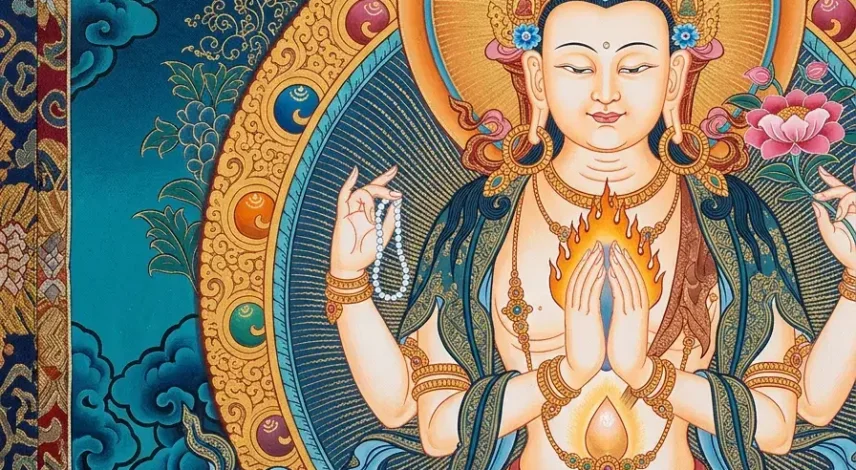

You have probably seen it without knowing its name: a small jewel wrapped in flames, held in a bodhisattva’s palm on a Tibetan thangka. The Mani Jewel is the wish-fulfilling jewel of Buddhism, called cintāmaṇi in Sanskrit. It symbolizes compassion and the clear Buddha-nature within every person. It is not a literal gem that grants personal wishes.
This guide explains what the jewel means, how to recognize its three common forms in Buddhist art, how it differs from the “mani” in Om Mani Padme Hum, and what its “spiritual power” actually refers to. It draws on Columbia University’s JAANUS art dictionary, The Metropolitan Museum of Art, Britannica, and the Soka Gakkai Dictionary of Buddhism, so you get the tradition’s own meaning rather than the myth.
PotalaStore carries hand-painted Tibetan thangka art, and the jewel appears in many of those paintings. That is why we wrote this guide for readers meeting the symbol for the first time.
Mani Jewel at a Glance: 5 Key Facts
- Word meaning: Maṇi means “jewel” in Sanskrit and Pali.
- Full name: The wish-fulfilling jewel is called cintāmaṇi.
- Holders: Avalokiteshvara and Ksitigarbha are often shown holding it.
- Forms in art: It appears in 2 main shapes, flaming and round, and is often shown as a triple jewel.
- Meaning: It symbolizes compassion and Buddha-nature, not literal wish-granting.
Table of Contents
What Is the Mani Jewel in Buddhism?
The Mani Jewel is the wish-fulfilling jewel of Buddhism, known in Sanskrit as cintāmaṇi and in Tibetan as yid bzhin nor bu. Held by bodhisattvas such as Avalokiteshvara and Ksitigarbha, it symbolizes compassion that meets every being’s needs and the clear, unstained Buddha-nature within each person, not a literal gem that grants personal wishes.
The English phrase doubles up on meaning, because maṇi already means “jewel.” It renders the Chinese term 摩尼珠 (móní zhū). The jewel works on two levels. In legend it is a physical treasure. In doctrine it is a metaphor for what every being already holds.
What Does “Mani” Mean in Sanskrit and Tibetan?
Maṇi simply means “jewel” in Sanskrit and Pali, and cintāmaṇi adds cintā, “thought,” to name the jewel that answers what the mind wishes for. The idea then traveled into at least five Asian languages.
| Language | Name for the wish-fulfilling jewel |
|---|---|
| Sanskrit | cintāmaṇi |
| Tibetan | yid bzhin nor bu |
| Chinese | 如意寶珠 (rúyì bǎozhū) |
| Japanese | nyoihōju |
| Korean | yeouiboju |
| Mongolian | Chandmani |
In Tibetan, nor bu is the everyday word for “jewel.” The full name yid bzhin nor bu translates as “wish-fulfilling jewel.”
Mani Jewel vs. Cintamani: Are They the Same?
Not exactly: “Mani Jewel” is an umbrella term for several jewels in Buddhist texts, and the wish-fulfilling cintāmaṇi is the most famous of them. A second type is the water-purifying jewel. Dropped into muddy water, it makes the water clear.
The Abhidharma-kośa, a classic Indian Buddhist treatise, uses that jewel as a simile for faith, which clears the mind of doubt. A third jewel stands for Buddha-nature, covered in the next section.
Where Does the Wish-Fulfilling Jewel First Appear?
The jewel first appears in the Pali Canon as one of the seven treasures of a “wheel-turning king,” described as a flawless beryl cut into eight facets. In the Mahāsudassana Sutta (Dīgha Nikāya 17), its light reaches one yojana around it. A yojana is an ancient Indian unit of distance, equal to several miles.
Later tradition ties the jewel to Indra, king of the gods, and says it fell to earth during his battle with the asuras. Tibetan accounts also link the jewel to King Lha Thothori Nyantsen, onto whose palace four sacred objects are said to have fallen. Reliable sources for that story are thin, so treat it as legend rather than history.
What Does the Wish-Fulfilling Jewel Symbolize?
In Buddhist teaching, the wish-fulfilling jewel stands for the virtue and power of the Buddha and his teachings, a treasure that gives without ever running out. The Soka Gakkai Dictionary of Buddhism describes it in exactly those terms.
Three layers of meaning recur across traditions: Buddha-nature, compassion, and merit. “Wish-fulfilling” therefore refers to meeting the real needs of beings. Think of a lamp that lights a thousand others without growing dim.
Buddha-Nature: The Clear Jewel That Takes On Colors

Three Mahayana sutras, the Laṅkāvatāra, the Sutra of Perfect Enlightenment, and the Śūraṅgama, describe a clear jewel inside every being that seems to change color with its surroundings.
In these readings, the cintamani is Buddha-nature, and the colors are passing mental states and the aggregates of ordinary experience. Greed, anger, and delusion make a person see only the colors and miss the clear jewel beneath. The jewel and Buddha-nature are one teaching told as an image.
The Avataṃsaka tradition adds Indra’s net, where every jewel reflects all the others. In Kyoto in 1238, the Zen master Eihei Dōgen wrote “Ikka myōju” (“One Bright Pearl”), building on the Chinese teacher Xuansha Shibei’s saying that the whole world in the ten directions is one bright jewel.
Compassion, Bodhicitta, and Generosity
Many teachers read the jewel as bodhicitta, the wish to awaken for the benefit of all beings, because it fulfills the needs of others before the holder’s own.
Columbia University’s JAANUS dictionary lists several meanings attached to the jewel in Buddhist art: wealth, wisdom, the aspiration to enlightenment, and Buddha-nature. The link to generosity runs through dāna, the Buddhist virtue of giving. A jewel that supplies what beings need is a picture of perfect giving.
Does the Wish-Fulfilling Jewel Represent Wealth?
Yes, but with a twist: in Tibetan art the jewel appears most often with wealth deities, where prosperity is meant to flow outward as generosity. Himalayan Art Resources notes that the jewel as a hand attribute is most commonly found with wealth deities.
Jambhala, the Tibetan wealth deity, is typically shown with a mongoose that spits jewels. In this reading, wealth means merit and resources to share, not riches to hoard.
How Is the Cintamani Depicted in Buddhist Art?
In Buddhist art, the cintamani usually takes one of two shapes: a teardrop-shaped jewel crowned with flames, or a smooth round jewel, often shown in a group of three. The form tells you what the artist wants you to notice.
Flaming Jewel vs. Round Jewel vs. Three Jewels
A flaming jewel signals radiance that dispels ignorance, a single round jewel suggests inner treasure, and a triple jewel points to the Buddha, Dharma, and Sangha.
| Form | What you see | Common meaning | Where you often see it |
|---|---|---|---|
| Flaming jewel | Teardrop shape topped with flames, often on a lotus pedestal | Radiance that dispels ignorance | In the hands of bodhisattvas and wealth deities on thangkas |
| Round jewel | Smooth sphere or oval, sometimes with a faint halo | Inner treasure, Buddha-nature | Cupped in a deity’s palm, as in many Jizō statues |
| Triple jewel | Three jewels, usually flaming, grouped together | Buddha, Dharma, Sangha (the Three Jewels) | Triratna emblems and the center of prayer flags |
Flames do not signal destruction here. They show the jewel’s light. Treat the table as a guide, not a rule, because styles differ across Tibetan, Chinese, and Japanese traditions.

Who Holds It: Avalokiteshvara, Ksitigarbha, and Wealth Deities
Avalokiteshvara, known in Tibet as Chenrezig, often holds the wish-fulfilling jewel at the heart, and his Cintāmaṇicakra form, called Nyoirin Kannon in Japan, is most often six-armed, holding a jewel and a wheel.
JAANUS records versions with anywhere from 2 to 12 arms. It notes that the two-armed version does not hold a jewel. In the six-armed form, the arms are commonly read as reaching all six realms of rebirth.
Britannica describes Ksitigarbha, called Jizō in Japan, with a staff that opens the gates of hell and a flaming pearl, the cintamani, that lights the darkness. A Kamakura-period Jizō at The Metropolitan Museum of Art (Japan, 1185 to 1333) holds a jewel in the left hand and a six-ringed staff, Sanskrit khakkara, in the right.
The jewel is small and easy to miss. When you study a statue or painting, check the left palm first, then the center of the chest.
The Wind Horse and the Jewels on Prayer Flags

At the center of many Tibetan prayer flags, the Lungta, or wind horse, carries three flaming jewels that stand for the Buddha, the Dharma, and the Sangha.
Lungta literally means “wind horse.” The image pairs a horse’s speed with the wind’s reach, so printed prayers travel in every direction. Our guide to the wind horse and five colors of Tibetan prayer flags covers the flag side in detail.
See the jewel painted in traditional form. Explore PotalaStore’s Thangka Paintings collection.
Is the “Mani” in Om Mani Padme Hum the Same Jewel?
Yes and no: the mani in Om Mani Padme Hum is the same Sanskrit word for “jewel,” but the mantra uses it as part of a poetic name, not as a reference to a physical gem. Dictionaries gloss maṇi in the mantra as a wish-fulfilling gem, which is the direct link to the cintamani.
What “Jewel in the Lotus” Means
In the most common reading, maṇi (jewel) stands for compassion and padme (lotus) for wisdom, so “the jewel in the lotus” points to their union. The lotus carries its own symbolism of purity rising from mud, and you can see what each lotus color symbolizes in Buddhism.
For the full six-syllable breakdown and how practitioners use the mantra, read the six-syllable meaning of Om Mani Padme Hum. Those details belong on that page, not here.
Scholars still debate the grammar. Donald Lopez reads maṇipadme as a vocative that addresses Avalokiteshvara as “Jewel-Lotus.” Alexander Studholme reads it as a locative, “in the jewel-lotus,” and links it to rebirth in the pure land of Sukhāvatī, in his 2002 study of the Kāraṇḍavyūha Sūtra. That sutra, where the mantra first appears, is believed to have been composed in Kashmir in the late 4th or early 5th century CE.
Norbu, Mani Stones, and Other Look-Alike Terms
Five terms often get mixed up: mani jewel, cintamani, the mantra’s “mani,” norbu, and mani stones, and only the first two name the wish-fulfilling jewel itself.
| Term | Language or context | What it refers to | The wish-fulfilling jewel? |
|---|---|---|---|
| Mani jewel | English, from Sanskrit and Chinese | Umbrella term for jewels in Buddhist texts | Yes, in the broad sense |
| Cintamani | Sanskrit | The wish-fulfilling jewel | Yes |
| “Mani” in the mantra | Sanskrit, in Om Mani Padme Hum | Part of the name “Jewel-Lotus” | Related, but not the object |
| Norbu | Tibetan | “Jewel” or treasure, often evoking the Three Jewels | Only as part of yid bzhin nor bu |
| Mani stone | Tibetan Buddhist practice | Stone carved with the six-syllable mantra | No |
What Spiritual Power Is the Mani Jewel Believed to Hold?
In Buddhist teaching, the jewel’s “power” is the power of compassion and awakened mind: it is believed to inspire generosity and clarity, not to grant personal wishes on demand. Buddhist traditions treat the jewel as a symbol, not a guarantee.
Using the Symbol in Daily Practice

For many practitioners, an image of the jewel on an altar or in a thangka is a daily reminder to act with generosity and to see the clear mind beneath passing moods.
A simple habit often accompanies the image: pausing for a few breaths each morning in your meditation space, or making one small gift that day. Keeping sacred images clean and off the floor is a common courtesy.
The jewel will not guarantee wishes, wealth, or health. If someone promises that a pendant will grant your wishes, that is marketing, not Buddhism.
How to Choose a Jewel-Inspired Piece Respectfully
Choose a piece for what it reminds you of, look for traditional iconography, and treat it with the same care you would give any sacred image.
- Start with intention: Decide whether you want a reminder of compassion, a focus for meditation, or a gift for a practitioner.
- Check the iconography: Look for a flaming or round jewel in the correct deity’s hands, using the forms in the table above.
- Plan for respect: Keep the piece clean, and store it somewhere other than the floor or a bathroom shelf.
When customers ask us about thangka pendants, the question we hear most is whether the jewel in the painting will grant wishes. The honest answer is no, and that answer is part of why the symbol still matters.
One option is our hand-painted Four-Armed Avalokiteshvara thangka pendant, one of 16 deity variants in the Tibetan Thangka Buddha Pendant Necklace range, priced at $68.95 as of 10/01/2026. The hand-painted 3D thangka portrait sits in a leather gau box, a portable shrine format, so you carry a quiet reminder of compassion through the day. Like any devotional object, it is a reminder, not a guarantee.
⚠️ Important Note: This article explains traditional Buddhist symbolism for educational purposes. Statements about spiritual significance reflect traditional beliefs, not scientific evidence. This is not religious instruction, and no object can guarantee wishes, wealth, or health.
Frequently Asked Questions About the Mani Jewel
The Mani Jewel is Buddhism’s wish-fulfilling jewel, called cintāmaṇi in Sanskrit and yid bzhin nor bu in Tibetan. It symbolizes the compassion of bodhisattvas like Avalokiteshvara and the clear Buddha-nature within every being.
In legend, the jewel grants whatever its holder wishes for. In Buddhist teaching, the “wishes” it fulfills are the real needs of all beings, above all freedom from suffering, so the name points to compassion rather than personal gain.
No. Buddhist traditions treat the jewel as a symbol, not a guarantee. Its “power” is the generosity and clarity it is believed to inspire in the person who reflects on it.
Yes, as long as you treat it with respect: keep it clean, place it thoughtfully, and value it for its meaning. To see the jewel in traditional form, explore hand-painted thangka art that shows the flaming and round forms described above.
In summary, the Mani Jewel is a symbol, not a magic stone. It names the wish-fulfilling jewel, cintāmaṇi, and points to compassion, generosity, and the clear Buddha-nature present in every being. The key takeaway is simple: learn to recognize its flaming, round, and triple forms, and you will read thangkas, statues, and prayer flags with new understanding.
See the Jewel in Traditional Form
Find the Four-Armed Avalokiteshvara and 15 other deity designs, hand-painted in the thangka tradition, at PotalaStore.Shop the Thangka Buddha Pendant Necklace
This article explains traditional Buddhist symbolism for educational purposes. It is not religious instruction, and no object can guarantee wishes, wealth, or health.
📚 References
- Nyoirin Kannon (Cintāmaṇicakra): Arm counts, jewel attributes, and meanings of the jewel in Japanese Buddhist art. JAANUS, Columbia University Media Center for Art History
- Jizō, the Bodhisattva of the Earth Store (Kamakura period): A museum sculpture holding a jewel and a six-ringed staff. The Metropolitan Museum of Art
- Wish-granting jewel: Definition and symbolism of the jewel in Buddhist teaching. The Soka Gakkai Dictionary of Buddhism, Nichiren Buddhism Library
- Kshitigarbha: Iconography of the bodhisattva with the staff and the flaming pearl (chintamani). Encyclopaedia Britannica