
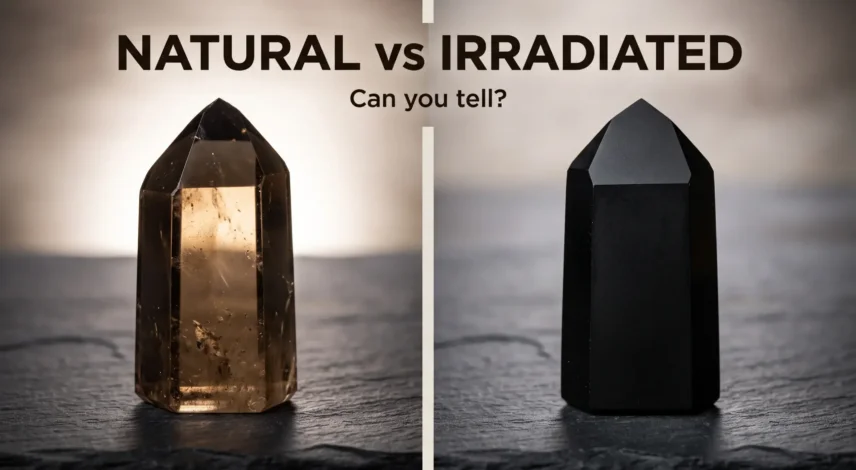

The darkest, most dramatic smoky quartz is sometimes the least natural. Smoky quartz is a brown-to-black variety of quartz (silicon dioxide), colored when natural radiation strikes trace aluminum inside the crystal. In crystal tradition, it is a grounding, protective stone. A lab can reproduce the same color with gamma rays.
This guide explains what smoky quartz means, how people use it, and five clues that help separate natural stones from irradiated ones. You also get a seven-question checklist to use with any seller.
We built it from primary sources: the International Gem Society, GIA, the Health Physics Society, the US Nuclear Regulatory Commission, and the FTC. At PotalaStore, we believe you should know what a stone is before you choose it.
Key takeaways
- No home test proves natural color. You can read tendencies, then ask the seller directly.
- Irradiated smoky quartz is real quartz. Gamma-ray coloring does not make the stone radioactive.
- Heat and long UV exposure can pale either kind. Keep the stone away from ovens and sun-baked windowsills.
Table of Contents
What Does Smoky Quartz Mean?
In crystal tradition, smoky quartz means grounding and protection: it is believed to help you feel steady, present, and shielded from negative energy. It is traditionally associated with the root chakra, and its Scottish variety, cairngorm, was set into traditional Scottish jewelry.
Grounding and Protection in Crystal Tradition
Practitioners describe three layers of meaning. Grounding comes first: the stone is believed to anchor your attention in the present moment. Protection comes second, as a traditional shield against stress and negative energy. Release comes third, the idea of letting go of tension you no longer need.
Many crystal guides place smoky quartz at the root chakra, the energy center linked to stability and security. Our smoky quartz meaning and root chakra symbolism guide covers each tradition in more detail.
These are belief-based associations, not measured effects. Treat the stone as a focus tool for your own routine.
Cairngorm, Morion, and the Stone’s Cultural Roots
Cairngorm is the brown, translucent smoky quartz named for the Cairngorm Mountains of Scotland. Morion is the near-black end of the range. The two names describe depth of color, not different minerals.
Dark smoky stones appeared in Victorian mourning jewelry. New Hampshire named smoky quartz its official state gem in 1985.
A crystal is a focus tool, not a switch. A seller who promises guaranteed results is selling hope, not quartz.
Important note: The spiritual and energy meanings in this guide come from traditional beliefs and personal experience, not scientific evidence. This content is educational and does not replace professional medical advice.
What Gives Morion and Cairngorm Their Dark Color?
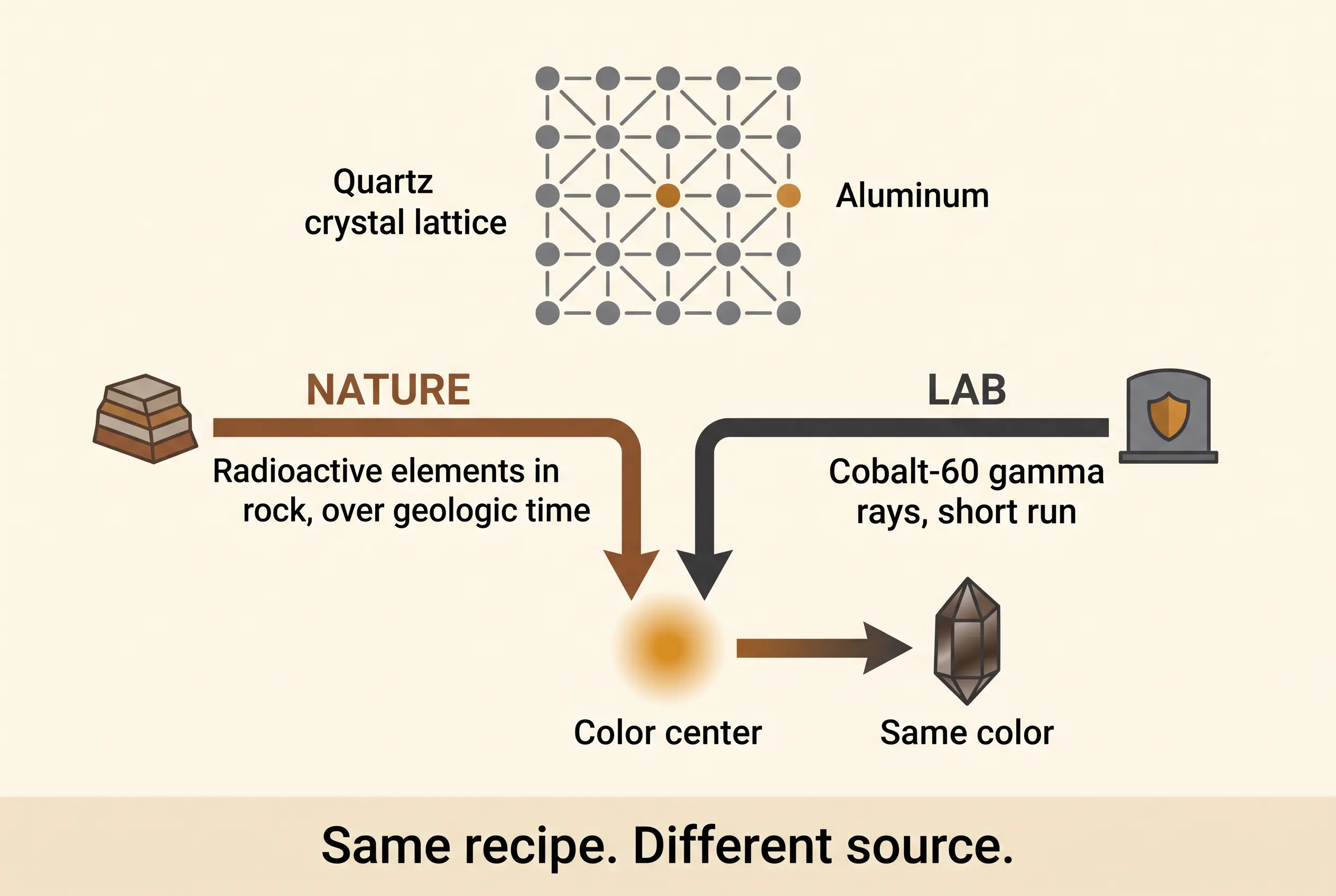
Brown-to-black quartz gets its color when gamma radiation strikes a trace aluminum impurity in the crystal, creating light-absorbing color centers. In nature, that radiation comes from radioactive elements in the surrounding rock over geologic time. In a lab, a cobalt-60 source delivers a comparable dose and leaves an identical color center.
Natural Gamma Rays vs. a Cobalt-60 Chamber
A color center is a defect in the crystal that traps an electron and absorbs part of the visible light. In smoky quartz, aluminum replaces about one in every 10,000 silicon atoms, and radiation then creates the color center.
Gem labs describe the same process in nature. GIA’s Gems & Gemology reports that natural irradiation of aluminum-rich zones produces smoky color layers in Bolivian ametrine.
The lab version is simple. The International Gem Society reports that 0.5 to 1.5 megarads of cobalt-60, gamma, X-ray, or electron radiation turns quartz blackish or brownish, though not evenly. A dose near 60 megarads returns stones opaque black or brown.
Both routes make the same color center. That is why composition alone cannot separate natural from irradiated stones.
Morion: When “Black” Is a Look, Not a Species
Sources disagree on how common treated stones are. Geologist Hobart M. King writes at Geology.com that lab coloring is not often done, because natural smoky quartz is inexpensive and plentiful. Other educators say it is still common practice to irradiate colorless quartz and sell it as smoky quartz.
Both can be true. Natural stones likely dominate the market overall, while treated stones are more likely in the uniform, jet-black niche.
The color is not permanent. Smoky quartz loses its color when heated to roughly 392–572 °F (200–300 °C), and long UV exposure can pale some stones. Gamma rays can bring the color back, because the recipe does not care where the radiation came from.
How Can You Tell If Smoky Quartz Is Natural or Irradiated?
You cannot prove smoky quartz is naturally colored at home, because lab and natural radiation create the same color center. You can read tendencies: warm brown tone, translucent edges, and uneven zoning lean natural, while flat, opaque, edge-to-edge black and bargain bulk pricing lean irradiated.
Clues That Lean Natural vs. Clues That Lean Treated
Use this table as odds, not proof. Treated stones can show a few natural clues.
| Clue | Leans natural | Leans treated |
|---|---|---|
| Color tone | Warm brown or gray-brown | Flat, jet black |
| Edge translucency | Brown glow through thin edges under a bright light | Opaque from edge to edge |
| Color zoning | Uneven bands or smoky phantom layers | Uniform color from tip to base |
| Price versus size | Price rises with size and clarity | Large black points at bulk prices |
| Seller disclosure | Names the locality and says “natural” | Silent or vague about treatment |
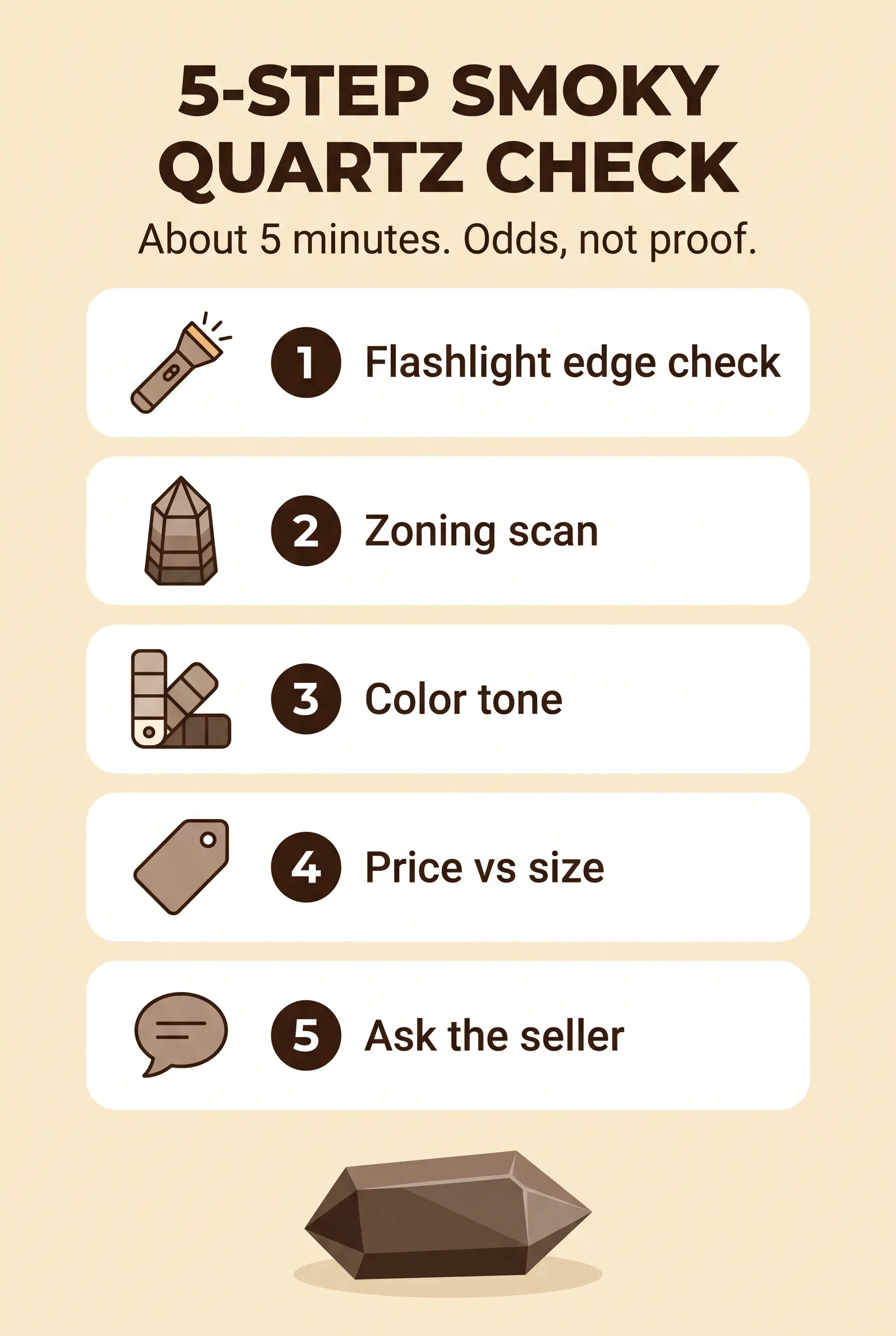
Run this five-step check in about five minutes:
- Flashlight edge check (1 minute): Shine a bright white light through the thinnest edge. A brown glow suggests natural color. A dead-black edge suggests treatment, though very dark natural morion can also be opaque.
- Zoning scan (1 minute): Rotate the stone under a lamp and look for uneven bands or phantom layers. Attached host rock is a mild natural clue, since irradiation can also treat stones on matrix.
- Color tone check (1 minute): Compare the stone to the table above. Warm brown leans natural, and flat black leans treated.
- Price check (1 minute): A large, perfectly black point priced like a tumbled stone deserves questions.
- Disclosure check (1 minute): Ask the seller directly using the checklist near the end of this guide.
Only a gemological lab can go further. For an inexpensive tumbled stone, a lab report can cost more than the stone itself.
Home “Tests” That Don’t Work (Sunlight, UV, Scratch)
Sunlight, UV light, and scratch tests do not separate natural from irradiated smoky quartz. Here is why each one fails:
- Sunlight: Natural stones can fade too, so fading proves nothing. A long sunlight soak can also bleach the stone you are trying to test.
- UV light: One gemstone reference lists smoky quartz as inert under both short-wave and long-wave UV. A claimed glow is not a reliable sign of anything.
- Scratch: Smoky quartz scores 7 on the Mohs scale, natural or irradiated. A scratch test only separates it from glass, and it can damage your stone.
Is Irradiated Smoky Quartz Safe, and Is It Fake?
Irradiated smoky quartz is not radioactive, and it is not fake. Gamma rays shift electrons inside the crystal without making the stone itself radioactive.
If you already own a jet-black point and the word “irradiated” made your stomach drop, take a breath. One reader asked the Health Physics Society’s Ask the Experts column about holding an irradiated crystal for long stretches. The answer: “There is no radiation hazard associated with irradiated smoky quartz.” The column notes that answers are individual professional opinions, not Society positions.
The US Nuclear Regulatory Commission says it has no reason to believe wearing irradiated gemstones is harmful, and it reports no cases of harm. Neutron-irradiated gems, such as some blue topaz, are a different case. Federal rules require them to decay before sale.
“Fake” is the wrong word here. An irradiated stone is still quartz, with the same composition (SiO2) and the same hardness. The real problem is non-disclosure, which the seller checklist below covers.
This section is general information, not medical or legal advice.
Brown Quartz Look-Alikes: Citrine, Glass, and Obsidian Compared
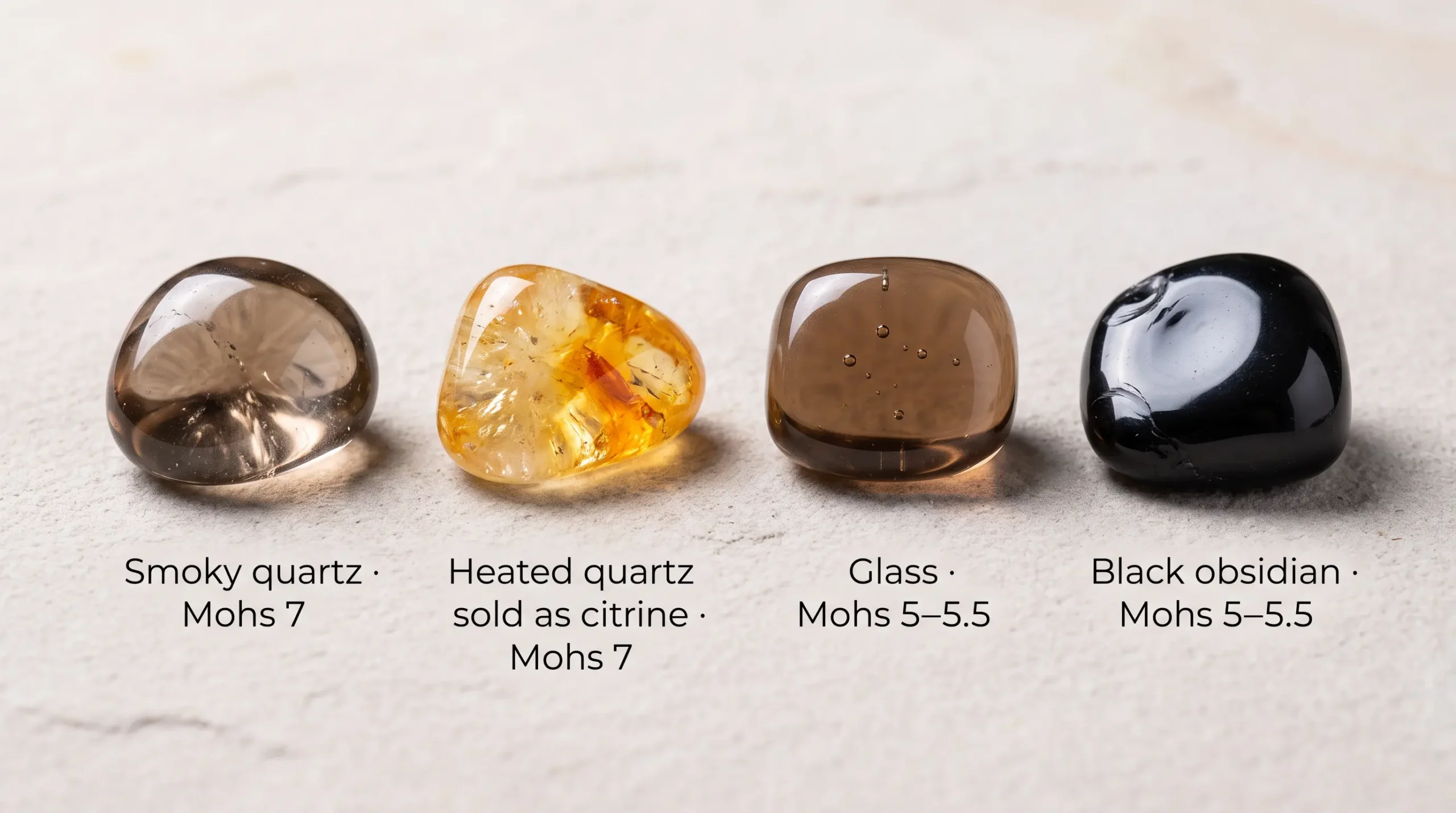
Heat-treated smoky quartz is sometimes sold as citrine, glass imitates faceted smoky stones, and black obsidian is mistaken for morion. A quick comparison of transparency, hardness, and dichroism separates most of them, though telling heated smoky quartz from natural citrine can be nearly impossible without lab tools.
| Material | Look | Mohs hardness | Key clue | Common treatment |
|---|---|---|---|---|
| Natural smoky quartz | Translucent brown to gray-brown | 7 | Brown glow through thin edges | None (natural irradiation) |
| Irradiated smoky quartz | Gray-brown to opaque black | 7 | Flat color, little or no zoning | Gamma, X-ray, or electron irradiation |
| Heated smoky quartz sold as citrine | Yellow to orange-brown | 7 | May show faint dichroism | Heat |
| Glass simulant | Smooth, uniform brown | About 5–5.5 | Round gas bubbles or swirl marks | None (man-made) |
| Black obsidian | Opaque black, glassy luster | About 5–5.5 | Curved, shell-like fracture | Not radiation-colored |
When Heated Smoky Quartz Is Sold as Citrine
Heat-treated smoky quartz can turn yellow to orange-brown, and some of it is sold as citrine. Heating changes the stone’s color centers, so the result can pass for citrine at a glance. It may still show faint dichroism, which means two slightly different shades as you turn it.
If a “citrine” has a smoky undertone, ask whether it was heated smoky quartz.
Glass Simulants and Black Obsidian
Glass is softer than quartz, at about 5 to 5.5 on the Mohs scale against 7. Under a loupe, look for round gas bubbles or swirl marks. Jewelers also separate the two by specific gravity (2.65 for quartz) and refractive index (1.544 to 1.553).
Black obsidian is natural volcanic glass, and its dark color is not produced by radiation. The irradiation question does not apply, which means one less thing to verify before you buy. If you want a protection stone without that question, consider PotalaStore’s natural black obsidian Pixiu bracelet for protection. Obsidian is not smoky quartz, so ask any seller to confirm the stone is natural obsidian and not molded glass.
Everyday Uses for a Grounding Crystal
Most people use smoky quartz in three ways:
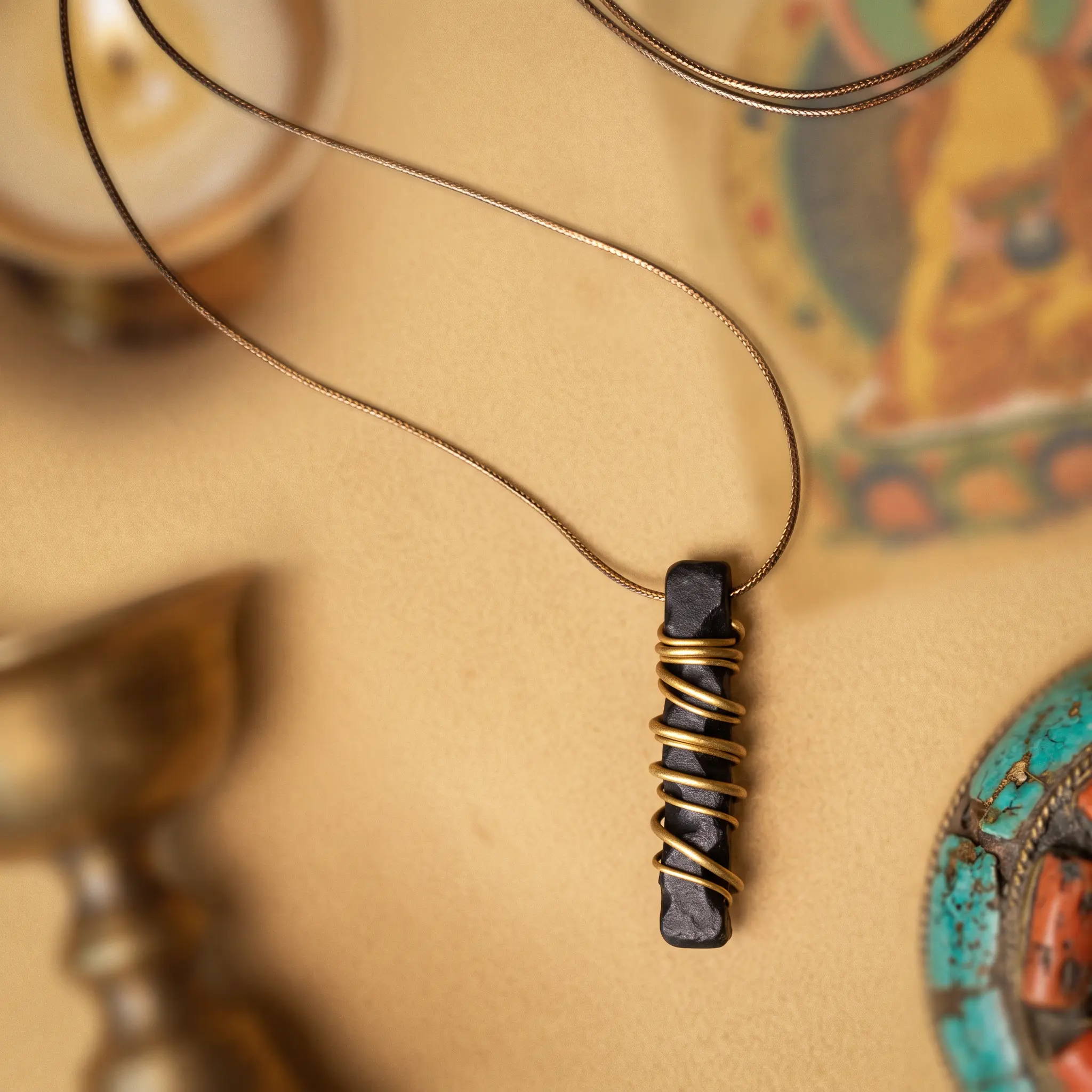
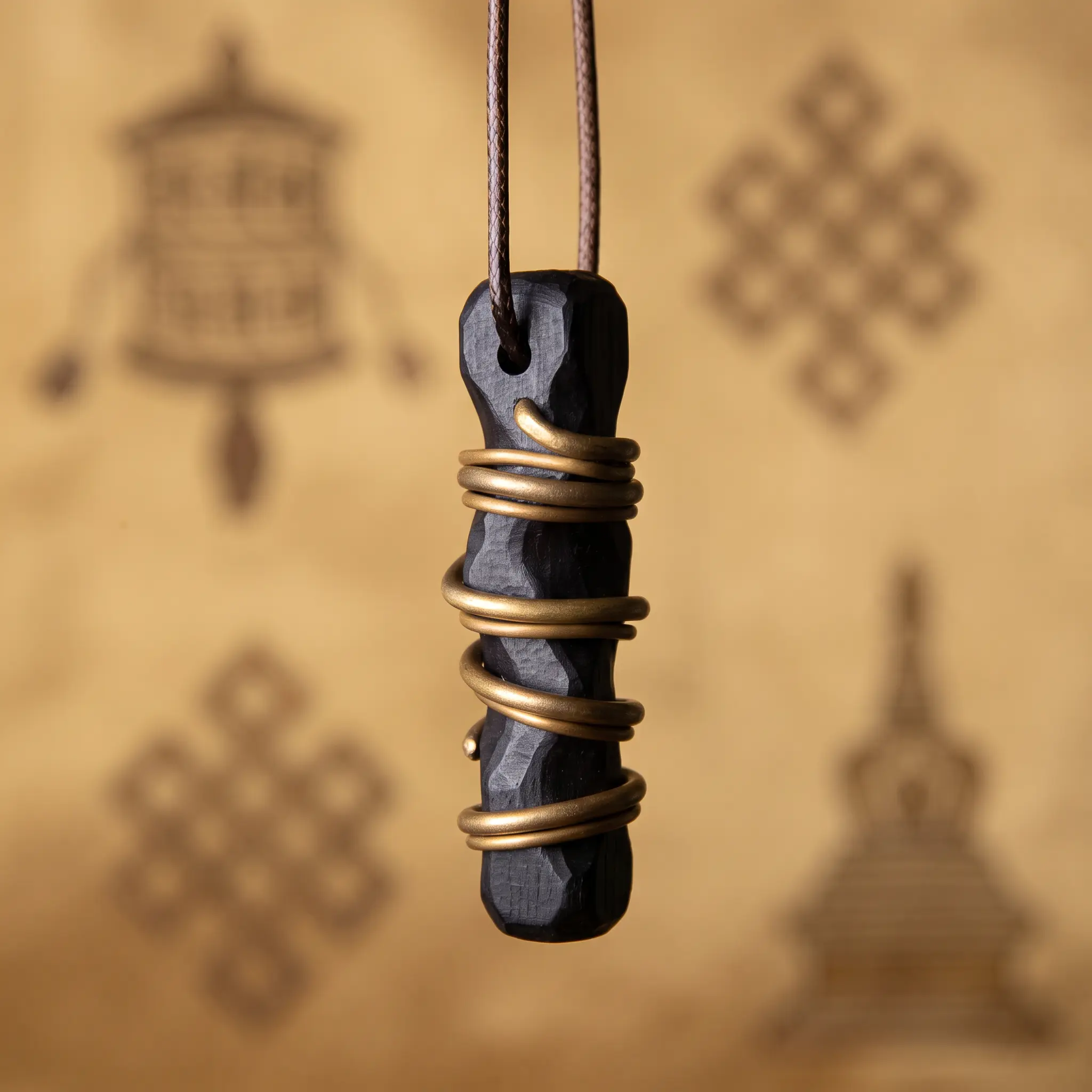
- Wear it: as a bracelet or pendant that stays with you through the day.
- Place it: on a desk or near an entryway, within arm’s reach.
- Hold it: during a few minutes of slow, breathing-based meditation.
Wearing It: Bracelets and Pendants
At Mohs 7, smoky quartz resists scratches from dust and keys far better than softer stones like selenite, which rates 2. That hardness makes it a practical choice for daily wear. Browse natural crystal bracelets for everyday grounding to compare styles.
Buying it as a gift? Ask the seller about treatment first, so the recipient gets exactly what the listing says.
Placing It: Desk, Entryway, and Meditation
On a desk, a smoky quartz point works as a visual cue to pause and breathe. Near an entryway, tradition treats it as a protective threshold stone. In meditation, hold it for five to ten minutes while you breathe slowly.
Many crystal guides cast black tourmaline as the shielding stone and smoky quartz as the grounding stone. Our ranking of the best crystals for protection from negative energy compares the options.
Results depend on your own consistency, not on the stone.
Before You Buy: A 7-Question Seller Checklist
Ask these seven questions before you pay; a straight answer matters more than which answer you get.
- Is the color natural or irradiated? Both are acceptable when disclosed.
- Where was it mined? A named locality is a good sign.
- Has it been heated? Heat can change or remove the color.
- Why is this lot so uniform? Identical black points at a low price need an explanation.
- Can you send photos in strong backlight? You want to see edge translucency.
- What is your return policy if a treatment surfaces later? A clear window protects you.
- Is it quartz or glass? Ask them to confirm the material.
What a Good Answer Sounds Like (and What the FTC Says)
A good seller names the origin, states any treatment plainly, and offers a return window. A vague reply such as “it’s all natural energy” is a flag. Black Friday deals on large, uniformly black points are a good moment to ask question four.
The FTC’s Jewelry Guides (16 CFR §23.24) call it unfair or deceptive to hide a gemstone treatment in three cases. Those are a treatment that is not permanent, one that creates special care needs, or one that significantly affects value. Heat and long UV exposure can pale smoky quartz, so asking is reasonable. The Guides are guidance for sellers, and this article is not legal advice.
Keeping the Color After You Buy
To protect the color, keep the stone away from ovens, torches, hot car dashboards, and sun-baked windowsills. Smoky quartz fades above roughly 392 °F (200 °C), and long, strong sunlight can pale it too. Everyday warmth will not hurt it.
A quick rinse in lukewarm water and a soft dry cloth are enough for cleaning. For more routine care mistakes to avoid, read about beginner crystal care mistakes like sun-fading quartz.
In summary, natural and irradiated smoky quartz are both real quartz, and disclosure is what matters. Read the clues, ask the seven questions, and protect the color from heat and long sunlight. The bottom line is simple: you are buying a grounding stone, so buy one you understand.
Shop grounding crystal bracelets with honest stone descriptions.
Browse PotalaStore’s grounding crystal bracelets and read each listing’s stone details before you choose.Shop Crystal Bracelets →
Frequently Asked Questions About Smoky Quartz
No. Smoky quartz is typically colored with gamma rays, often from cobalt-60, which shift electrons inside the crystal but do not make the stone radioactive. The Health Physics Society’s Ask the Experts column reports no radiation hazard from irradiated smoky quartz.
It can. Heating above roughly 392–572 °F (200–300 °C) or long exposure to strong UV light can pale both natural and irradiated stones. That is also why the popular sunlight test cannot tell them apart.
In crystal tradition, smoky quartz is linked to the root chakra and most often paired with Capricorn and Scorpio. These are belief-based associations, not scientific properties.
Keep wearing it if you love it. It is still genuine quartz and safe to handle. Care for it like any quartz, and our guide on how often to cleanse a crystal bracelet covers a simple schedule.
📚 References
- Irradiated Gemstones (Ask the Experts): An expert’s answer on radiation safety of irradiated smoky quartz, including gamma versus neutron irradiation. Health Physics Society
- Quartz Color Treatments: Dose ranges and results for irradiating quartz with cobalt-60, gamma, X-ray, and electron radiation. International Gem Society
- Ametrine with Layers of Smoky Quartz: Gem News International (Summer 2000) on natural irradiation of aluminum-rich zones producing smoky color layers. GIA, Gems & Gemology
- 16 CFR §23.24, Disclosure of Treatments to Gemstones: The FTC’s guidance on when sellers should disclose gemstone treatments. eCFR, Federal Trade Commission
- Backgrounder on Irradiated Gemstones: Regulatory background and safety statements on irradiated gemstones. US Nuclear Regulatory Commission