
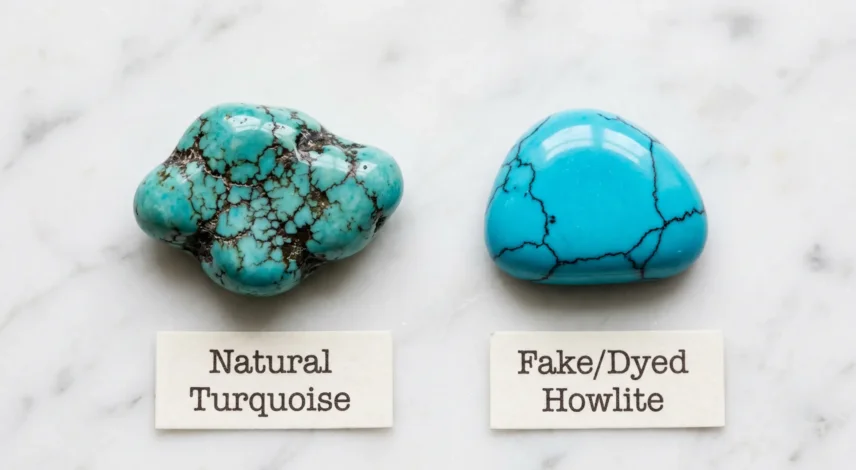

If you’ve ever bought turquoise and quietly wondered — even for a second — whether it was genuine, that instinct is worth trusting. Industry estimates suggest over 90% of the “turquoise” sold today is dyed howlite, reconstituted powder, or outright plastic. And the fakes have gotten very convincing.
At PotalaStore, we’ve sourced Himalayan turquoise directly from Tibetan artisan communities for over a decade — which means we’ve examined thousands of pieces and seen nearly every imitation technique in circulation. This guide gives you the same tests our sourcing team uses, including one method — the UV light test — that almost no other guide covers.
Real turquoise is a hydrated copper-aluminum-phosphate mineral (chemical formula CuAl₆(PO₄)₄(OH)₈·4H₂O) with a Mohs hardness of 5–6, a specific gravity of 2.6–2.8, and a natural waxy luster. The most common fake is dyed howlite — a soft white mineral (Mohs 3.5) colored blue-green with aniline dye. Seven at-home tests, starting with the acetone test, will tell you which one you’re holding.
💡 Fastest test: Dip a cotton swab in acetone (nail polish remover) and rub it gently on a hidden spot for 10 seconds. If the swab picks up a blue-green stain, the color is dye — not mineral. Real turquoise shows no color transfer because its color is structural, not applied.
What Real Turquoise Actually Is
Turquoise forms when copper-bearing groundwater reacts with aluminum-rich rock in arid, high-altitude environments — a process that takes thousands to millions of years. That geological origin explains why no dye or resin can fully replicate its physical properties: the color is chemically bonded into the mineral structure itself, not layered on the surface.
According to the Gemological Institute of America (GIA), natural turquoise ranks 5 to 6 on the Mohs hardness scale and has a specific gravity of 2.6–2.8 — measurably denser than the minerals most commonly used as imitations. Its color, ranging from sky blue to greenish-blue, comes from copper ions embedded in the crystal lattice. Where iron substitutes for aluminum in the structure, the color shifts greener.
The matrix — the dark veining you see in most turquoise — is host rock from the original mining environment: iron oxide, black chert, pyrite, or sandstone. In genuine stone, matrix lines have irregular, organic boundaries that fade gradually into the blue-green mineral. In fakes, the matrix is either painted on (sharp, uniform edges) or absent entirely (a single, perfectly flat color).
| Property | Real Natural Turquoise | Dyed Howlite (Most Common Fake) | Plastic / Resin |
|---|---|---|---|
| Mohs Hardness | 5–6 | 3.5 | 2–3 |
| Specific Gravity | 2.6–2.8 | 2.5–2.6 | 1.0–1.3 |
| Feel (Temperature) | Cool, dense in hand | Slightly lighter; similar coolness | Warm, noticeably light |
| Acetone Test | No color transfer | Blue-green stain on swab | No stain (melts with heat) |
| Matrix Pattern | Irregular, organic edge variation | Painted-on, too uniform | Printed or absent |
| Price per Carat (Natural) | $20–$200+ USD | $0.50–$5 | Cents |
How to Tell Real from Fake Turquoise: 7 Tests You Can Do at Home
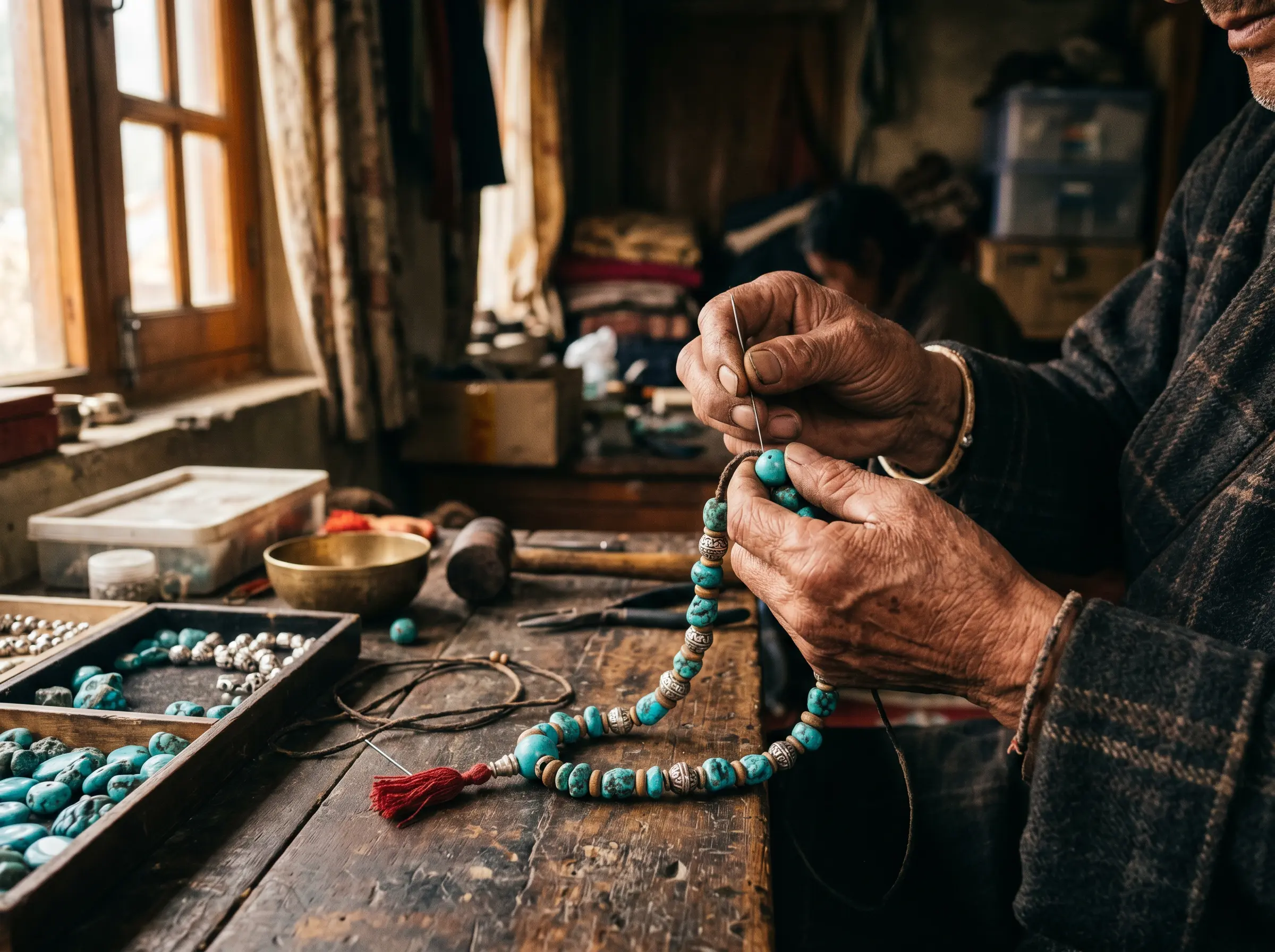
Here are 7 tests you can run at home or in a store before buying. Run at least three for a reliable verdict:
- 1The Acetone TestDip a cotton swab in acetone (nail polish remover) and gently rub a hidden spot for 10 seconds. Real turquoise shows no color transfer — the blue-green color is chemically structural. A stained swab means dye. Don’t use this on lacquer-coated or finished jewelry, as acetone dissolves most surface treatments.
- 2The Scratch TestA US copper penny has a Mohs hardness of roughly 3.5. Lightly drag it across a hidden surface. Real turquoise (Mohs 5–6) will not be scratched by a penny. Dyed howlite and magnesite (both Mohs 3.5) will scratch easily. If a fingernail (Mohs 2.5) leaves a mark, it’s almost certainly plastic or chalk turquoise.
- 3The Water Absorption TestPlace a drop of water on the surface and watch for 30 seconds. Natural untreated turquoise is porous — it will visibly absorb the droplet. Stabilized turquoise, plastic, and most coated fakes bead the water into a perfect sphere. This also reveals lacquer coatings: the drop will remain spherical far longer than it would on bare stone.
- 4The Temperature & Weight TestHold the stone in your closed palm for 20–30 seconds. Real turquoise (specific gravity 2.6–2.8) feels cool and noticeably dense. Plastic and resin fakes (specific gravity 1.0–1.3) feel lighter and warm to body temperature within seconds. This test is most effective when comparing two similar-looking pieces side by side.
- 5The Hot Needle TestHeat a metal needle until the tip glows red, then touch it briefly (1 second) to a hidden spot — the inner wall of a bead hole works well. Real turquoise and natural stone won’t melt or emit a burning plastic smell. Plastic, resin, and block turquoise will melt slightly or produce a chemical odor. This is a destructive test; use only on inconspicuous surfaces.
- 6The Magnification TestUse a 10× jeweler’s loupe or a smartphone macro lens to examine the matrix veining. In genuine turquoise, matrix lines vary in width, fade organically at their edges, and have a three-dimensional depth into the surface. In painted fakes, lines are suspiciously uniform in width with hard stop edges. Also look for dye pooling in natural cracks — real mineral color doesn’t pool.
- 7The UV Light Test Unique to this guideHold the stone under a 365 nm longwave UV flashlight in a darkened room. Real natural turquoise typically shows weak or no fluorescence. Dyed howlite, however, often emits a soft blue-white glow under UV because the aniline dyes used in the coloring process are UV-reactive. This test is especially useful when the other five are inconclusive. Longwave UV flashlights are available for under $15 and are worth adding to any gemstone buyer’s kit.
⚠️ What about “stabilized” turquoise? Stabilized turquoise is genuine natural turquoise infused with a colorless polymer to harden low-grade material and deepen its color. It is not fake — it’s real stone that has been treated. Reputable sellers are required to disclose stabilization. It will typically fail the water absorption test (the polymer seals surface pores) and is generally less valuable than natural, untreated stone. Always ask before you buy.
The 4 Most Common Turquoise Imitations — and How to Spot Each
Not all fakes are created equal. Knowing what you’re actually holding speeds up identification significantly.
| Imitation Type | What It Is | Dead Giveaway |
|---|---|---|
| Dyed Howlite | A white mineral (Mohs 3.5) dyed blue-green with aniline dye. The most common substitute worldwide. | Blue stain on acetone swab; glows blue-white under 365 nm UV; scratches with a penny |
| Dyed Magnesite | Similar to howlite; sold as “African turquoise” or “white buffalo turquoise.” Naturally white to pale gray. | Acetone test positive; overly vivid, uniform color; scratches easily; no organic matrix variation |
| Block / Reconstituted Turquoise | Turquoise powder — often genuine but low grade — mixed with resin and pressed into blocks. Technically contains real turquoise but in highly diluted form. | Perfectly uniform color and texture from edge to edge; no organic variation; hot needle test produces slight melt |
| Plastic / Resin | Fully synthetic material, often with printed matrix patterns. Lightweight and warm to the touch. | Warms in hand immediately; distinctly light; hot needle melts and smells of burning plastic; no porosity |
One treatment worth knowing about specifically: Zachery-treated turquoise is genuine natural turquoise subjected to an electrochemical potassium-enrichment process invented by engineer James E. Zachery. Unlike standard stabilization, it contains no polymer — so it passes most at-home tests. According to a 1999 peer-reviewed study published in GIA Gems & Gemology, detection requires EDXRF spectroscopy to identify abnormal potassium levels in the stone’s chemical profile. If you’re purchasing high-value pieces, request a GIA gemological certificate.
The “Tibetan Turquoise” Label Problem: What Most Sellers Won’t Tell You
Here’s the uncomfortable truth: the majority of jewelry sold as “Tibetan turquoise” in the US market isn’t from Tibet at all. Most of it is sourced from Hubei Province in China — a major commercial turquoise-producing region that supplies the global wholesale trade with high-volume, affordable material. Hubei turquoise is real turquoise. It’s not a fake. But calling it “Tibetan” is a provenance misrepresentation, not a material one.
Genuine turquoise from the Tibetan plateau — called gyu in Tibetan — is traditionally sourced from four regions: Lhasa, Ngari-Khorsum, Draya, and Derge. Stone from these high-altitude Himalayan deposits has a distinct character that differs from Hubei or American material:
- A denser, darker spiderweb matrix — near-black or iron-brown veining from pyrite-rich Himalayan host rock
- A more subdued, greenish-blue color range rather than the bright electric blue associated with Sleeping Beauty (Arizona) material or most Hubei stock
- Greater variation between individual pieces — high-altitude deposit conditions produce less uniform material than commercial-scale Chinese mining operations
- Higher per-piece pricing: $80–$200+ USD for a single authentic mala, reflecting genuine sourcing scarcity and traditional artisan labor costs
We’ve encountered this directly at PotalaStore. When we began working with Tibetan artisan communities — a relationship maintained since 2014 through our monastery partners at Sera Jhe in India and Kopan in Nepal — it quickly became clear that “Tibetan turquoise” had become a loosely applied marketing label rather than a verifiable provenance guarantee. That’s why we only carry pieces we can trace to their source community.
🙏 Read how PotalaStore works with Tibetan artisan communities — including our monastery sourcing standards and why 10% of every sale goes directly to the artisans who handcraft each piece.
Reading the Spiderweb Matrix: The Authentic Himalayan Turquoise Signature
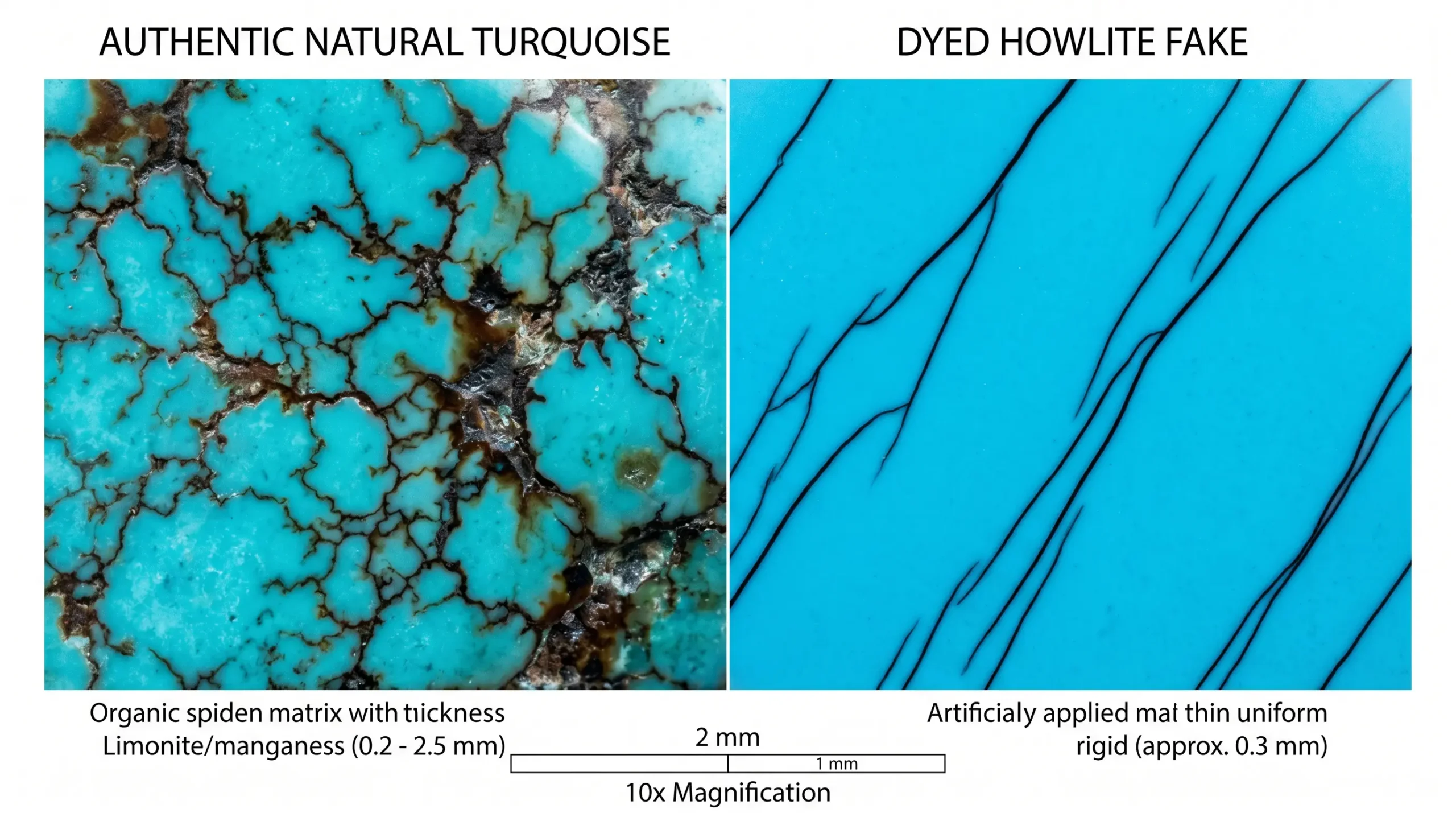
The spiderweb matrix is the most reliable visual marker for authentic Tibetan turquoise — and the hardest feature for imitations to replicate convincingly. It forms when mineral-rich solutions fill microscopic fractures in the surrounding host rock before slowly crystallizing over thousands of years. The pattern is a geological record of the specific environment where the stone formed, which is why no two genuine pieces are identical.
Here’s how to read it with confidence:
- Organic edge variation: In genuine turquoise, matrix veins vary in thickness along their length and fade gradually at their edges — the blue-green mineral bleeds slightly into the vein border, creating a soft, natural transition. In painted fakes, each line starts and stops with a hard, perfectly uniform edge.
- Depth and dimension: Under 10× magnification, real matrix has a three-dimensional quality — veins appear to go into the surface, not sit on top of it. A printed or applied matrix appears perfectly flat regardless of the viewing angle.
- Color variation within the blue area: Genuine Tibetan turquoise rarely has a perfectly uniform blue across its entire surface. You’ll see subtle gradients — slightly greener near matrix lines, slightly bluer at the center of larger areas — because the copper content varies microscopically throughout the stone. Perfect color uniformity is a warning sign.
- Matrix color itself: Authentic Tibetan plateau material typically has a near-black matrix with reddish or rusty undertones from iron-oxide compounds in the host rock. Matrix that is perfectly charcoal gray and completely consistent throughout suggests reconstituted material or dyed howlite with an applied pattern.
📸 [CMS: Insert 3 comparison photos here — (1) authentic Tibetan spiderweb matrix at 10× showing organic edge variation, (2) dyed howlite fake with uniform painted-on lines, (3) reconstituted block turquoise showing flat, consistent color. Alt text: “Authentic Tibetan turquoise spiderweb matrix close-up” / “Fake turquoise dyed howlite matrix comparison” / “Reconstituted block turquoise vs natural turquoise”]
💎 Each of our Tibetan Turquoise Malas for Protection features a natural spiderweb matrix verified by our sourcing team — with each piece traceable to its Himalayan artisan community.
How to Shop for Authentic Tibetan Turquoise Without Getting Burned
The seven tests above are your best defense when you can hold the piece in hand. When shopping online — where you can’t physically examine the stone — use these buying criteria instead:
- Price signals the truth. Natural untreated turquoise starts at around $20 per carat. An “authentic Tibetan turquoise” mala priced at $15 is almost certainly reconstituted powder or dyed howlite. Genuine Himalayan-sourced malas with verifiable provenance typically run $50–$200+.
- No treatment disclosure = red flag. Reputable sellers always state whether their turquoise is natural, stabilized, or reconstituted. Silence on this question tells you something.
- Uniformly bright, electric blue color. Genuine Tibetan plateau stone trends toward a deeper, slightly greenish blue. Unnaturally vivid, perfectly consistent blue is common in dyed or reconstituted material.
- Vague origin language. “Tibetan style,” “Himalayan-inspired,” and “boho turquoise” are phrases used when the seller can’t verify the actual source. Look for sellers who can name the artisan community, region, or monastery partner.
- Ask directly: “Is this natural, stabilized, or reconstituted?” and “What is the source region?” Honest sellers answer immediately. Vague or defensive responses tell you everything you need to know.
For US buyers purchasing jewelry labeled “Native American” or “Navajo-made”: the Indian Arts and Crafts Act (IACA, 1990) makes it a federal offense to misrepresent non-Native-made goods as Native American origin — with individual penalties of up to $250,000 and business fines of up to $1,000,000. Always verify hallmarks (silversmith stamps) and request tribal affiliation documentation from dealers who use this labeling.
For spiritual and mala jewelry specifically, authentic sourcing matters for reasons beyond material quality. Our Tibetan mala and necklace collection includes verified turquoise pieces with transparent sourcing — each made by artisans whose craft supports monastery communities that have preserved Himalayan traditions for centuries. Learn more about what makes traditional Tibetan craftsmanship distinctive in our guide to authentic Tibetan bracelet sourcing.
Frequently Asked Questions
The fastest home test is the acetone test: rub a cotton swab dipped in nail polish remover on a hidden spot for 10 seconds. A blue-green stain on the swab means the color is applied dye — the stone is not genuine. Real turquoise shows no color transfer because its color is chemically structural. Pair this with the scratch test (a US penny at Mohs 3.5 should not scratch genuine turquoise at Mohs 5–6) and the magnification test (look for organic, irregular matrix veining versus uniform painted lines) for a reliable three-test verdict.
Yes — stabilized turquoise is genuine natural turquoise that has been infused with a colorless polymer resin to harden lower-grade material and intensify its color. It is not a fake, but it is treated stone. Reputable sellers are required to disclose stabilization. Stabilized turquoise is generally less valuable than natural untreated stone. It typically fails the water absorption test because the polymer seals surface pores, and it responds differently to long-term wear than natural stone.
Authentic Tibetan turquoise — called gyu in Tibetan — comes from high-altitude mining regions on the Tibetan plateau, historically from Lhasa, Ngari-Khorsum, Draya, and Derge. It’s characterized by a dense dark spiderweb matrix, near-black veining from iron-rich host rock, and a deeper greenish-blue color compared to American or commercial Chinese material. However, most jewelry labeled “Tibetan turquoise” in the US market is sourced from Hubei Province, China — genuine turquoise, but not plateau-origin stone. Honest sellers will tell you which one they carry.
Does real turquoise change color over time?
Yes — natural, untreated turquoise can gradually shift toward a greener hue over years of wear. This happens because skin oils, cosmetics, and light exposure slowly oxidize the copper in the stone’s mineral structure (CuAl₆(PO₄)₄(OH)₈·4H₂O). Tibetan tradition views this color shift as the stone “absorbing” the wearer’s energy — a sign of an authentic, living mineral. Stabilized turquoise resists color change because the polymer seals the pores. Dyed fake turquoise fades abruptly and unevenly, which is a very different process and easy to distinguish.
Shop Verified Tibetan Turquoise
Every turquoise piece we carry is handcrafted by Tibetan artisans and traceable to its source community. No vague labels. No mystery materials. 10% of every sale goes directly back to the artisans.
Tibetan Turquoise Mala for Protection →Browse All Tibetan Malas
📚 References
- Turquoise Gemstone Properties — Hardness, Composition & Care. Authoritative data on turquoise mineral composition, Mohs hardness (5–6), and specific gravity (2.6–2.8). Gemological Institute of America (GIA)
- The Identification of Zachery-Treated Turquoise. Fritsch, E., et al. (Spring 1999). Peer-reviewed study on the electrochemical potassium-enrichment treatment; detectable only via EDXRF spectroscopy based on abnormal potassium levels. GIA Gems & Gemology
- Natural Gemstones — Mineral Properties: Turquoise. USGS reference data on turquoise mineralogy including chemical composition and specific gravity range. U.S. Geological Survey (USGS)
- The Indian Arts and Crafts Act of 1990. Federal statute governing misrepresentation of non-Native-made goods as Native American; penalty structure for individuals (up to $250,000) and businesses (up to $1,000,000). U.S. Department of the Interior — Indian Arts and Crafts Board