
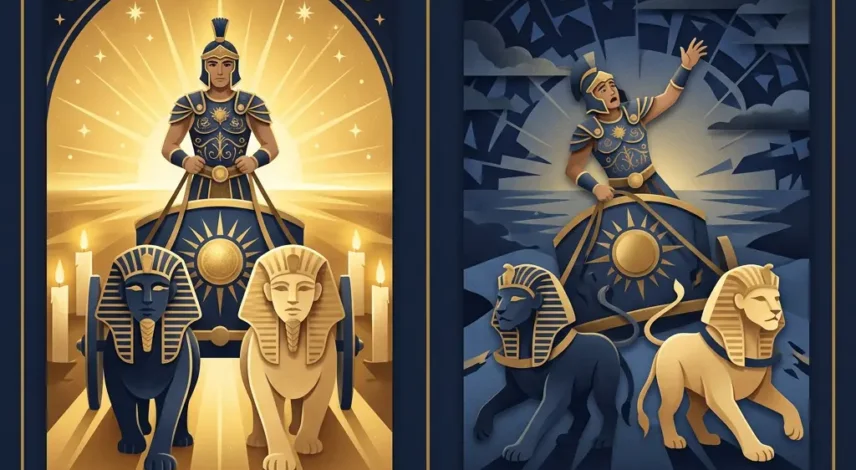

You just drew a card showing an armored charioteer with no reins and two sphinxes pulling in different directions. Is it a green light or a warning? In short, the Chariot tarot card is about willpower with a direction: you move forward by steering opposing pulls, not by making them disappear.
This guide explains the Chariot, Major Arcana card VII, in the Rider-Waite-Smith deck, including its upright and reversed meanings plus love, career, and yes-or-no readings. At PotalaStore, we compared Biddy Tarot’s and Labyrinthos’s published meanings with A. E. Waite’s original 1910 text, so you get the familiar reading and the shadow side most guides skip. New to the deck? Start with our guide to all 78 tarot card meanings, then come back to card VII.
Table of Contents
What Does the Chariot Tarot Card Mean?
The Chariot is Major Arcana card VII, and it traditionally stands for willpower, determination, and victory through self-control. Upright, it suggests you can move forward by steering two opposing forces in one direction. Reversed, it often points to lost direction, scattered effort, or pushing so hard that the push becomes the problem.
| Feature | Upright | Reversed |
|---|---|---|
| Core message | Steer opposing forces toward one goal | Direction or control has slipped |
| Keywords | Control, willpower, success, action, determination | Lack of direction, opposition, scattered effort |
| Best next step | Commit to a plan and keep moving | Pause, recheck the goal, adjust course |
| Yes or no | Yes, if you stay focused | Not yet |
| Watch out for | Pushing too hard | Gripping too tightly or losing motivation |
Upright Meaning: Willpower, Direction, and Earned Victory
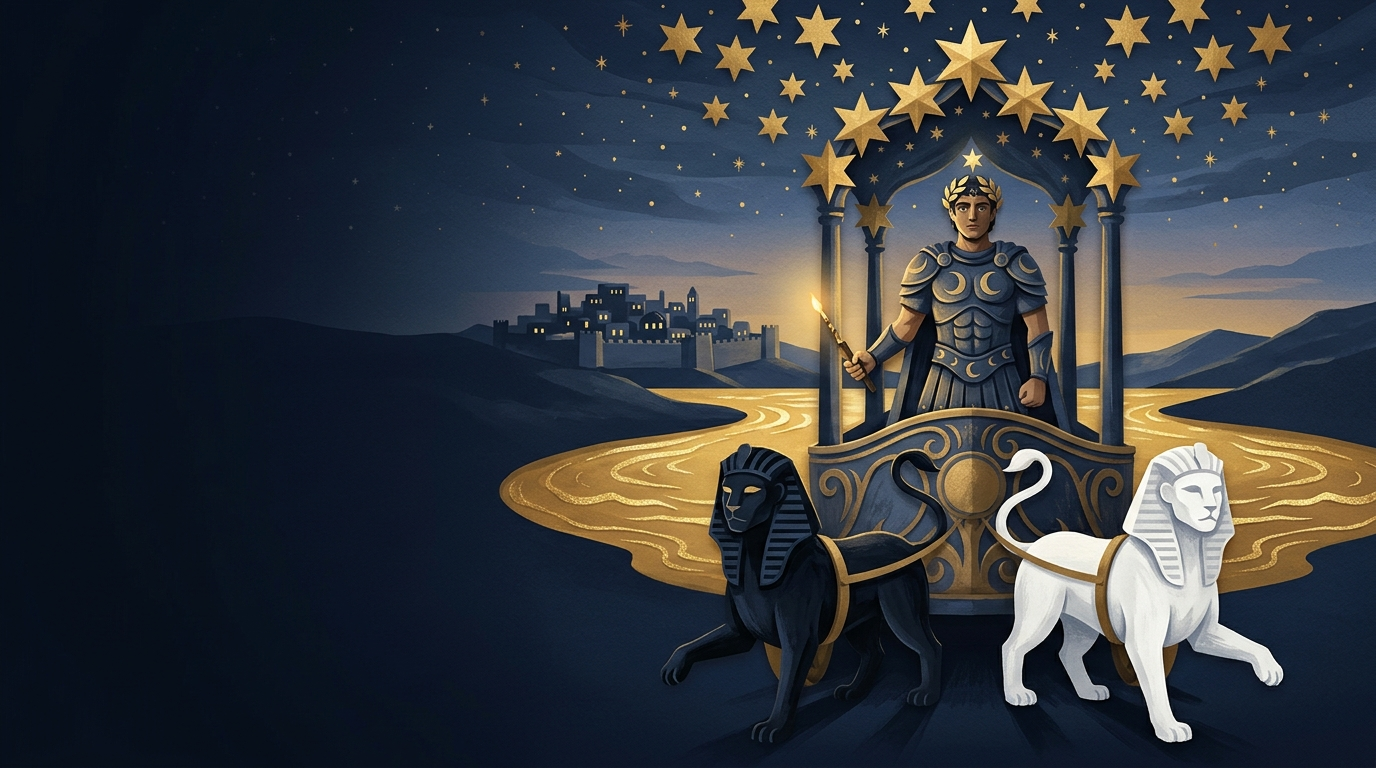
Upright, the Chariot suggests you have what it takes to reach a goal, as long as you keep your focus and steer instead of drift. Biddy Tarot lists five upright keywords: control, willpower, success, action, and determination. The card follows The Lovers, where you clarify your values, so the Chariot is the moment you act on that choice.
Expect resistance along the way. The two sphinxes pull in different directions, and the charioteer wins by holding course, not by luck. In practice, that means choosing one goal, setting a schedule, and finishing before you start something new. When your question is literal, the card can also point to travel, such as a road trip or a move.
What Does the Chariot Reversed Mean?
Reversed, the Chariot usually means your control or direction has slipped, either because you are pulled in too many directions or because you are forcing the outcome. It tends to show up in two forms. In the first, you have lost motivation, and the sphinxes are pulling you apart. In the second, you grip every detail so tightly that the whole project stalls.
Biddy Tarot’s reversed keywords are self-discipline, opposition, and lack of direction, and she advises re-evaluating whether you need to change course. Try writing your goal in one sentence, then ask whether it still matters to you. If it does, simplify the plan. If it does not, you can let it go. Feeling stalled is common, and it does not mean you failed.
Is the Chariot a Yes or No Card?
Upright, the Chariot is traditionally read as a yes, but a conditional one: yes, if you stay focused and do the steering. Reversed, many readers interpret it as a no or a “not yet,” a sign to regroup before pushing ahead.
The condition matters. The card answers yes to effort and commitment, not to luck. If you draw it upright for something you have not started, read it as “yes, once you commit to a plan.” Yes-or-no pulls are a simplification, so treat the answer as a prompt for reflection, not a ruling.
Card VII’s Hidden Map: Sphinxes, Cancer, and the Hebrew Letter Cheth
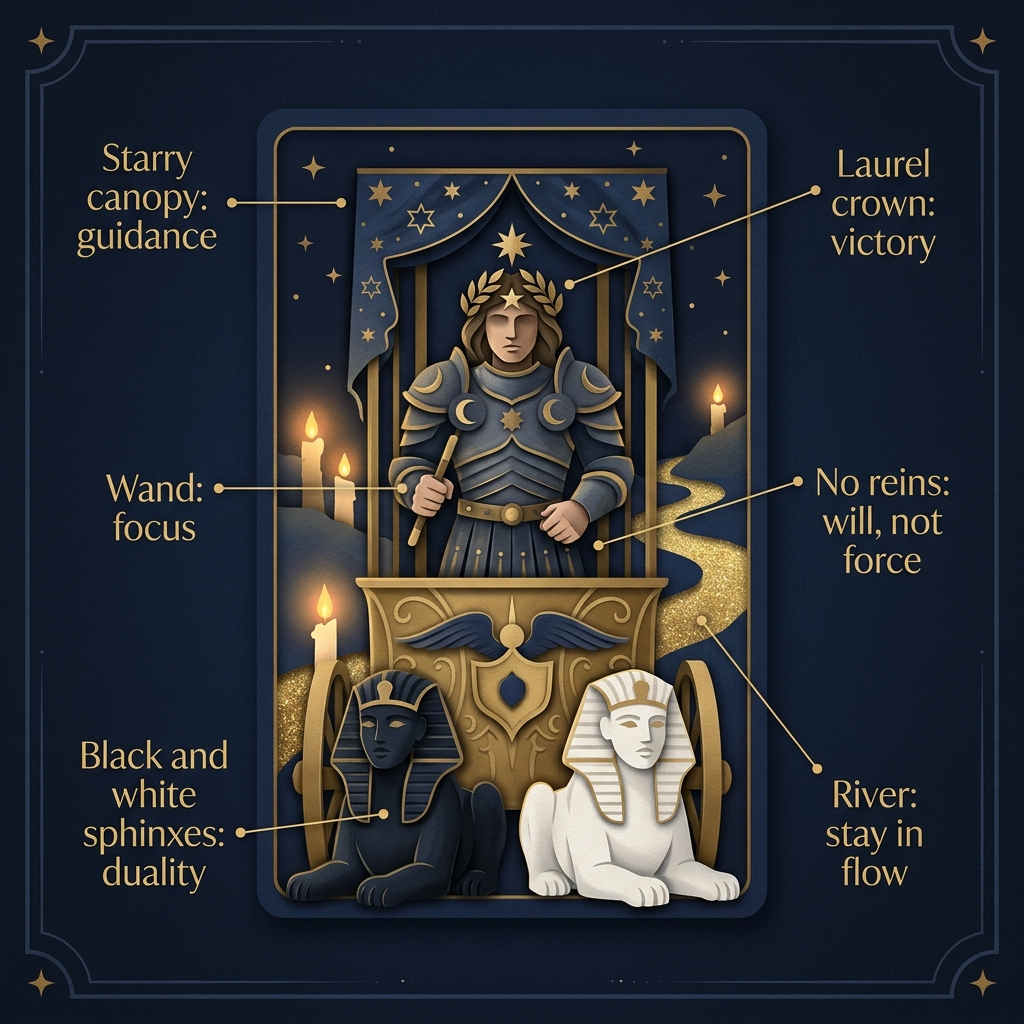
Most of the Chariot’s meaning is hiding in plain sight on the card itself, starting with the fact that the charioteer holds no reins. Each symbol maps to an idea you can use in a reading.
The Black and White Sphinxes and the Missing Reins
The black sphinx and the white sphinx represent opposing forces, and the charioteer steers them without reins, through will alone. Biddy Tarot reads the pair as duality, positive and negative, pulling in opposite directions while he steers the chariot forward.
The rest of the image supports that reading. Crescent moons decorate his armor, a square marks his tunic, and a laurel crown with a star signals victory. He holds a wand like The Magician’s, and a canopy of six-pointed stars hangs overhead. A river flows behind the chariot, and a walled city sits in the distance.
Descriptions differ on one detail. Some guides say the charioteer sits, while Biddy Tarot says he stands tall in the chariot. We follow Biddy Tarot here.
What Zodiac Sign Is the Chariot?
In the Golden Dawn system used by the Rider-Waite-Smith deck, the Chariot corresponds to Cancer, the cardinal water sign, and to the Hebrew letter Cheth, which is commonly translated as “fence” or “enclosure.” That pairing echoes the crab’s protective shell carried into motion: a protected space that moves. Wikipedia also lists the Moon, Cancer’s ruling body, as the card’s planetary link.
In Golden Dawn teaching, Cheth also labels the Tree of Life path between Binah (understanding) and Geburah (severity), the 18th path. These pairings are tradition-specific. Éliphas Lévi linked the Chariot to Zayin, and the Golden Dawn later gave Zayin to The Lovers and Cheth to the Chariot. If your deck follows a different system, check its guidebook before using these correspondences.
From Marseille Horses to Waite’s Sphinxes
Older decks like the Tarot de Marseille show the chariot pulled by horses; the sphinxes arrived through the French occultist Éliphas Lévi, whose design A. E. Waite adopted for the 1909 Rider-Waite-Smith deck. Italian tarocchi decks called the card il Carro, “the cart,” long before either man.
Waite wrote that he accepted Lévi’s variation of two sphinxes drawing the chariot, and he described the figure as, above all, a triumph of the mind. Pamela Colman Smith illustrated the deck, which is why the Rider-Waite-Smith Chariot looks so different from the older horse-drawn versions.
Love, Career, and Feelings: How the Charioteer Reads in Context
The Chariot keeps the same core message in every kind of reading, which is to pick a direction and steer, but what it asks of you changes with the question. Tarot can help you reflect on a decision, but it is not a substitute for financial, legal, or medical advice.
What Does the Chariot Mean in Love?
In love, the Chariot usually suggests taking initiative, making your intentions clear, and moving a connection forward on purpose. Labyrinthos reads the upright card as taking action on love and taking control of your love life. It also notes the card can signal a need to balance two urges.
If you are single, that can mean making the first move or planning the date instead of waiting. In a relationship, the two sphinxes become two needs, and the card asks you to steer them the same way. Reversed, the pull can turn into controlling behavior or mismatched pacing, so slow down and check in with the other person.
The Chariot in Career and Money Readings
In career readings, the Chariot is one of the most encouraging cards you can draw, favoring ambition backed by a clear plan. Labyrinthos links it to strong ambition, motivation, and control at work, and to determination in reaching financial goals. Think promotions, deadlines, and finishing a project you started.
Example scenario: say you are weighing a job offer and pull the Chariot upright. A traditional reading would not say “take it.” It would ask whether you can name the goal and commit to the steps. Reversed, the card often signals scattered energy or burnout, so check where your effort is leaking.
If you want a physical reminder of a goal you have committed to, browse our Attract Success collection of intention jewelry.
What Does the Chariot Mean as Feelings?
As feelings, the Chariot describes someone who has made up their mind and is acting on it, with drive and focus rather than soft declarations. Upright, expect directness: plans, effort, and follow-through. Reversed, it can describe someone who wants to move forward but is unsure how, or who is pulled between two options.
Keep one limit in mind. A card describes a pattern, not another person’s private thoughts, so use it as a conversation starter rather than proof of what someone feels.
Victory or Presumption? Waite’s Shadow Side of Card VII
Even upright, the Chariot carries a shadow, because A. E. Waite’s own 1910 list of meanings pairs triumph with war, presumption, and vengeance. That list is the clearest place to see what modern keyword summaries leave out.
Waite’s 1910 Divinatory List: Help, Triumph, and Trouble
Waite’s upright list reads: “Succour, providence; also war, triumph, presumption, vengeance, trouble.” It mixes help and conquest in one breath. Succour and providence point to support arriving. War and vengeance point to conflict. Presumption warns of overconfidence.
His reversed meanings are blunter, naming riot, quarrel, dispute, litigation, and defeat. Many modern keyword lists, including Biddy Tarot’s, keep the willpower and success side and leave out the presumption and vengeance side.
When Drive Turns Into Control: Shadow Signals to Watch
Many readers interpret the Chariot’s shadow as winning the argument but losing the room. Drive that ignores other people can slide into aggression, even when your goal is good. Ask yourself three questions:
- Am I guiding or steamrolling? Steering means adjusting to the road, not forcing it.
- Have the people affected been heard? A plan that only you understand is easy to resist.
- What will remain after I win? A victory that costs a relationship may not be worth it.
Willpower vs. Inner Strength: Where the Card Sits Between The Lovers and Strength
The Chariot makes the most sense as the middle step of a three-card story: The Lovers choose, the Chariot acts, and Strength learns to lead without force. Reading the three cards together shows why the Chariot’s control feels different from the cards around it.
The Lovers Choose, the Chariot Acts
Biddy Tarot frames the Chariot as the moment you start acting on the values you clarified with The Lovers. In the Fool’s Journey, the Major Arcana story that begins at card 0, this is where the traveler stops deciding and starts moving. If you are following the sequence, begin with The Fool tarot card, card 0 of the Major Arcana, and read forward from there.
Chariot vs. Strength: Force of Will or Gentle Mastery?
Both cards are about control, but the Chariot controls through focused will while Strength controls through patience and compassion.
| Feature | The Chariot (VII) | Strength (VIII in Rider-Waite-Smith) |
|---|---|---|
| Method of control | Focused will and direction | Patience, compassion, and gentle persuasion |
| Energy | Outward and goal-driven | Inward and steady |
| Question it answers | How do I reach this goal? | How do I stay calm and kind while I pursue it? |
| Risk when reversed | Forcing the outcome or losing direction | Self-doubt or giving up control |
Strength is numbered VIII in the Rider-Waite-Smith deck, though some other decks number it XI. In summary, the Chariot shows control from the outside in, and Strength shows control from the inside out.
Steering the Chariot With Focus: A Grounding Practice With Tiger Eye and Mala Beads
The fastest way to work with the Chariot is to turn its image into a question: what is pulling you forward, what is pulling you off course, and who is holding the reins? The practice below takes about 10 minutes and needs only a deck and a notebook.
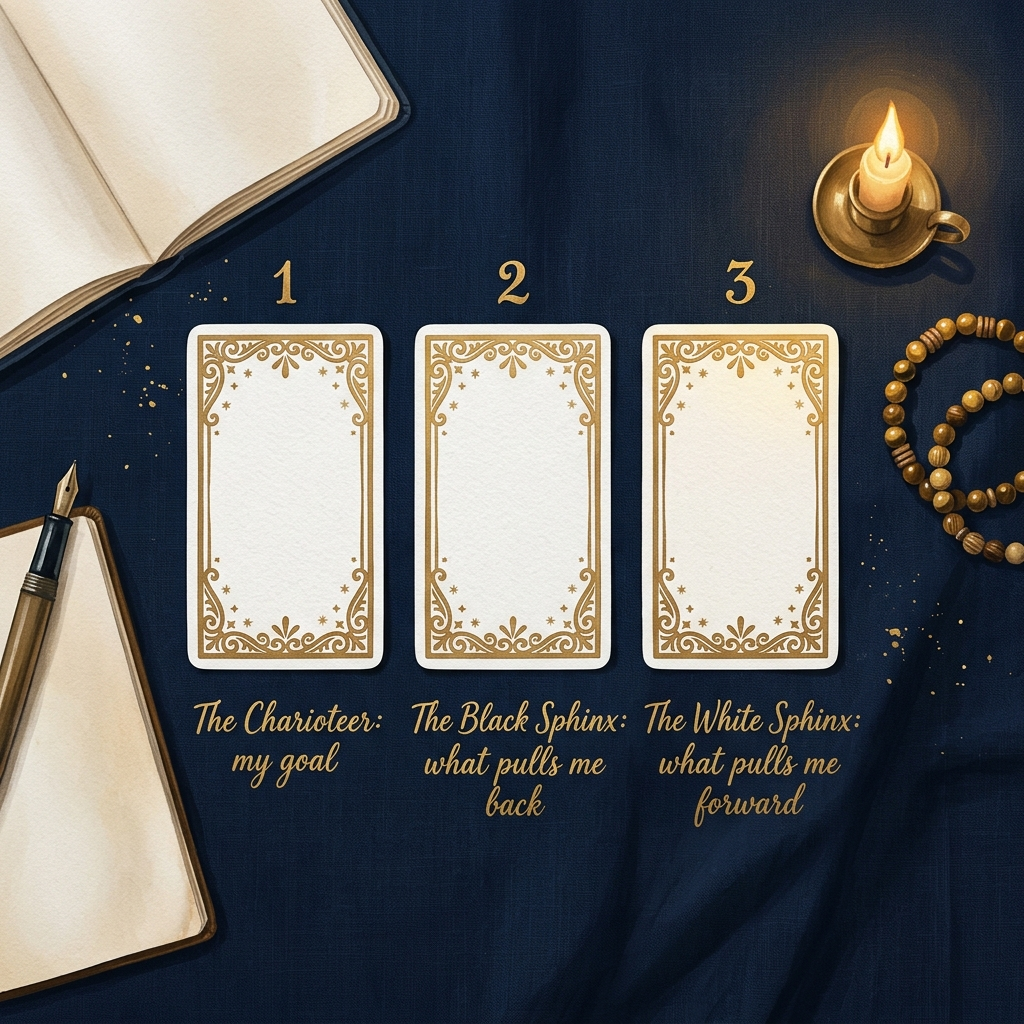
A Three-Card Charioteer Spread
A three-card spread built on the Chariot’s own image gives you a clear reflection: one card for the charioteer and one for each sphinx.
- Card 1, The Charioteer: What goal am I steering toward right now?
- Card 2, The Black Sphinx: What pulls me back or makes me hesitate?
- Card 3, The White Sphinx: What pulls me forward or gives me energy?
This layout is our own adaptation, not a traditional spread. The card only tells you the sphinxes pull in opposite directions, so the back-and-forward positions are our interpretive choice. After you draw, write one sentence for each card. Then answer this: what is one action I can finish in the next seven days?
If you are new to card positions, our guide to 10 beginner tarot spreads, from a one-card daily draw to the Celtic Cross shows how to read each placement.
Anchoring Focus With Tiger Eye or a 108-Bead Mala
If you like a physical anchor for an intention, tiger eye is traditionally associated with courage and willpower, the same qualities the Chariot asks of you. These associations come from tradition, not scientific evidence, and a bracelet will not do the steering for you. Treat it as a reminder, not a guarantee.
The Tiger Eye Chakra Bracelet for Balance pairs a tiger eye bead, which the product page links to the Solar Plexus chakra and to confidence and willpower, with chakra-colored stones. Its beads measure 0.33 inches (8.45 mm), and the sliding-knot cord adjusts to fit wrists from 6 to 8 inches. It costs $38.95 at the time of writing (regularly $48.95). When you review your Charioteer card, a glance at the golden bead can bring the goal you named back to mind.
If you prefer counting breaths, the 108 Mala Beads Bracelet has 108 beads plus a guru bead, 8 mm (0.31 inches) each, strung on an elastic cord. It wraps four times around your wrist and costs $25.95 (regularly $33.95). Touch one bead per breath through a full round to practice the steady, no-reins kind of attention the card describes.

Tiger Eye Chakra Bracelet for Balance
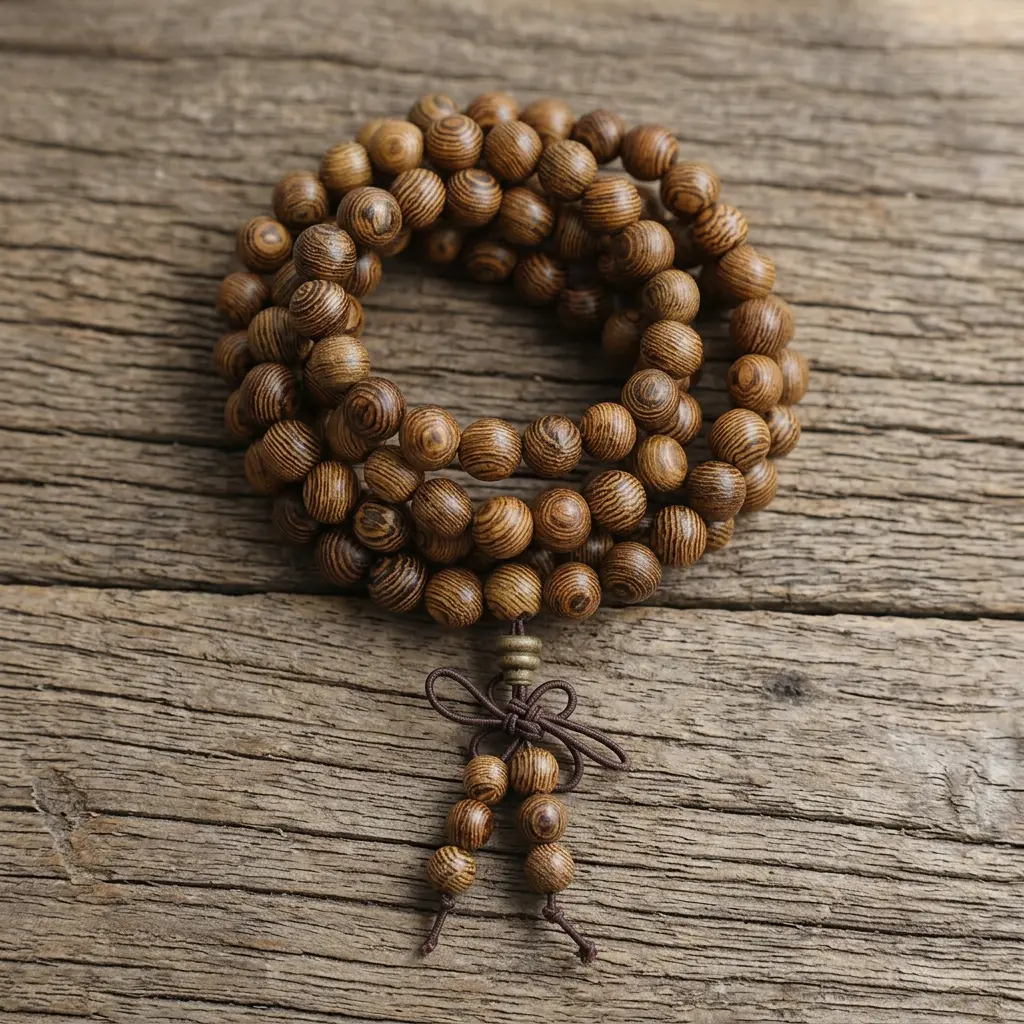
108 Mala Beads Bracelet in wenge wood
Frequently Asked Questions About the Chariot Tarot Card
As a person, the Chariot often describes someone driven, competitive, and goal-focused, like the friend who plans the road trip and also does the driving. At their best, they are decisive and reliable. On a bad day, they can steamroll quieter voices.
Most readers treat the Chariot as a positive card because it signals momentum you can earn through effort. Its positivity is conditional, though. Success depends on your focus, and a heavy-handed approach can turn drive into conflict.
Yes. In a literal sense, the Chariot is traditionally linked to travel, especially driving, road trips, or a move. Read it alongside your question: in a career spread, it more likely means professional momentum than an actual trip.
Tiger eye is a popular pairing because it is traditionally associated with courage and willpower, the same qualities the Chariot highlights. That link comes from tradition, not scientific evidence. For a simple daily reminder, wear a tiger eye bracelet while you journal on your Charioteer spread.
The bottom line: the Chariot tarot card is willpower with a direction. Upright, it asks you to commit and steer. Reversed, it asks you to pause, check your goal, and adjust. Either way, the card describes a pattern you can work with, not a fixed future.
Ready to steer?
Pair your Charioteer spread with the Tiger Eye Chakra Bracelet for Balance ($38.95), or count breaths on a 108 Mala Beads Bracelet ($25.95). Browse PotalaStore’s collection of Tibetan spiritual jewelry. Shipping is free, and orders include 60-day returns.
Shop the Tiger Eye bracelet Shop the 108 mala bracelet
Important Note: This guide reflects traditional tarot interpretations for reflection and entertainment. Tarot readings and crystals are based on traditional beliefs and personal experience, not scientific evidence. They are not substitutes for professional medical, mental health, financial, or legal advice. For major decisions, please consult a licensed professional.
References
- Biddy Tarot, The Chariot Tarot Card Meanings: Keywords, symbolism, and upright and reversed interpretations based on the Rider-Waite deck. biddytarot.com
- Labyrinthos, The Chariot Meaning: Love, career, and finance interpretations, with deck comparisons. labyrinthos.co
- A. E. Waite, The Pictorial Key to the Tarot (1910): Primary source for the Chariot’s description and divinatory meanings. Read the Chariot entry and the divinatory meanings at Sacred Texts.
- Wikipedia, The Chariot (tarot card): Overview of the card’s history and astrological association with Cancer and the Moon. en.wikipedia.org