

Pulled the Magician tarot card and wondering if it’s a green light or a warning? Upright, this Major Arcana card signals manifestation through skill, willpower, and inspired action. Reversed, it points to manipulation or untapped talent, and it works as a prompt, not a verdict.
At Potala Store, we write about spiritual practice, and we know one card can collect very different meanings online. This guide checks the card’s history and symbolism against the sources listed at the end. We don’t sell tarot decks, so nothing here nudges you toward buying one. For the rest of the deck, see our guide to all 78 tarot card meanings, from the Fool to the World.
Important note: This guide reflects traditional tarot symbolism and common interpretations, not scientific fact or professional advice. For decisions about health, money, or relationships, please consult a qualified professional.
Table of Contents
What Does the Magician Tarot Card Mean?
The Magician tarot card means skill, willpower, and manifestation: the moment an idea becomes action. As card I of the Major Arcana, it shows a figure using all four suit tools at once. Upright, it is read as a green light to act; reversed, it points to manipulation or untapped talent.
Traditionally, this card is closer to a craftsperson’s card than a lucky charm. Many readers expect a “magic” card to promise luck, but the Magician rewards preparation. The tools are already on the table. The question is whether you pick them up.
Four upright keywords appear in almost every guide: manifestation, willpower, skill, and resourcefulness.
Is the Magician a Good Card to Pull?
Yes, most readers consider the Magician a favorable card, though a demanding one. It signals that you have the resources you need. It does not do the work for you. Think of it as encouragement to start, with a reminder that results follow action.
Why Is the Magician Card Number One?
The Magician is card number one because it is the first numbered card of the Major Arcana, right after The Fool at 0. Numerology traditionally reads 1 as a beginning, a single will setting something in motion. The Fool (0) holds raw potential, while the Magician (I) takes the first deliberate step.
If you want the card that comes just before, read our guide to the Fool tarot card, card 0 of the Major Arcana.
What Do the Symbols on Card I Reveal?
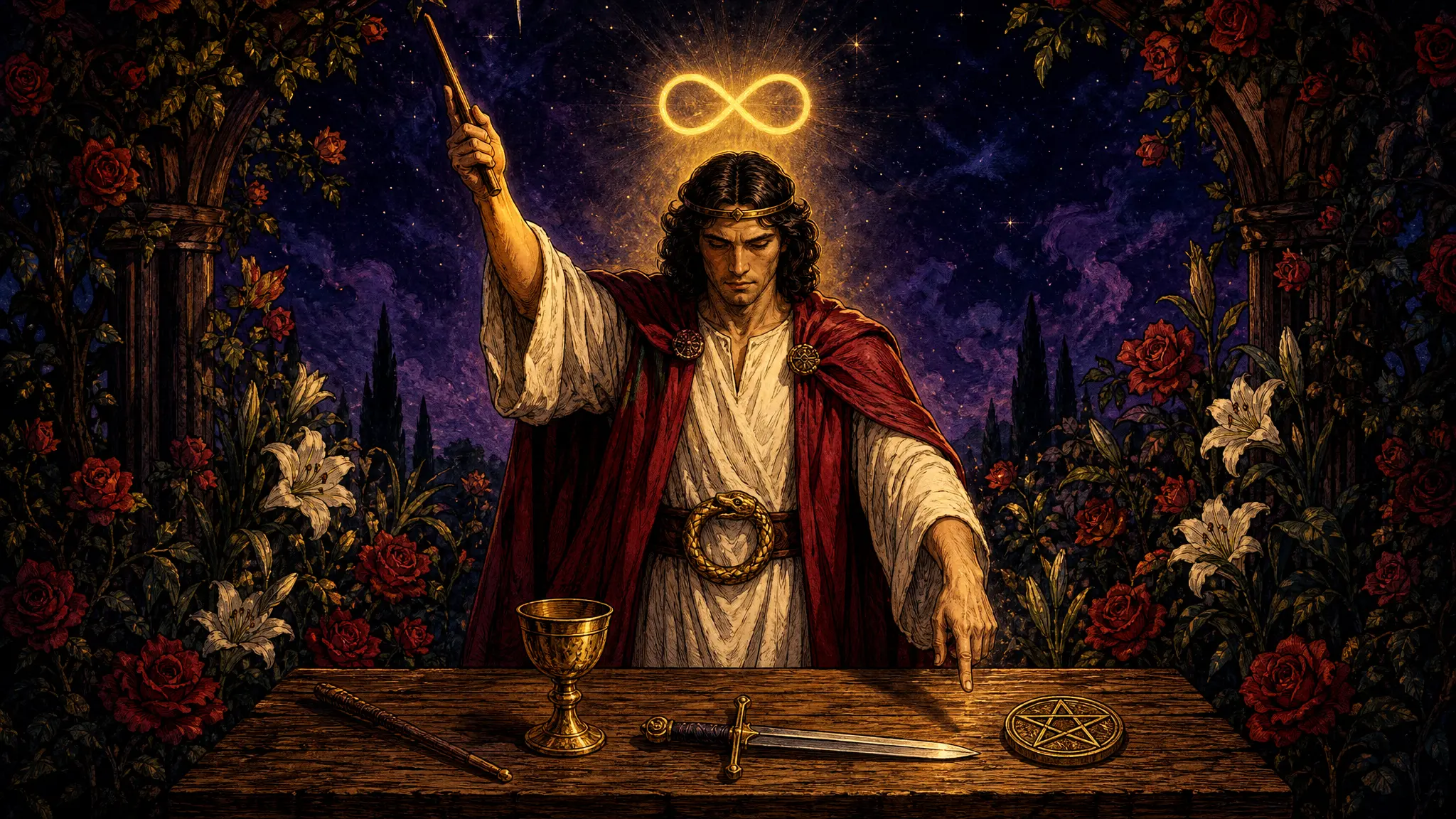
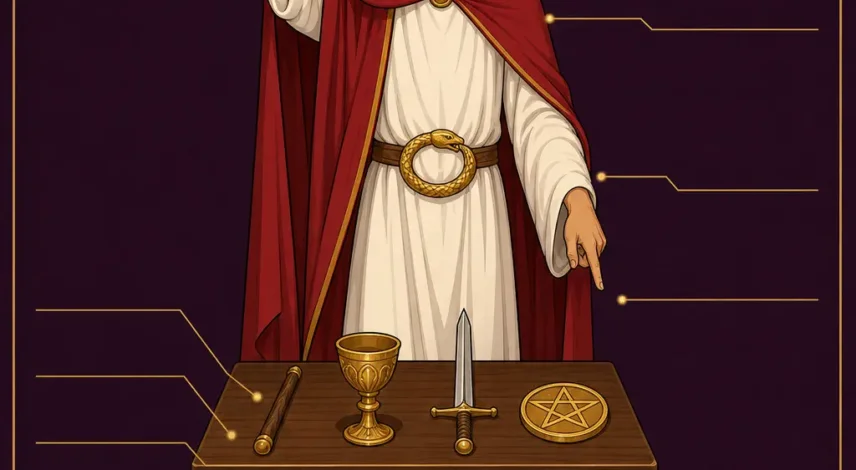
Almost every detail on the Rider-Waite-Smith Magician signals unlimited potential put to use: the infinity symbol over his head, the ouroboros belt at his waist, and the four suit tools laid out like a craftsperson’s kit.
- Infinity symbol: it floats above his head and is commonly read as limitless potential.
- Ouroboros belt: a snake eating its tail, usually read as eternity and cycles.
- One hand up, one hand down: the “as above, so below” gesture from Hermetic thought, linking the spiritual and the material.
- White robe and red cloak: often read as pure intent paired with active desire.
- Roses and lilies: the garden around him, often read as growth that blooms when attention stays steady.
Pamela Colman Smith painted this imagery after Arthur Edward Waite commissioned her in 1909. The deck was first published in London around 1909 to 1910.
The Four Tools on the Table: Wand, Cup, Sword, and Pentacle
The four tools on the Magician’s table are a wand, a cup, a sword, and a pentacle, one for each suit of the Minor Arcana. They stand for fire, water, air, and earth, so the Magician holds every element within reach. That is why readers link the card to resourcefulness.
| Tool | Suit | Element | Stands for |
|---|---|---|---|
| Wand | Wands | Fire | Action, will, drive |
| Cup | Cups | Water | Emotion, intuition |
| Sword | Swords | Air | Thought, communication |
| Pentacle | Pentacles | Earth | Money, body, the material world |
From Street Juggler to Magus: How Le Bateleur Became the Magician
The Magician began as a street performer, not a wizard. The earliest painted version, from the Visconti-Sforza deck of about 1460, is attributed to Bonifacio Bembo and shows a figure playing with cups and balls. Later Marseille decks called him Le Bateleur, meaning a mountebank or sleight-of-hand artist.
Occultists, starting with Oswald Wirth, then recast him as a magus. Waite and Smith carried that image into the deck most readers know today. Writer Rachel Pollack (1997) described the result as part trickster, part wizard. That double identity helps explain why the reversed card can mean trickery or wasted skill.
Upright vs. Reversed: Which Reversal Did You Draw?
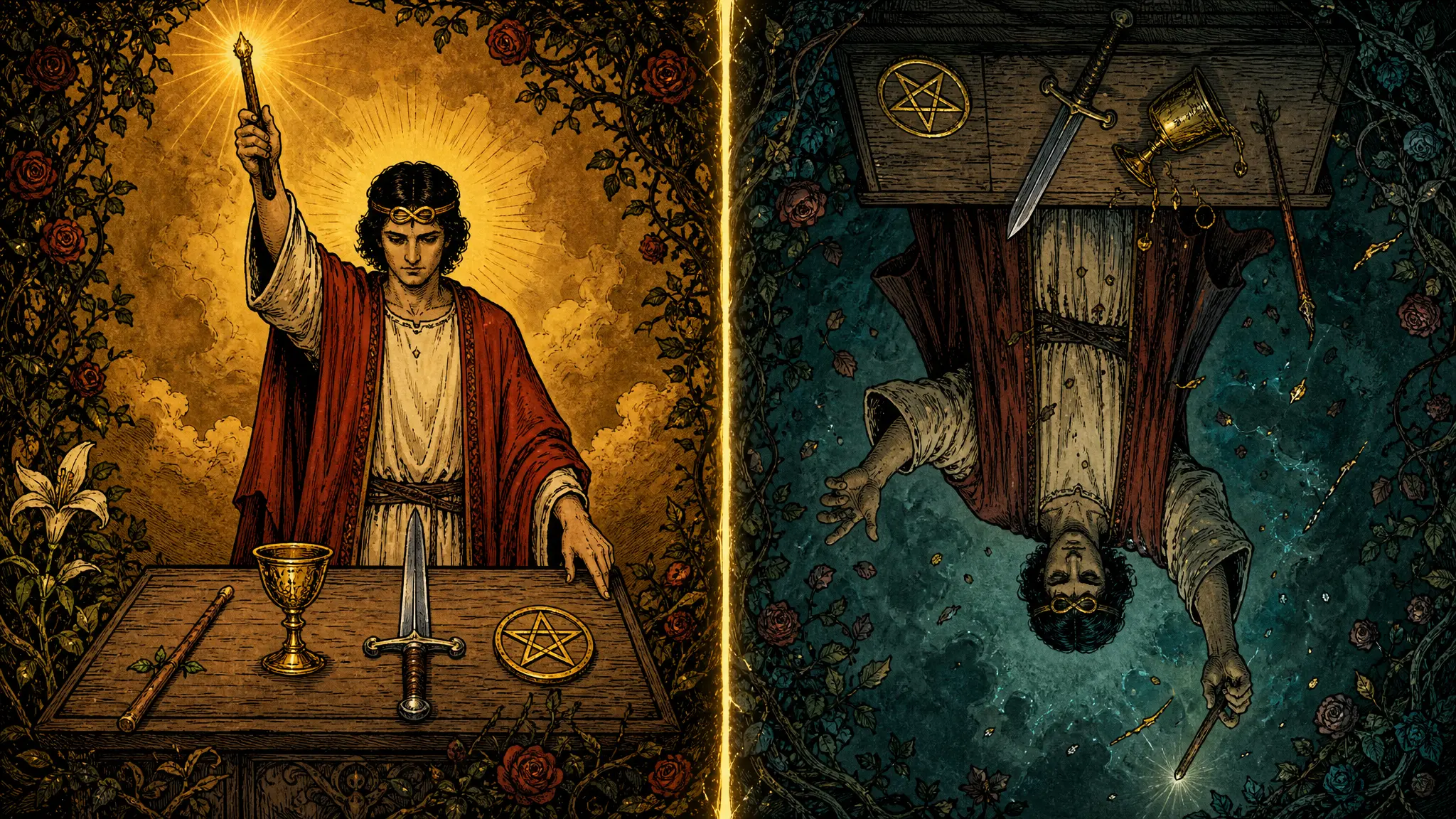
Upright, the Magician signals focused skill and inspired action. Reversed, most readers interpret it in one of two ways: power used crookedly (manipulation, trickery) or power left idle (untapped talent, poor planning). The cards around it usually tell you which one applies.
| Aspect | Upright | Reversed A: crooked | Reversed B: idle |
|---|---|---|---|
| Keywords | Manifestation, willpower, skill | Manipulation, trickery | Untapped talent, poor planning |
| Core message | Use what you have, on purpose | Check whose interests are being served | You have the tools; the plan is missing |
| Question to ask | What can I start today? | Do words and actions match? | Which skill am I not using yet? |
The Magician Upright Meaning
Upright, the Magician means you have the skills and resources to begin, and now is a good time to use them. Readers often connect it to confident communication, clear intention, and decisive first steps. It asks for alignment: what you think, say, and do should point the same way.
The Magician Reversed Meaning
Reversed, the Magician usually points to power misdirected. Biddy Tarot ties the worst case to greed, manipulation, and trickery. Other guides stress a quieter version: poor planning and scattered energy. Manipulation and untapped talent are two faces of the same will, either misused or left unspent.
A common mistake among newer readers is assuming a reversed Magician means someone is lying to them. Just as often, the trickster is our own procrastination. If the card gave you a jolt, that reaction is normal. A reversal is a prompt, not a verdict.
How Do You Tell the Two Reversals Apart?
Look at the surrounding cards and at your own question. The table below is a working heuristic many readers use, not a rule from the original deck.
| Surrounding signal | Likelier reading | Reflection question |
|---|---|---|
| Swords, The Moon, or The Devil nearby | Manipulation or deception | Where might words and actions not match? |
| Four of Pentacles or The Hanged Man nearby | Untapped talent or stalled plans | Which skill am I not using yet? |
If both signals appear, treat it as a cue to slow down and verify before you commit.
What Does Card One Say About Love, Career, and Money?
In love, career, and money readings, the Magician is traditionally read as a call to act on skills you already have, while its reversal asks whether those skills are being used honestly, or at all.
| Area | Upright | Reversed |
|---|---|---|
| Love | Pursuing a connection on purpose | Charm without depth, mixed signals |
| Career | Initiative, showing your skills | Talent sitting idle, promises outrunning preparation |
| Money | Turning skill into income | Offers that sound too good to be true |
The Magician in a Love Reading
In love, the upright Magician is often read as clear, confident communication that matches real effort. Reversed, it can suggest charm without depth. Compare what someone says with what they do. The same test applies to you.
The Magician in a Career Reading
In a career reading, the Magician traditionally means taking initiative and showing the skills you already have. Pitching an idea, launching a project, or asking for a new role all fit the card. Reversed, it can mean talent sitting idle. Ask yourself one question: what is the single skill I could use this week?
If you like a small physical reminder, tiger’s eye is traditionally associated with courage, confidence, and willpower. Potala Store’s Gold Tiger Eye Bracelet, a tiger’s eye stone traditionally tied to willpower ($43.95 as of November 2026) is natural gold tiger’s eye you can wear daily, so the “pick up the tools” message stays in view. It is a reminder, not a guarantee of results.
The Magician and Money: Opportunity or Red Flag?
In a money reading, the Magician points to turning skill into income, and its reversal warns you to check the offer behind the opportunity. Readers often connect the reversed card to schemes that sound too good to be true. Tarot can frame a question; it can’t audit a contract.
This is a big decision, so it makes sense to slow down. Read the terms and ask a qualified professional before you commit any money.
Is the Magician a Yes or No Card, and Why Do Readers Disagree?
Upright, the Magician is one of the clearest “yes” cards in tarot, especially for questions about starting or acting. Reversed, readers disagree: some read “not yet,” others “no,” and a few “yes with conditions.” Treat it as “check your plan first.”
| Source | Reversed Magician as yes or no |
|---|---|
| The Psychic Line | Still leans toward yes |
| Deckaura | No |
| Sibyl Tarot | Conditional yes, with possible setbacks |
The split exists because the reversal has two meanings. A reader who sees idle talent leans toward yes. A reader who sees manipulation leans toward no.
When the Magician Means Yes
The upright Magician answers “yes” when your question is about beginning, acting, or using a skill you already have. Phrase the question around action, such as “Should I start this project?” Tarot is a tool for reflection, not prediction, so treat the answer as a nudge, not a promise.
When the Reversed Magician Means “Not Yet”
The reversed Magician is best read as “not yet, until the plan or intention is clean.” We prefer this reading because it avoids both a flat “no” and a false “yes.” Run three quick checks:
- The plan: is it written down in clear steps?
- The intention: is anyone being misled, including you?
- The first step: have you started the smallest possible action?
How Does Major Arcana I Compare to the Fool and the High Priestess?
If the Fool is the leap and the High Priestess is the pause, the Magician is the moment you pick up the tools: card I turns the Fool’s raw potential into deliberate action.
| Card | Number | Core theme | How it acts |
|---|---|---|---|
| The Fool | 0 | Potential, the leap | Trusts and begins |
| The Magician | I | Will, skill | Acts with tools |
| The High Priestess | II | Intuition | Waits and listens |
The Magician vs. the Fool: Potential vs. Action
The Fool begins without a plan, while the Magician begins with one. The Fool trusts the unknown and steps off the cliff. The Magician studies the table and chooses a tool. Together they show two halves of starting something new.
The Magician vs. the High Priestess: Outer Will vs. Inner Knowing
The Magician acts outward through will, while the High Priestess draws inward through intuition. Many readers see them as a pair. The Magician decides what to do, and the High Priestess senses when to do it.
How to Set Up Your Own “Magician’s Table”
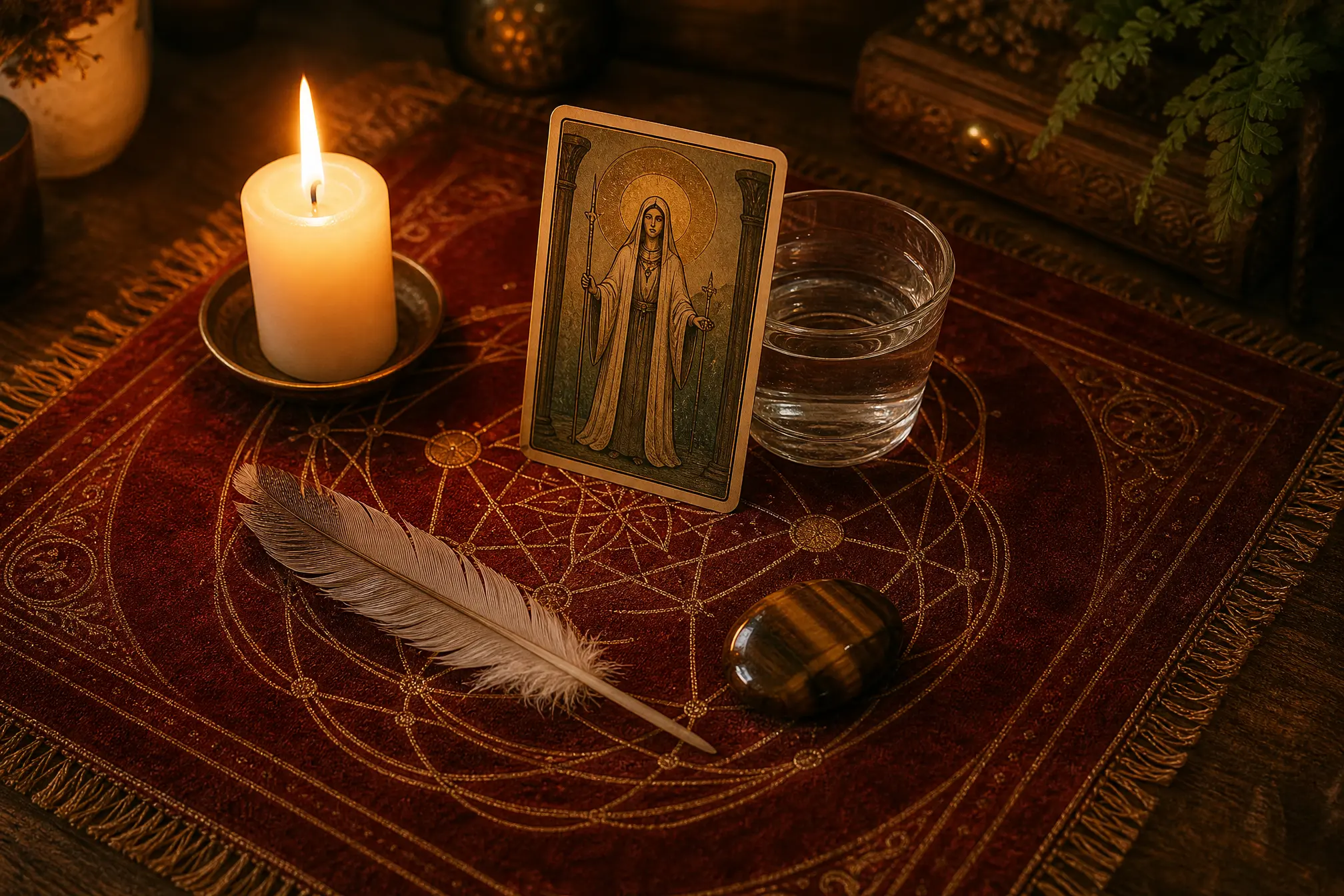
A Magician’s table is a simple reading surface with one object for each element: a candle for fire, a small cup of water, a feather or incense for air, and a stone or coin for earth. Place the Magician card beside them and use the setup as a daily reminder to act on one small intention. If you are new to readings, start with beginner tarot spreads.
A dedicated cloth keeps the surface tidy. The Tibetan Vajra Prayer Altar Mat for your reading table ($48.95 as of November 2026) features double vajra embroidery and a brocade border, which gives your cards a defined space and turns each draw into a small ritual.
One boundary matters here. Tibetan altar items come from a different tradition than Western tarot. We suggest this mat as a practical surface, not as a tarot tool, and we encourage you to learn what the vajra means in Tibetan Buddhism before using it.
Ready to build your own practice space? Explore crystals for setting intentions, or read Potala Store’s tarot guides for the next card in the Major Arcana.
Magician Tarot FAQ
The Magician is traditionally associated with Mercury, the planet of communication and skill, and through it with Gemini and Virgo, according to Wikipedia citing McCann (1999). Many modern guides assign it Air, and the Golden Dawn pairs it with the Hebrew letter Beth.
Upright, it is often read as active, confident interest: someone pursuing a connection on purpose. Reversed, it can suggest charm without depth, or mixed signals worth checking against real actions.
It can. Many readers interpret it as a connection someone is actively creating, or a deliberate fresh start. It describes effort and intention, not a guaranteed outcome.
Write down one skill you already have and one small action for this week. If you’re new to reading, try a one-card daily draw from our tarot spreads guide for beginners.
In summary, the Magician tarot card (Major Arcana I) pairs willpower with skill and asks you to use the tools already on your table. Upright, it is a green light. Reversed, it asks whether your power is being misused or left idle. Read it as a prompt to reflect, then choose one small action.
References
- Rider-Waite-Smith deck: museum record covering Pamela Colman Smith’s 1909 commission and the deck’s first publication. Victoria and Albert Museum
- The Pictorial Key to the Tarot (1910): overview of Waite’s original companion book to the deck. Wikipedia
- The Magician (tarot card): history from the Visconti-Sforza deck, Le Bateleur, Oswald Wirth, and planetary associations. Wikipedia
- The Magician Tarot Card Meanings: upright and reversed interpretations used for comparison. Biddy Tarot