

The Hierophant tarot card is not a sermon in a robe. Behind the robes sits the oldest idea in learning: wisdom handed from teacher to student.
The Hierophant is card V of the Major Arcana, and it traditionally stands for tradition, mentorship, and shared belief. Upright, it points you toward a proven path and a trusted teacher. Reversed, it asks whether the rules you follow still fit your values.
At PotalaStore, we sell Tibetan Buddhist jewelry and ritual objects, a world where teachings pass from teacher to student, so this card feels familiar to us. We also checked the card against its sources, including A. E. Waite’s 1910 text, and found details that most guides skip. You will get the upright and reversed meanings, the yes or no disagreement explained, and a Tibetan view of the teacher archetype.
If the card is nudging you toward a steady daily ritual, a simple 108-bead wood mala bracelet is a traditional place to start.
| Number | V (5) of 22 Major Arcana cards |
|---|---|
| Element | Earth |
| Zodiac and planet | Taurus, ruled by Venus |
| Hebrew letter | Vav (Golden Dawn system) |
| Also called | The Pope, The High Priest |
| Upright keywords | Spiritual wisdom, religious beliefs, conformity, tradition, institutions |
| Reversed keywords | Personal beliefs, freedom, challenging the status quo |
Table of Contents
What Does the Hierophant Tarot Card Mean?
The Hierophant is card V of the 22-card Major Arcana, and it traditionally stands for spiritual wisdom, tradition, mentorship, and the beliefs a community shares. Upright, it favors learning inside a proven system. Reversed, it asks whether inherited rules still fit. In the Fool’s Journey, it arrives after the Emperor and just before the Lovers. Think of it as the card of the classroom, the lineage, and the vow.
Is the Hierophant a Good Card to Draw?
Yes, in most readings the Hierophant is a stable, supportive card, with one condition: it works best when you choose a tradition rather than merely obey it. Card V makes many readers pause, especially anyone with a complicated relationship to organized religion. The card does not require religious belief. It describes how learning works: someone has already walked the path, and you can borrow their map.
To see how card V sits beside the rest of the deck, read all 78 tarot card meanings explained.
Keys, Pillars, and the Two Acolytes: Reading the Card’s Symbols
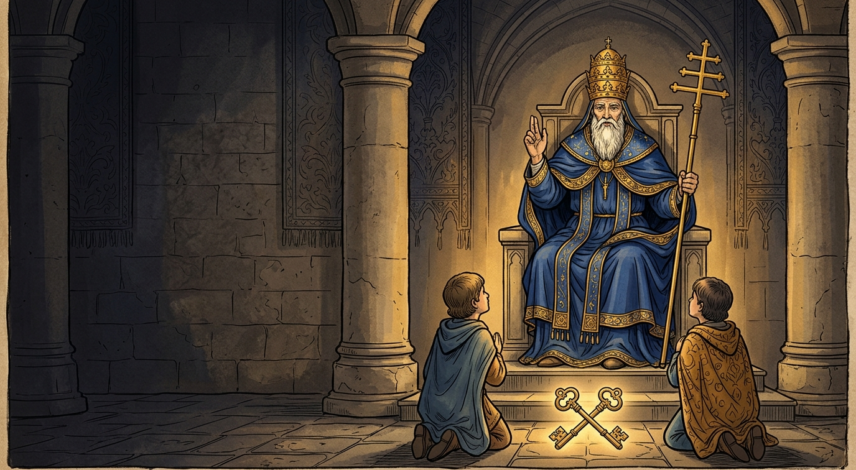
The Rider-Waite-Smith Hierophant shows a seated teacher in a three-tier crown, flanked by two pillars, with two acolytes kneeling before him and two crossed keys at his feet.
- Crossed keys: Many readers see them as access to the teachings, an echo of initiation, where a door opens only after instruction.
- Triple crown and triple cross staff: Both signal layered authority. The staff belongs to the office, not the person who holds it.
- Raised hand: The gesture of blessing marks a teaching being passed on.
- Two pillars: They represent the structure of the institution that holds the tradition.
- Two acolytes: The real subject of the card is this relationship between teacher and student, not the throne.
Why Was Card V Once Called the Pope? Names, History & Waite’s 1910 Keywords
Card V was simply “the Pope” in early decks such as the Tarot de Marseille; the title “Hierophant” arrived later, from the 18th-century writer Antoine Court de Gébelin. Tarot itself began in 15th-century northern Italy as a card game and only later became a tool for divination.
From “Le Pape” to “Hierophant”: How the Name Changed
The Besançon pattern renamed the card “Jupiter,” while Marseille decks kept “the Pope.” Court de Gébelin then argued that tarot descended from ancient Egyptian wisdom. He called card V the Hierophant, the title of the chief priest in the Eleusinian Mysteries, an ancient Greek ritual.
Historians treat his pre-Christian origin story as mistaken. Waite himself dismissed the Egyptian claims in his 1910 book.
What Waite Actually Wrote in 1910 (And Why Modern Reversals Differ)
Here is the detail that surprises most readers: Waite’s own reversed meaning leans toward people-pleasing, not rebellion.
| Version | Upright | Reversed |
|---|---|---|
| Waite, 1910 | Marriage, alliance, captivity, servitude; also mercy, goodness, and inspiration | Society, good understanding, concord, overkindness, weakness |
| Most modern guides | Tradition, spiritual wisdom, institutions, conformity | Personal beliefs, freedom, challenging the status quo |
Rachel Pollack’s modern interpretation adds unorthodoxy and originality to the reversed card, with gullibility as its shadow. The “break the rules” reading is a later layer on top of Waite, not his original wording.
Upright vs. Reversed: How the Teacher Archetype Shifts in Love, Career & Health
Upright, the Hierophant points to tradition, mentorship, and learning inside a proven system; reversed, it asks whether those rules still match your values, or whether you keep them only to fit in.
| Area | Upright | Reversed |
|---|---|---|
| Core idea | Tradition and shared belief | Personal belief and questioning rules |
| Love | Commitment, shared values, serious intentions | Feeling boxed in by expectations, or resisting convention |
| Career | Mentors, formal study, established institutions | Going your own way, or outgrowing a mentor |
| Money | Steady, conventional choices | Doubt about standard advice, or accepting advice without checking it |
Upright Meaning: Mentors, Shared Belief, and the Proven Path
Upright, the Hierophant says the answer lives in a tradition, a teacher, or a community with a track record. It suits moments of formal learning, commitment, and ceremony, such as a degree, a vow, or an apprenticeship. The risk is conformity for its own sake, so ask whether the path fits you, not only whether it is respectable.
Reversed Meaning: Your Own Teacher, or Rules Kept Past Their Use?
Reversed, the card asks whether you have outgrown a rule or never questioned it. That can mean healthy independence, such as choosing your own teacher or beliefs. It can also point to dropping guidance too quickly, or to accepting a claim without checking it. Reversals vary a lot by reader and deck, so we treat them as a prompt to reflect, not a verdict.
The Hierophant in Love and as Feelings
In love, the upright Hierophant points to commitment and shared values, often with a formal step such as engagement or vows. As feelings, it usually describes serious, respectful regard from someone who wants to do things properly. Readers on one Tarot Forum thread described it two ways: as protective care, and as a focus on what “should” happen. Reversed, it can show real interest tangled up with resistance to convention.
Career, Money & Health Readings
In a career reading, the upright card favors mentors, formal study, and established institutions. In money matters, it favors steady, conventional choices over shortcuts. On health, the card does not diagnose anything. Some readers link it with following a professional’s plan and keeping routines, but it is not medical advice, so please talk with a licensed professional.
Is the Hierophant a Yes or No Card?
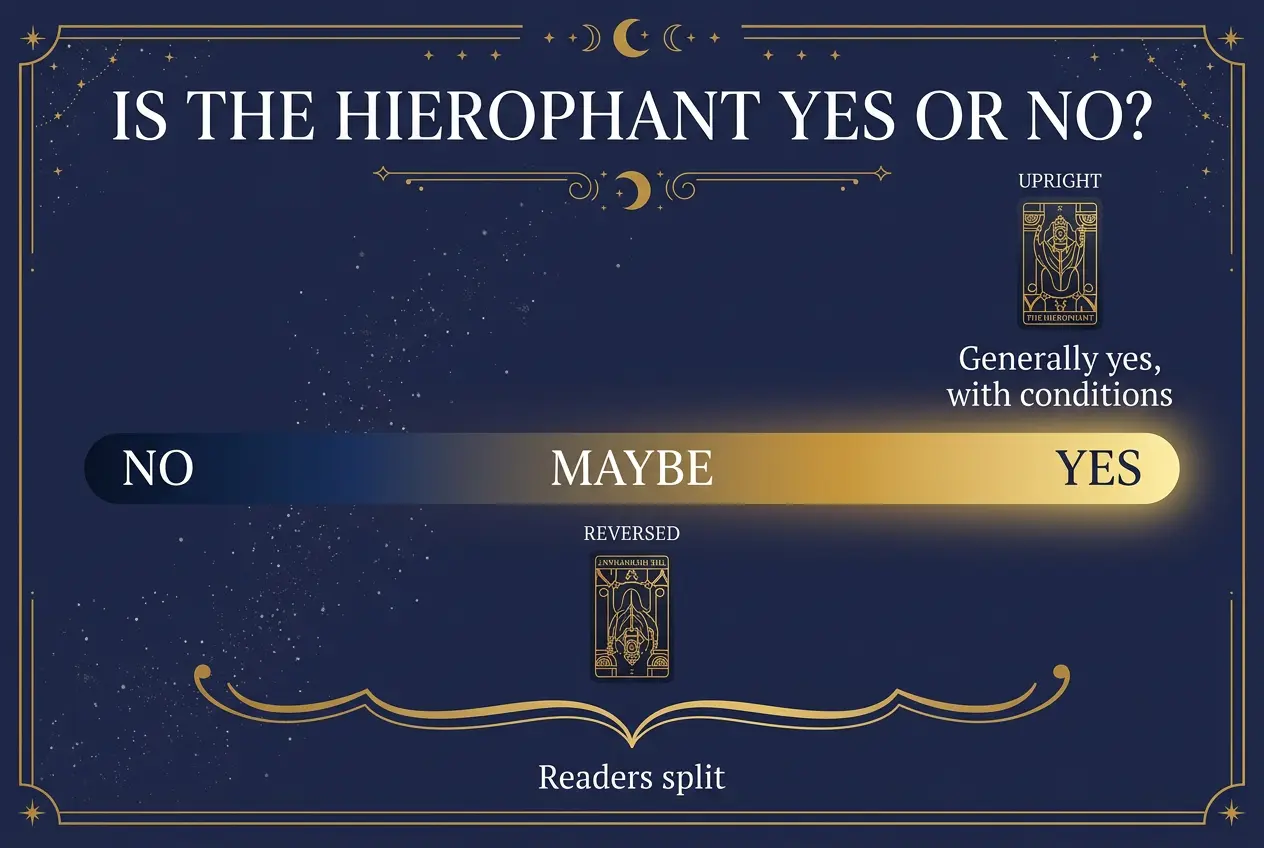
Upright, the Hierophant is generally read as a yes, especially for commitment, study, or anything done through official channels; reversed, readers genuinely disagree, so read it as “not this way” rather than a flat no.
| Source | Card position | Verdict |
|---|---|---|
| Tarot.com | Upright | Yes |
| YesNoTarot | Upright | Generally yes, with conditions |
| Darkforest Tarot | Upright | Maybe |
| TaroStarot | Reversed | No |
| Darkforest Tarot | Reversed | Leans yes for independent-path questions |
Where Readers Agree: The Upright Yes
Most sources treat the upright Hierophant as a yes when the question involves commitment, study, or official processes. YesNoTarot adds a condition: the yes holds when the path has structure, a teacher, or a track record. A smaller group, including Darkforest Tarot, calls it a maybe.
Where Readers Split: The Reversed Answer
Reversed answers disagree more. TaroStarot reads it as a no, while Darkforest Tarot says it leans yes when the question is about forging an independent path. One forum reader drew the card twice on the same question and asked whether that meant yes or neutral. The replies split along the same lines.
Our advice is to read the reversed card as “not this way” rather than “not this goal.” If you ask about joining a program and draw it reversed, the goal may be fine while the method does not suit you. A reversed card is also not a verdict on a relationship, so treat it as a prompt to talk, not a sign that anything is doomed.
If one card feels too blunt, a layout with positions adds context. These 10 beginner tarot spreads are a gentle place to start.
High Priestess, Emperor, or Pope Card? Three Kinds of Authority Compared
The High Priestess keeps sacred knowledge inward and silent, the Emperor enforces worldly rules, and the Hierophant teaches shared tradition out loud. Newer readers often mix up these three authority cards, so keep this table close.
| Card | Number | Zodiac link | Kind of authority | Question it asks |
|---|---|---|---|---|
| High Priestess | II | Moon | Inner, esoteric knowing | What do I already sense? |
| Emperor | IV | Aries | Secular law and structure | What rules will I set? |
| Hierophant | V | Taurus | Taught, exoteric tradition | What have I inherited, and from whom? |
Hierophant vs. High Priestess: Outer Teaching, Inner Knowing
The High Priestess (II), linked to the Moon, guards esoteric knowing that cannot be fully taught. The Hierophant (V), linked to Taurus, shares exoteric knowledge openly through teaching, rites, and community. One keeps the mystery. The other hands on the method.
Hierophant vs. Emperor: Sacred Rules, Secular Rules
The Emperor (IV), linked to Aries, builds secular law and structure. The Hierophant gives that structure a moral and spiritual meaning. In the Fool’s Journey, the Fool meets both before choosing a path of his own. See the Fool tarot card’s upright and reversed meaning for where that journey starts.
The Teacher Archetype Through a Tibetan Buddhist Lens
If the Hierophant is about wisdom handed from teacher to student, Tibetan Buddhism offers one of the clearest living examples: lineage, where teachings pass person to person, generation after generation. This is a parallel, not a claim that tarot and Tibetan Buddhism share a source.
Teacher-to-Student Transmission: Lineage, Tulkus, and the Guru Bead
In Tibetan Buddhism, a lineage is an unbroken chain of teachers and students, and the card’s two kneeling acolytes echo that same relationship. The Karmapa line began tracing its reincarnations, called tulkus, in the thirteenth century, making it one of the earliest formal tulku lineages.
The mala carries the idea in your hand. A traditional Tibetan mala has 108 counting beads plus a three-holed guru bead, and that guru bead represents the student’s relationship with the teacher. Practitioners count from the bead beside it. When they reach it again, they turn the mala around instead of crossing it, a sign of respect for teachers.
Thangka painting follows the same pattern. Techniques and iconography are traditionally taught by a master to a student over years. Our hand-painted 3D thangka pendant necklace comes in several deity designs, including Manjushri, the bodhisattva traditionally associated with wisdom. It is $68.95 and comes in a leather gawu box. Worn daily, it works as a quiet reminder that wisdom comes through learning and lineage.
We will say it plainly: a vajra and bell set can wait. Working with Himalayan artisans, we have learned that the most traditional advice is often the most patient. Start small, and let a teacher guide the bigger purchases. Our guide to Tibetan ritual objects like the mala, vajra, and bell explains what each one is for.
Bringing the Archetype Into Daily Practice
You do not need a temple to work with the Hierophant. Try these three steps this week:
- Find one guide. Choose a teacher, a book, or a community you trust, and commit to it for a month.
- Set a five-minute ritual. Count a 108-bead mala each morning with one slow breath per bead, or keep any simple routine you will repeat.
- Audit three inherited rules. Spend 10 minutes writing down three rules you follow, then mark each one keep, adjust, or drop.
Hierophant Tarot Card: Frequently Asked Questions
The Hierophant is traditionally linked to Taurus, the fixed earth sign ruled by Venus. That pairing fits the card’s steady, patient, tradition-keeping character. Correspondences vary between tarot systems, so treat this as a convention, not a rule.
Upright, it usually describes serious, respectful feelings from someone who wants to do things properly and may be thinking long term. Reversed, it can point to real interest tangled up with resistance to convention.
Not necessarily. Modern readers see it as a call to test inherited rules, and Waite’s 1910 reading even included “concord” and “good understanding.” Treat it as a prompt to reflect, not a warning.
Not necessarily. The card uses religious imagery, but its core subject is how knowledge is handed on and what a community believes together. You can read it through any tradition of teaching, religious or not. If it stirs something for you, write down one belief you inherited and decide whether to keep it.
The bottom line: five keys to the Hierophant tarot card
In summary, the Hierophant tarot card is about wisdom that is passed on, and you decide what to carry forward.
- Tradition: the card values paths proven over time.
- Mentorship: it points to a teacher, a text, or a community.
- Shared belief: it speaks to commitment, vows, and common values.
- Reversal: it asks you to test inherited rules, not discard them blindly.
- The teacher within: from tarot’s acolytes to a mala’s guru bead, lineage shows that wisdom is handed on, not invented alone.
Start small, with a daily five minutes
Browse PotalaStore’s Tibetan mala and necklace collection, with pieces starting at $25.95, and choose one that fits a simple daily practice.Shop Tibetan malas and necklaces
⚠️ Important Note: This guide reflects traditional tarot symbolism and personal interpretation, not scientific fact. It is for educational purposes. For decisions about health, money, or relationships, please consult a qualified professional.
📚 References
- The Hierophant, in The Pictorial Key to the Tarot (1910): A. E. Waite’s original description and divinatory meanings for card V. Sacred Texts Archive
- The Hierophant (tarot card): Overview of the card’s names, symbolism, Court de Gébelin’s naming, and modern interpretations. Wikipedia
- How to Use a Tibetan Mala or Tibetan Prayer Beads: The 108 counting beads, the guru bead, and why practitioners do not cross it. Tibetan Nuns Project
- Karmapa (glossary entry): Background on the Karmapa tulku lineage and its thirteenth-century beginnings. Rubin Museum, Project Himalayan Art