

Struggling to tell if a “Hetian jade” bracelet is the real thing? Start with one fact: genuine Hetian jade is nephrite, and GIA puts nephrite’s specific gravity at 2.95. That single number, plus a flashlight and a 10x loupe, rules out most glass, dyed quartz, and serpentine in about 15 minutes. Here’s the exact order to check—before you pay.
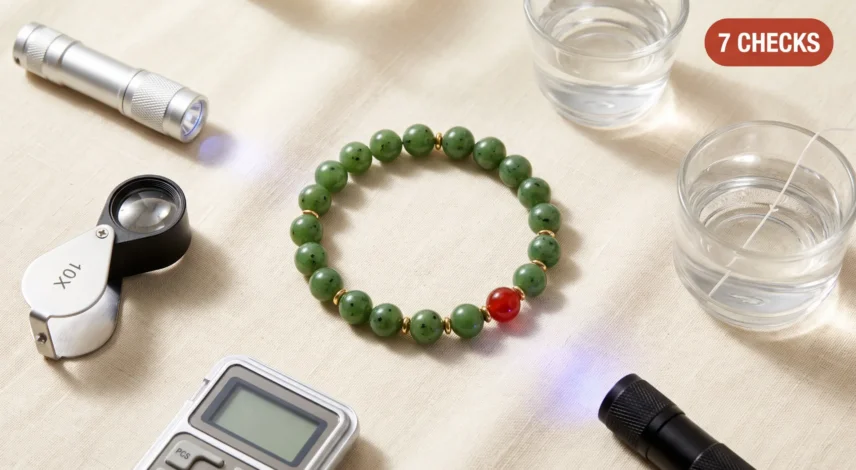
The short version: read the label for a mineral name. Shine light through every bead. Magnify the surface. Check cracks and drill holes for pooled color. Weigh one loose bead in water. Glance at it under 365 nm UV. Then verify any report number on the lab’s own website.
Pass all seven, and your confidence goes up. It still isn’t proof the stone is untreated. Home checks screen; only a lab confirms.
We’ll also show you how we label our own Hetian nephrite bracelet—including what we can’t show you yet.
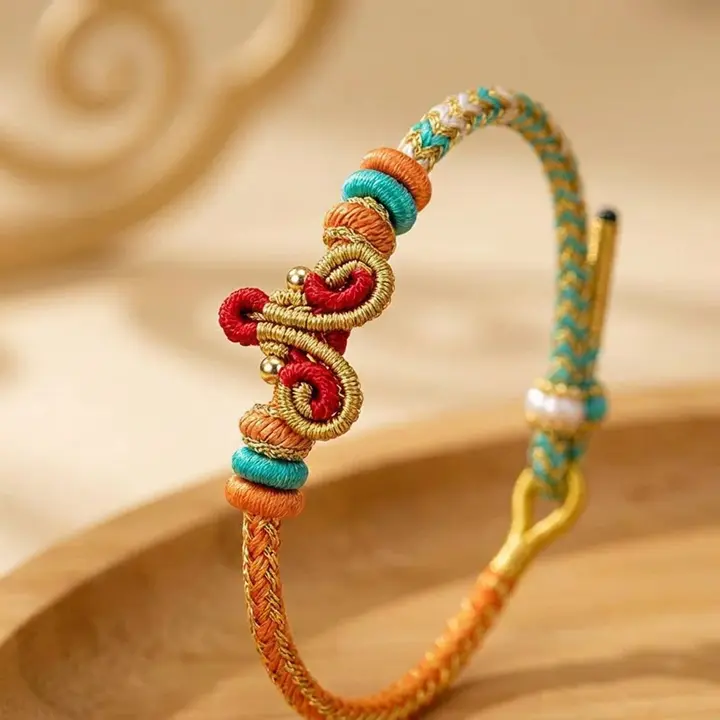
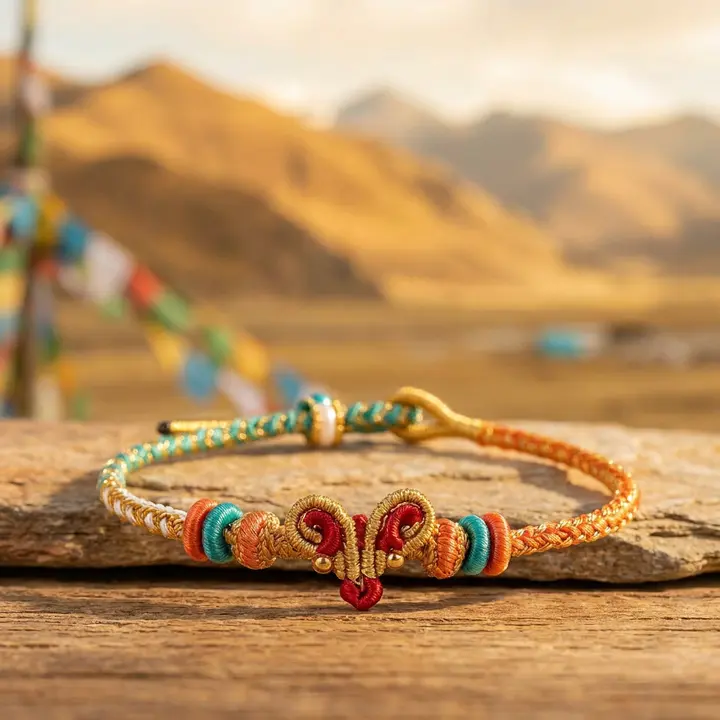
See how a nephrite bracelet listing names its materials: view the Hetian Jasper & Red Agate Luck Bracelet specs.
Table of Contents
What Is Hetian Jade, and Is It Real Jade?
Hetian jade is real jade: under China’s national standard GB/T 38821-2020, the name describes a material—a dense aggregate of the mineral tremolite, known in English as nephrite—rather than a place, so nephrite mined in Qinghai, Russia, or Xinjiang can carry the same “Hetian jade” name on a lab report.
GIA treats “jade” as a generic term for nephrite, jadeite, and, under certain conditions, green omphacite. Nephrite rates 6.0–6.5 on the Mohs scale, with a refractive index of 1.606–1.632. GIA sums up both jades as “Tough, But Not Hard”: they resist breaking better than they resist scratches. If you’re still deciding between stone families, our guide to crystal vs jade material and buying differences covers structure, treatment risk, and price.
Does “Hetian” Mean It Was Mined in Hotan?
No. Clause 3.1 of GB/T 38821-2020 defines Hetian jade as a tremolite aggregate with a density of 2.95 (+0.15, −0.05) g/cm³. It says nothing about geography. Chinese national standards records list the standard as reviewed on 03/18/2026 and still in force. Regular Chinese jewelry identification certificates don’t state a jade’s origin, so a report can confirm the material, never the mine.
Origin matters for U.S. buyers in another way. U.S. Customs and Border Protection states that since 06/21/2022, the Uyghur Forced Labor Prevention Act has applied a rebuttable presumption that goods “mined, produced, or manufactured wholly or in part” in Xinjiang are barred from U.S. import unless the importer rebuts it “by clear and convincing evidence.” The International Gem Society notes this logically covers Xinjiang nephrite. So if a U.S. listing advertises “Xinjiang-mined,” ask how it was imported.
How Is Nephrite Different From Jadeite in a Bracelet?
Weight is the fastest tell. GIA lists nephrite’s specific gravity (SG) at 2.95 and jadeite’s at 3.34, so a jadeite bead weighs about 13% more than a nephrite bead of the same size. Nephrite has a soft, oily luster and a felted, fibrous structure. Jadeite looks more glassy and granular. Treatment risk differs too: IGS says nephrite’s dense structure means it’s rarely dyed, and treatments are far more common in jadeite.
Which Listing Words Should Stop You Before Checkout?
The listing itself is your first test. It costs nothing, and it filters out more bad buys than any tool.
Which Material Words Are Red Flags?
- “Hetian jasper.” In Chinese jade trade, 碧玉 (biyu) means green nephrite. In English, jasper is a quartz-family rock. One label can describe two very different stones, so ask which one you’re getting.
- “Grade A.” This is a jadeite treatment grade. GIA explains that in the Chinese system, “A” jade is natural or wax-polished jadeite, “B” is acid-bleached and polymer-impregnated, and “C” is dyed. On a nephrite bracelet, “Grade A” tells you nothing.
- “Certified” with no lab name or report number. A certificate you can’t look up is just a promise.
- Just “jade.” If no species is named, the listing hasn’t told you what you’re buying. For example, our green jade Pixiu bracelet materials and labels guide describes a bracelet listed as untreated, undyed natural jade. Because it doesn’t name the species, we don’t sell it as Hetian jade.
What Treatment Disclosure Should You Ask For?
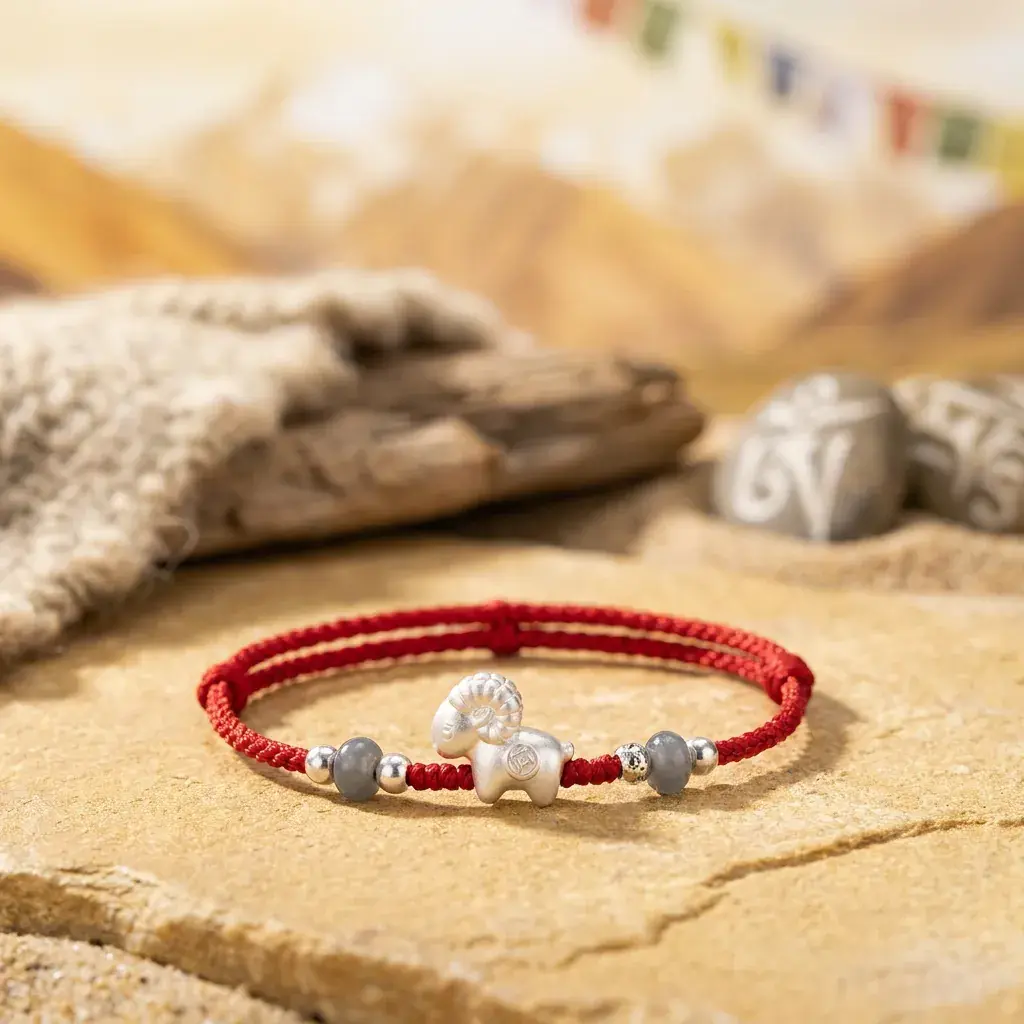
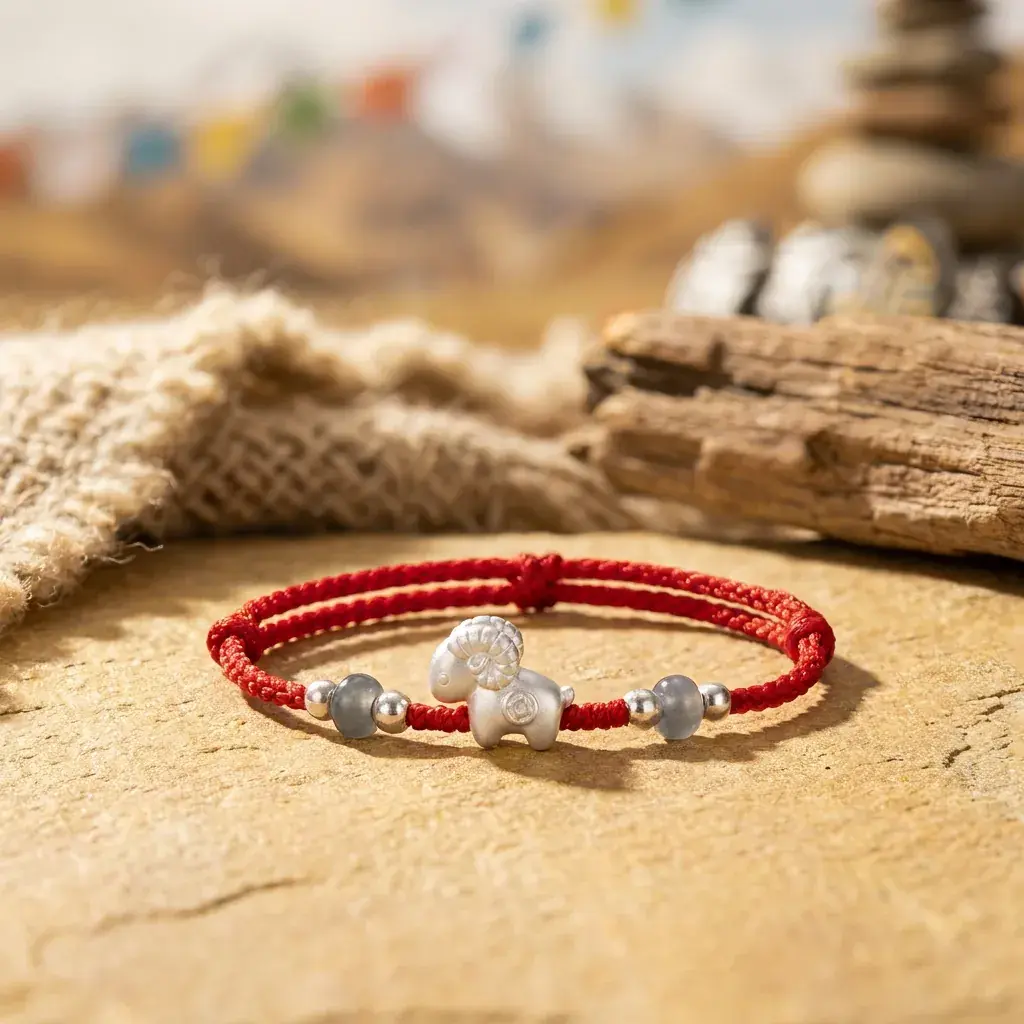
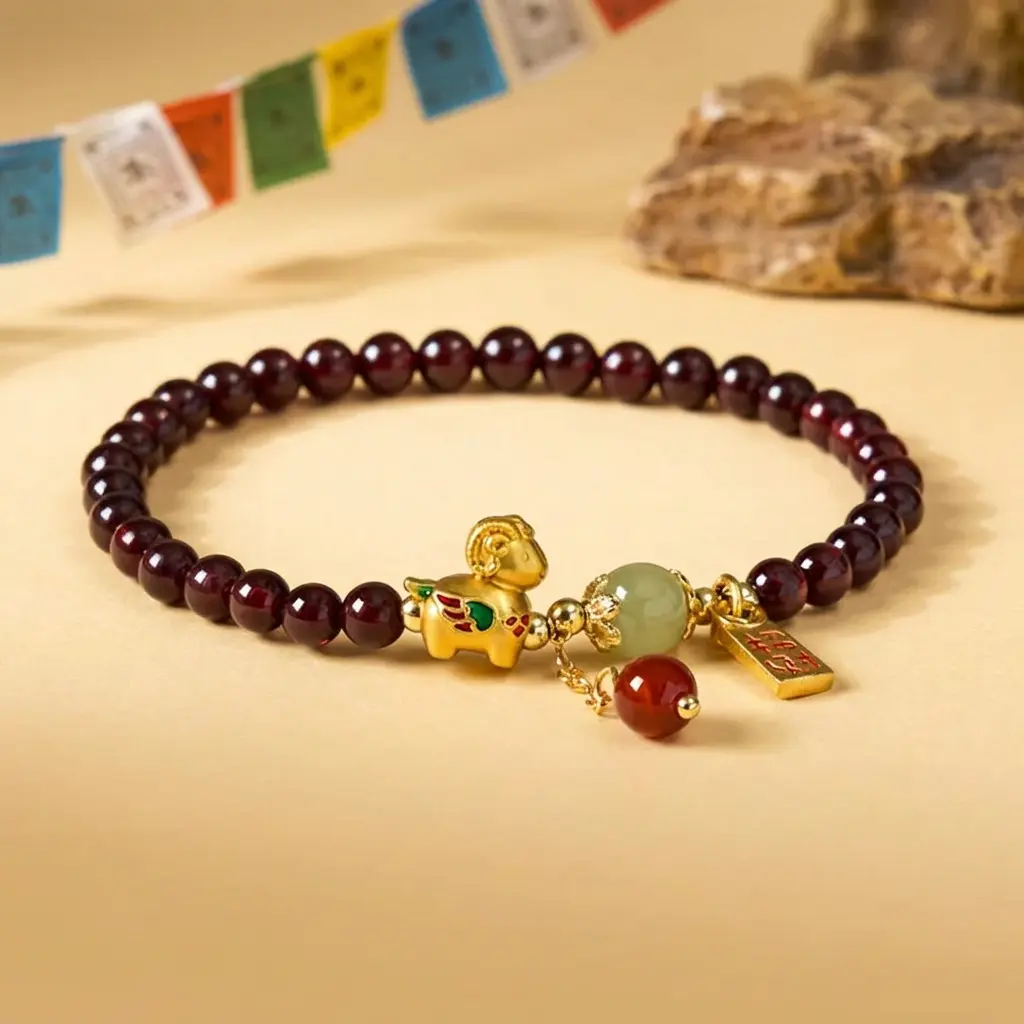
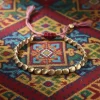
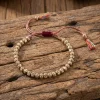
Ask for four things in writing: the mineral name, the treatment status (dye, wax, filling, bleaching), the lab name and report number, and a return window long enough to test after delivery. A good listing answers most of these up front. Our Hetian Jasper & Red Agate Luck Bracelet with natural Hetian nephrite beads is one example: its title uses the trade word “jasper,” but its specification line names the material as natural Hetian nephrite jade (碧玉).
🟠 If the seller can’t tell you nephrite vs jadeite, don’t pay yet.
How Can You Tell If a Nephrite Bracelet Is Real at Home?
Work through these seven steps in order; each takes one to five minutes, and together they take about 15.
- Read the label (1 minute). Find the mineral name and the treatment status. No name? Stop here.
- Flashlight test (1 minute). Press a flashlight against each bead. Look for a soft, fibrous glow inside.
- 10x loupe (2 minutes). Look for round bubbles, swirl lines, or sugary grains.
- Cracks and drill holes (2 minutes). Check whether color pools in cracks or rings the drill holes. That points to dye.
- Specific gravity (5 minutes). Weigh a loose bead in air and in water. Nephrite reads near 2.95; jadeite near 3.34.
- 365 nm UV (1 minute). In a dark room, shine a long-wave UV light on the bracelet. A very weak blue-white glow is fine. A strong or uneven glow means: send it for testing.
- Verify the report (3 minutes). Type the report number into the issuing lab’s own website. Match the weight and photo.
On step 6: in a 2018 GIA case, the genuine tremolite body of a bracelet showed “very weak blue-white fluorescence under a 5-watt long-wave UV lamp (365 nm).” IGS lists nephrite’s luminescence as “None.” So a faint blue-white glow alone isn’t a red flag.
What Should a Real Nephrite Bead Look Like Under a Flashlight and Loupe?
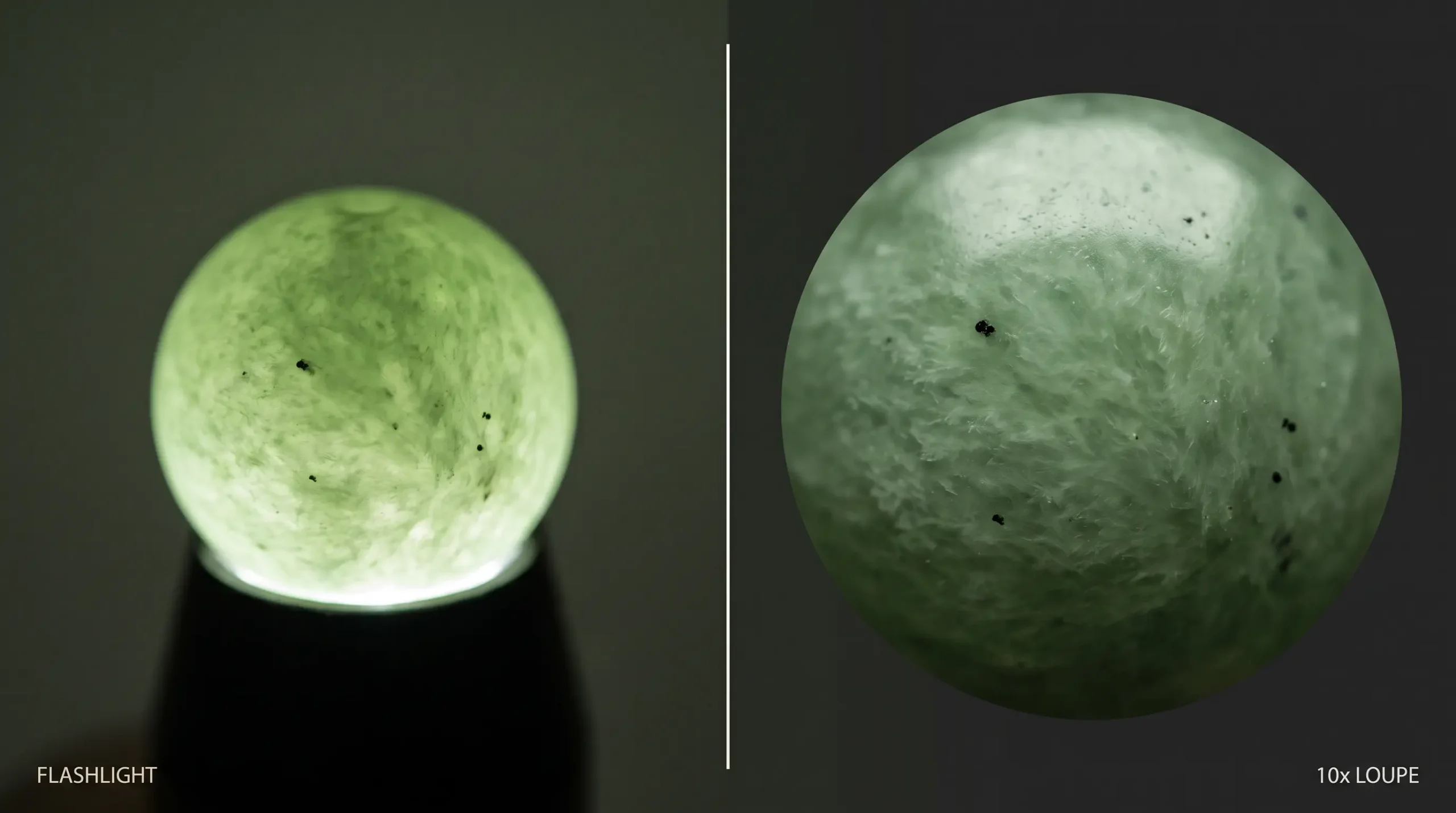
Expect a translucent-to-opaque bead with a felted texture and an oily luster. Green nephrite (碧玉) bracelets often show small black dots. These are usually natural mineral inclusions. Be wary when the warning signs below show up:
- Perfectly even color with round bubbles points to glass.
- A granular, sugary surface with color sitting in cracks points to dyed quartzite.
Which Popular Tests Should You Skip?
- Cold test. Glass and quartz feel cool too. It proves nothing.
- Knife scratch. IGS notes that at 6 to 6.5 on the Mohs scale, nephrites “do exhibit some vulnerability to scratching,” so a knife tells you little. It can leave a permanent mark that may void your return.
- Hot needle. It can burn the surface finish and crack beads.
- Acetone. It strips wax and may catch only crude surface dye. It’s a weak test that can damage the finish.
How Much Should a Real Nephrite Bead Bracelet Weigh?
A single 8 mm (0.31 in) nephrite bead should weigh about 0.79 g; a jadeite bead the same size, about 0.90 g. Here’s the math across common sizes:
| Bead diameter | Volume | Nephrite bead (SG 2.95) | Jadeite bead (SG 3.34) | 21-bead nephrite strand |
|---|---|---|---|---|
| 8 mm (0.31 in) | 0.268 cm³ | 0.79 g | 0.90 g | ≈16.6 g (0.59 oz) |
| 10 mm (0.39 in) | 0.524 cm³ | 1.55 g | 1.75 g | ≈32.5 g (1.15 oz) |
| 12 mm (0.47 in) | 0.905 cm³ | 2.67 g | 3.02 g | ≈56.1 g (1.98 oz) |
These are theoretical values from the sphere formula (V = 4/3 × π × r³), not measurements. Drill holes remove stone, so real beads weigh slightly less. The formula you’ll use: SG = weight in air ÷ (weight in air − weight in water).
How Do You Measure Specific Gravity With a Kitchen Cup?
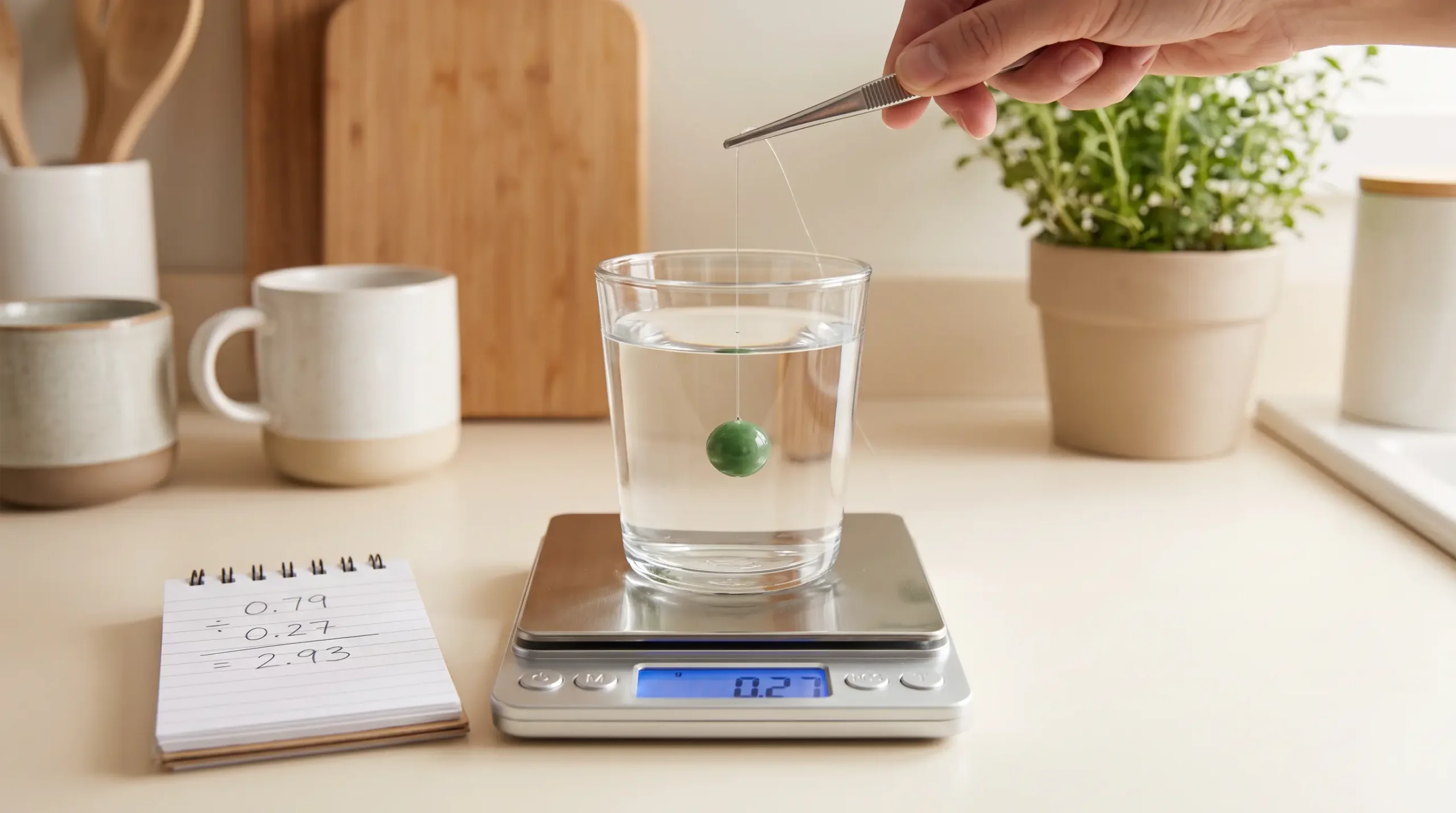
- Weigh one loose bead dry on a scale that reads to 0.01 g. Write it down.
- Set a cup of water on the scale and tare it to zero.
- Hang the bead from a thin thread so it’s fully underwater and touches nothing. The reading is the weight of water displaced, which equals air weight minus water weight.
- Divide the dry weight by that reading. Repeat three times and average.
Example: a bead weighing 0.79 g that displaces 0.27 g gives 2.93—close to nephrite. A reading near 2.65 suggests quartzite. One near 2.5 suggests serpentine or common glass.
What If Your Bracelet Has Metal Spacers or a Charm?
Then don’t trust a whole-strand reading. Metal spacers, charms, and elastic cord all skew the result. Test one loose bead, or ask the seller for the stone-only weight. Many beaded jade bangles and stretch bracelets mix materials, so this step matters more than it seems.
Before you test anything, check how long you’ll have to return it: read the return and exchange FAQs.
What Do Dyed, Filled, or Fake Hotan Jade Beads Look Like?
Most fakes give themselves away under light, magnification, or the scale. Filled nephrite is the exception: in GIA’s Summer 2018 case, filled bracelets read SG 2.95–2.96, “consistent with nephrite.”
| Material | Typical SG | What gives it away |
|---|---|---|
| Glass | ≈2.46–2.50 in GIA cases (most imitation glass 2.3–4.5, per SOSNA Gems) | Round bubbles, swirl lines, too-even color |
| Serpentine | ≈2.5–2.6 | Waxy look, soft, light in the hand |
| Dyed quartzite | ≈2.65 | Sugary grains; dye in cracks and drill holes |
| Filled nephrite | 2.95–2.96 (normal) | Gas bubbles and round pores in dark patches |
Glass, Serpentine, or Dyed Quartzite: What Gives Each Away?
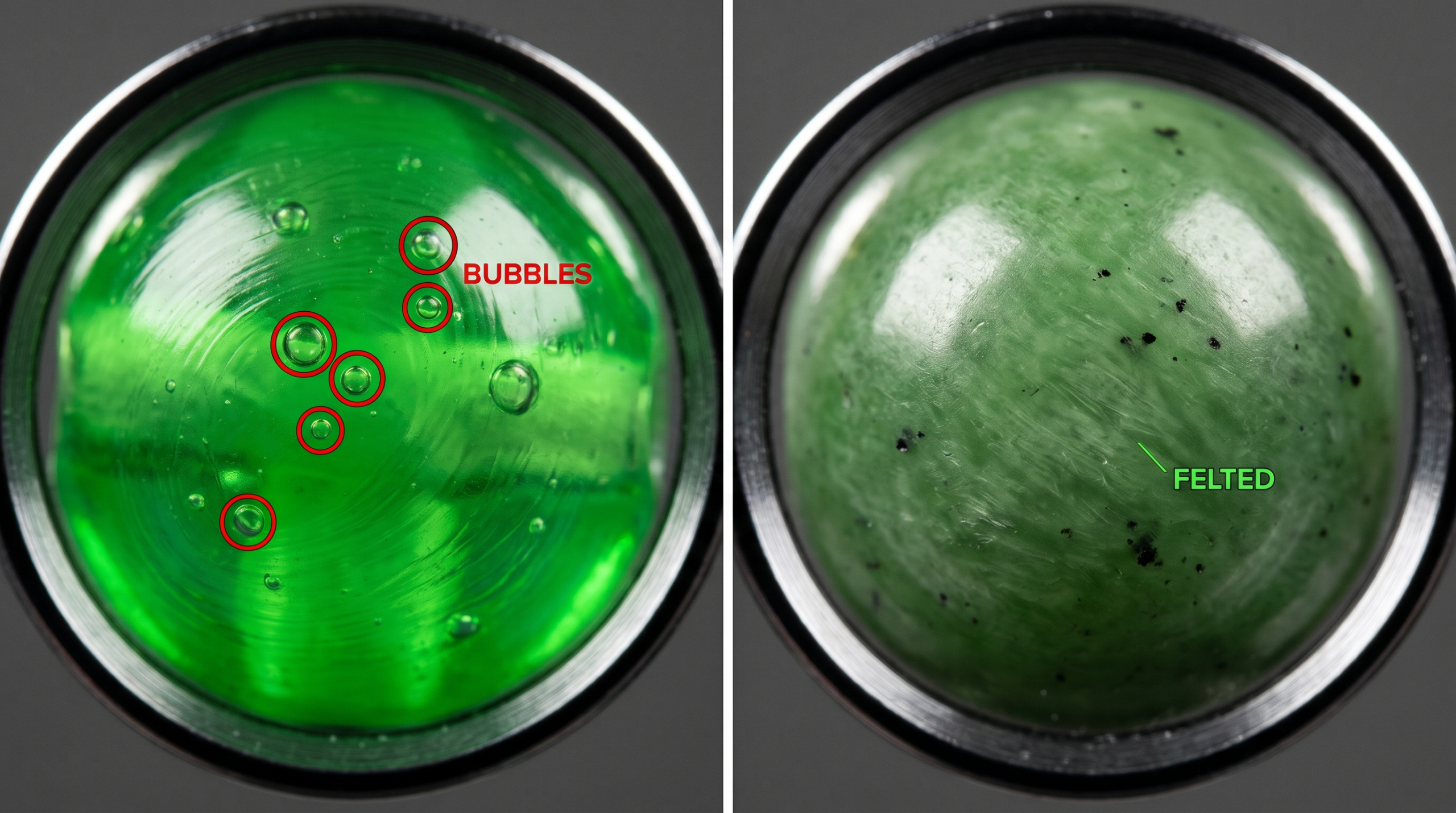
Glass shows bubbles under the loupe. Serpentine feels light and looks waxy. Dyed quartzite shows color pooled along grain edges and cracks. Two checks, light and SG, usually separate all three from real Hetian nephrite beads.
How Do Dyed “Skin” and Filled Cavities Show Up on Nephrite?
Some sellers fake the brown “skin” of prized river pebbles: GIA’s Summer 2018 report notes that “a great deal of white jade with partially dyed color is marketed as mutton-fat zi yu in the Chinese market” (mutton fat jade is creamy white nephrite; zi yu is river-pebble material). GIA adds that Chinese nephrite enthusiasts “often aspire to own mutton-fat zi yu jewelry,” and IGS (Joel E. Arem) links that creamy white color to magnesium-rich, tremolite-dominant stone. In a Summer 2018 GIA Gems & Gemology report, Jianjun Li and Guihua Li of the National Gold & Diamond Testing Center (Shandong), with Haixia Chen, examined two nephrite bracelets weighing 62.305 g and 69.422 g. Both had SG of 2.95–2.96, perfectly normal for nephrite. Yet their cavities had been artificially filled. The filled areas held gas bubbles and spherical pores. GIA called this feature common in glass or plastic imitations, yet one that has “never been found in nephrite.”
The lesson: a normal SG doesn’t rule out treatment. Inspect dark patches with the loupe. To keep any jade bangle or bead strand in good shape, see our notes on jade vs black obsidian care and storage differences.
Is a Lab Report Worth It for a $200 Hetian Jade Bracelet?
For a bracelet around $200, a lab report is worth it only if the seller won’t name the mineral and treatment status, or if the return window is too short to test after delivery—otherwise, home checks plus a clear return policy usually protect you.
What Should a Nephrite Lab Report State?
- The material name: nephrite, or 和田玉 (Hetian jade) on a Chinese report.
- “Natural,” or a note naming any treatment.
- A total weight that matches your bracelet, plus a photo.
- A report number you can verify on the lab’s own website.
Don’t expect it to state origin. Testing time and cost vary by lab.
Ready to compare a labeled nephrite jade bracelet against the seven checks? See the Hetian Jasper & Red Agate Luck Bracelet.
FAQs
Yes. Hetian jade is nephrite, which GIA says gemologists have long considered jade alongside jadeite, with some green omphacite more recently included. The name describes the material, not the mine.
Yes. Glass and quartz feel cool too. Use light, a loupe, and SG instead.
No. It proves little on nephrite and can leave a mark that may void your return.
Stop wearing it. Photograph the result. Contact the seller in writing inside the return window and ask for a refund or an independent lab report.
References
- GIA, “Jade” (Gem Encyclopedia): https://www.gia.edu/jade
- International Gem Society, “Nephrite Jade Value, Price, and Jewelry Information” (Joel E. Arem, updated 07/10/2025): https://www.gemsociety.org/article/nephrite-jewelry-and-gemstone-information/
- GIA Gems & Gemology, Summer 2018 GNI, “Nephrite Bracelet with Filled Cavity”: https∶//www·gia.edu/gems-gemology/summer-2018-gemnews-nephrite-bracelet-with-filled-cavity
- GIA, “Jade Description”: https://www.gia.edu/jade-description