
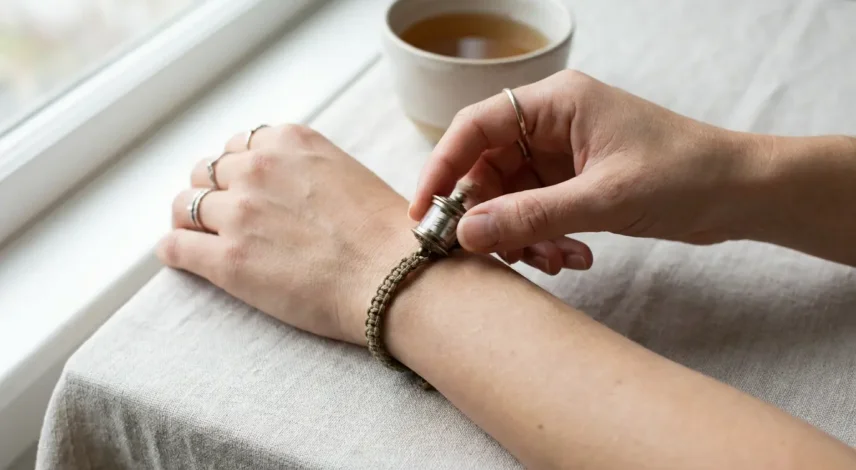

Got a prayer wheel bracelet that’s starting to stick, fray or feel too tight? Here’s how to wear it so the wheel keeps spinning and the meaning stays intact.
This guide covers Tibetan Buddhist prayer wheel (mani wheel) bracelets — not Christian prayer-knot bracelets. We pulled the traditions from museum collections (Rubin Museum, Britannica) and the care steps from our own product specs.
The 7 rules at a glance
- Spin it clockwise.
- Left wrist is customary, not mandatory.
- Snug, not tight — slide on, then pull the knot.
- Off for showers, pools and lotion.
- Wipe dry; never soak.
- Store it dry and flat.
- Wear it with curiosity, not as a costume.
Shopping for your first one? Our Tibetan Prayer Wheel Bracelet for Protection has a sliding knot that fits 6.3″–9.8″ wrists.
Table of Contents
Does Your Prayer Wheel Bracelet Actually Spin?
A real prayer wheel is a working object, not just a shape. Britannica describes it as a Tibetan Buddhist device: a hollow metal cylinder, often embossed and mounted on a rod handle, that holds a tightly wound scroll printed with a mantra. In that tradition, one turn by hand counts like reciting the mantra aloud — multiplied by the number of times it’s printed on the scroll.
Size matters less than you’d think. The Reading Museum’s hand-held mani lag khor (REDMG : 2007.2117.1) is just 7 cm across. It holds two paper scrolls and swings a lead counterweight on a chain to keep it turning. Your wheel charm is a miniature of the same idea.
The practice has deep roots: the Huntington Archive calls the prayer wheel a Tibetan innovation that dates back five or six centuries. The Rubin Museum’s 19th–20th-century Prayer Wheel (SC2010.32a-h) notes the practice is believed to go back to the Indian master Nagarjuna, and that turning is usually paired with reciting mantras and walking around a temple or sacred site.
The surprise for many first-time buyers: not every “spinning” bead holds a mantra scroll. Buddhabelief puts it bluntly: “A decorative spinner should be sold as prayer-wheel-inspired jewelry.” Functional vs decorative isn’t about price. It’s about what’s inside.
What is inside a prayer wheel?
Inside a traditional prayer wheel is a tightly rolled paper scroll printed with a mantra, most often Om Mani Padme Hum, wound around a central axle. The Rubin Museum describes thousands of mantras written on paper and tightly wrapped around a central pole. The mantra has six syllables — Om, Ma, Ni, Pad, Me, Hum. Turning the scroll is traditionally held to build merit, and the Huntington Archive at Ohio State notes that additional prayers wrapped inside are believed to multiply the merit gained per rotation.
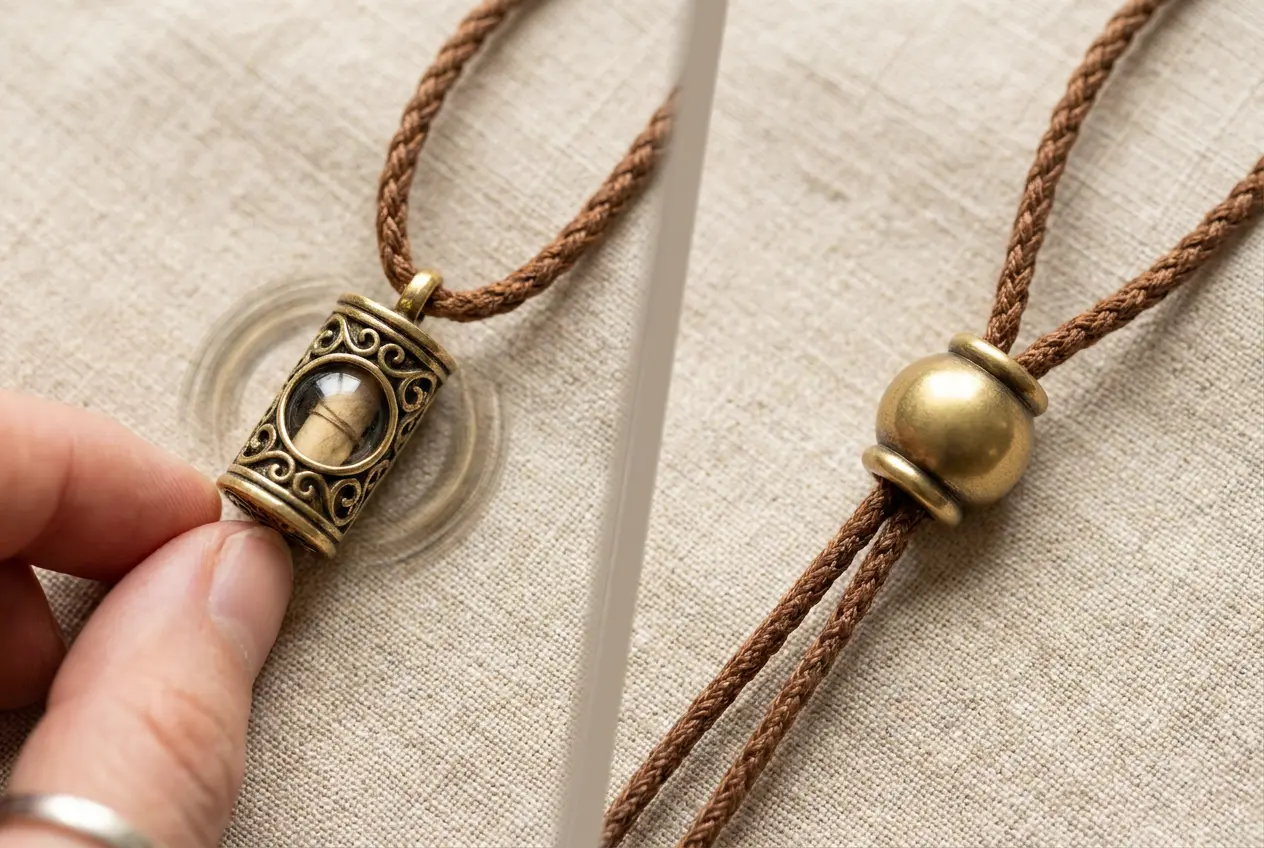
The 30-second check: functional spinner or decorative bead?
- Thumb test (10 seconds). Push the cylinder once with your thumb. A functional charm will rotate a full 360° on its own axle. A decorative bead stays put or just wobbles.
- Window test (10 seconds). Look for a glass window or a cap that opens. Either one lets you confirm a scroll.
- Listing test (10 seconds). Read the description. Our product page says the wheel “contains sacred mantra inside” and lists a glass window among the materials. If a seller says nothing about contents, ask.
Wrist and Fit: Where a Tibetan Mantra Bracelet Sits Best
Which wrist, and how tight? Those are the two questions buyers ask us most. For the bigger picture on symbols and cord colors, start with our guide to Tibetan bracelet meanings, symbols and materials.
Which wrist do you wear a Tibetan bracelet on?
Most people wear a Tibetan prayer wheel bracelet on the left wrist, traditionally called the receiving side, but there’s no universal Buddhist rule. Choose the wrist where the charm sits on top, doesn’t knock your desk, and stays snug — not too tight, not too loose.
Our product page follows the left-wrist custom: “wear on your left wrist to receive spiritual energy.” Treat that as custom, not a commandment. If you’re left-handed or your watch lives there, the right wrist is fine. Keep the wheel facing up so your opposite thumb can reach it.
How snug should an adjustable sliding-knot bracelet be?
Snug enough that the charm stays on top. Loose enough to slip one finger under the cord. Our product page sums it up: “not too tight, not too loose.”
- Measure just below your wrist bone with a soft tape. If you land between 6.3–9.8 inches (16–25 cm), a sliding-knot style fits.
- Open the sliding knot all the way.
- Slide the bracelet over your hand.
- Only now pull the cord ends to tighten it on the wrist.
The most common mistake is pulling the sliding knot tight over the hand instead of on the wrist. That strains the cord exactly where it frays first.
One buyer told us the bracelet “may not slide easily over larger hands because there is no clasp” — and still planned to give one as a gift. The fix is simple: open the knot fully before it reaches your knuckles.
How to Spin a Mani Wheel Charm the Traditional Way
To spin a prayer wheel bracelet, rest it on your wrist, place your thumb on the cylinder and turn it clockwise — left to right as you look at it — one slow rotation at a time, ideally while silently reciting Om Mani Padme Hum. A short round of 21 turns takes about one minute.
Each turn moves the mantra scroll inside past you in the direction it’s written. Here’s the full routine:
- Pause and set one intention (10 seconds).
- Rest your wrist palm-down so the wheel faces up (5 seconds).
- Place your opposite thumb on the cylinder (2 seconds).
- Turn it clockwise, one slow rotation per breath (about 1 minute for a short round, such as 21 turns).
- Recite Om Mani Padme Hum silently with each turn (same minute).
- Close with one breath and dedicate the moment to others (10 seconds).
The 21 is a habit, not a rule. It mirrors the starter routine in our Om Mani guide: 21 recitations each morning, about 2 minutes. Spinning while reciting is traditionally believed to strengthen the blessing of the mantra.
Do prayer-wheel bracelets spin clockwise?
Yes — traditional Tibetan prayer wheels are turned clockwise, so the mantra inside turns in the direction it’s written. The Rubin Museum says the wheels are spun clockwise “so the mantras inside can be read correctly, from left to right.” The Huntington Archive gives two more reasons: clockwise follows the direction of the sun, and it matches the clockwise circumambulation of stupas. Rare exceptions aside — the Huntington Archive notes that wheels in the Bon religion turn counterclockwise, matching the Bon direction of circumambulation — clockwise is the norm.
A one-minute spin routine for busy days
You don’t need a cushion or an altar. Try one round on your commute (as a passenger, never at the wheel). Try another at a desk break, between emails. Or do one before yoga class while everyone unrolls their mats. One minute, 21 turns, one breath to close.
Water, Sweat and Sleep: When to Take Your Bracelet Off
Take a prayer wheel bracelet off before showering, swimming, washing dishes or applying lotion. Water and soap wear down woven cord and can stiffen the spinning mechanism, and perfume can dull alloy charms. Short splashes are fine; just pat it dry and let it air-dry flat.
| Situation | Wear it? | Why |
|---|---|---|
| Shower | ✗ Remove | Soap and hot water soften cord and leave residue |
| Pool & hot tub | ✗ Remove | Chlorine and long soaks are hard on cord and metal |
| Dishes | ✗ Remove | Detergent gets into the mechanism |
| Lotion & perfume | ✗ Remove first | Can dull and tarnish alloy charms |
| Gym | Your call | Sweat dampens cord; wipe dry afterward |
| Sleep | Only if comfortable | The charm can snag or press into your wrist |
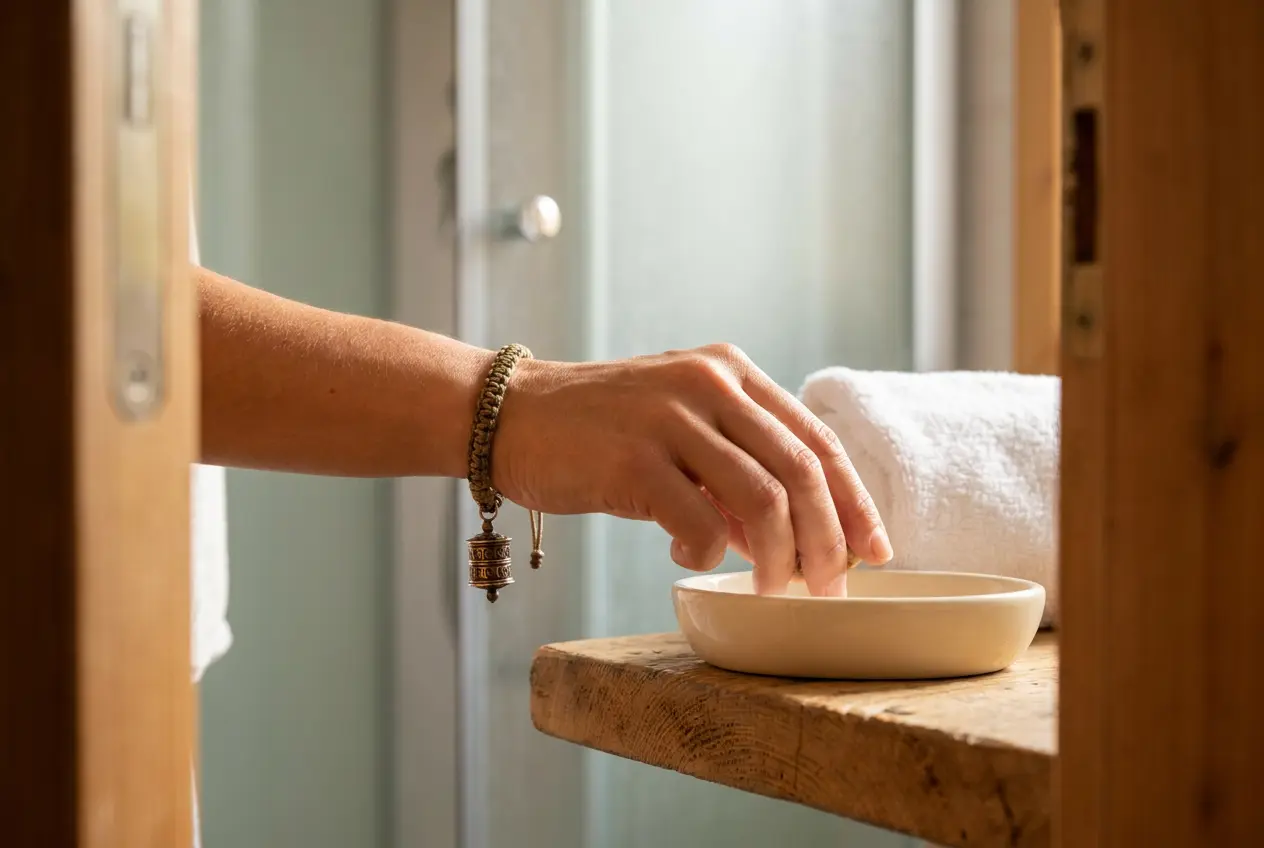
Our product page is direct: “Remove before swimming or showering,” and keep it away from perfume and lotions. The Tibetan Nuns Project gives malas the same advice. Don’t wear one while bathing or let it get wet, since water may weaken the cord, and take it off before bed so the cord isn’t stressed.
One honest limit: with no clasp, this style can be a squeeze over larger hands — a buyer told us exactly that. So every on-and-off means working the knot. Open it fully every time.
If the bracelet gets soaked, don’t panic — air-dry it flat; the mantra is still the mantra.
Can you wear a Tibetan bracelet in the shower?
It’s better to take it off: soap and hot water soften woven cord and can leave residue inside the spinning charm. Set it on a dry shelf outside the bathroom, not on a wet countertop.
Can you sleep with a prayer wheel bracelet on?
You can if it’s comfortable, but a spinning charm can snag on bedding or press into your wrist — many wearers set it on the nightstand instead. A small dish there also makes it easy to put back on in the morning.
How Do You Clean a Prayer Wheel Bracelet’s Cord, Charms and Window?
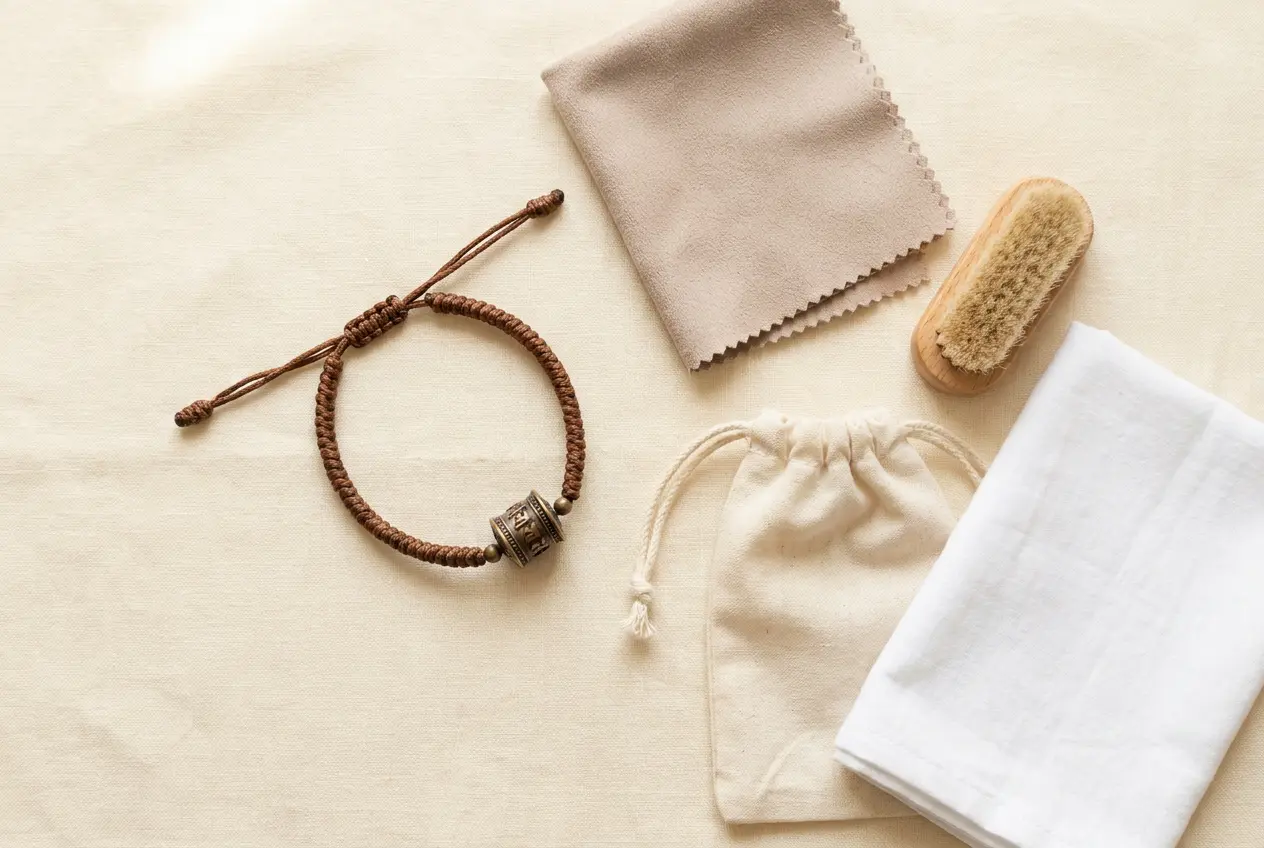
Clean a prayer wheel bracelet dry-first: wipe the charms and glass window with a soft dry cloth, brush lint from the cord, spin the wheel to check it turns freely, then store it in a dry pouch. Skip soaking, harsh chemicals and silver dips.
- Dry your hands so no lotion or sanitizer touches the charms.
- Wipe the charms and glass window with a soft dry cloth.
- Brush lint from the woven cord; spot-dab marks with a barely damp cloth.
- Spin the wheel a few turns to check it moves freely.
- Air-dry flat, then store dry in a pouch.
The easiest mistake is touching the charms with lotion- or sanitizer-damp hands. That film is what dulls the finish and gums up the axle.
| Part | Do | Don’t |
|---|---|---|
| Woven cord | Brush off lint; spot-dab with a barely damp cloth; air-dry flat | Soak, wring, or use a hair dryer |
| Zinc alloy charms | Wipe with a soft dry cloth | Silver dips, toothpaste, vinegar |
| Glass window | Dry microfiber wipe | Pressure or abrasive pads |
| Spinning mechanism | Spin a few turns after cleaning to check it moves freely | Oil or spray inside |
Cleaning the woven cord without weakening it
Work dry first. A soft toothbrush lifts lint from the weave. For a mark, dab — don’t scrub — with a barely damp cloth, then lay the bracelet flat until it’s fully dry. Heat from a hair dryer can shrink or stiffen the fibers and tighten the sliding knot unevenly.
Keeping charms and the glass window clear
On our bracelet, the charms are zinc alloy and the wheel has a glass window. A soft dry cloth is all they need. Zinc alloy can tarnish with moisture, sweat and cosmetics. Copper charms on other Tibetan bracelets tend to darken into a natural patina, which many wearers like. Either way, silver dips and polishes are made for different metals and can strip finishes.
What to do if the cord breaks or the wheel stops turning
Treat a break as wear and tear, not a bad omen: keep the charms together in a small pouch and have the cord restrung, or retire the piece respectfully if the wheel itself is damaged. If the wheel just feels stiff, a dry wipe and a few gentle turns often free it. Don’t force it or oil it.
Between wears, store it dry and flat in a cloth pouch, away from the bathroom.
Wearing Tibetan Buddhist Jewelry Respectfully
Yes, you can wear a prayer wheel bracelet without being Buddhist — what matters is knowing what the mantra is, treating the piece with care, and not using it as a costume.
Is it disrespectful to wear a prayer wheel bracelet if you’re not Buddhist?
Not when you wear it with understanding. The Tibetan Nuns Project, whose malas are made and blessed by Tibetan Buddhist nuns at Dolma Ling Nunnery and Institute near Dharamsala, says it plainly: “You don’t have to be a Buddhist to wear or use a mala.” The prayer wheel itself belongs to Tibetan Buddhism and the wider Himalayan world, not to every Buddhist tradition. As the Rubin Museum notes, Om Mani Padme Hum is the mantra of Avalokiteshvara — Chenrezig in Tibetan — the deity of compassion. For more on the mantra and wrist customs, read our Om Mani Padme Hum bracelet meaning and wrist guide.
Three habits that show respect
- Know the meaning. Learn the six syllables and who the mantra is for.
- Keep it off the floor. Don’t set it on the ground, on shoes or on a bathroom counter.
- Be able to explain it. If someone asks, say in one sentence what it is.
You don’t need to be perfect to wear it respectfully — curiosity and care are already the point. Our guide on how to wear spiritual jewelry respectfully without being religious goes deeper.
The Short Version
Spin it clockwise, keep it dry, and let it do what it does best: remind you to pause. Wear it snug on the wrist that suits your day, take it off for water and lotion, and wipe it with a soft dry cloth. Shopping for Thanksgiving (11/26/2026) or Black Friday (11/27/2026) gifts? Check the recipient’s wrist size first, and you can give it with confidence.
Browse handwoven Tibetan bracelets with mantra charms
Prefer a hand-held mani wheel? See our Tibetan prayer wheels
Or go straight to the adjustable Tibetan Prayer Wheel Bracelet for Protection (fits 6.3″–9.8″ wrists).
Prayer Wheel Bracelet FAQ
It’s a wearable miniature of the Tibetan Buddhist prayer wheel. The charm usually carries Om Mani Padme Hum, the six-syllable mantra of Avalokiteshvara, and it’s traditionally used as a reminder of compassion. See our Om Mani Padme Hum bracelet meaning and wrist guide.
No. A mala counts recitations bead by bead; a prayer wheel bracelet turns a mantra. Some people wear both together.
Give it a quick dry wipe each time you take it off. Do a fuller cord-and-charm clean when it looks dull or the wheel feels stiff.
Yes — it’s a thoughtful holiday gift for friends into yoga or meditation. Check their wrist size first. The Tibetan Prayer Wheel Bracelet for Protection fits 6.3″–9.8″ wrists and comes with 60-day returns.
References
- Huntington Archive (The Ohio State University). “Prayer Wheel – Mani chho-khor.”
- Rubin Museum of Himalayan Art. “Prayer Wheel” (SC2010.32a-h).
- Reading Museum. “Prayer wheel” (REDMG : 2007.2117.1).
- Encyclopaedia Britannica. “Prayer wheel.”