
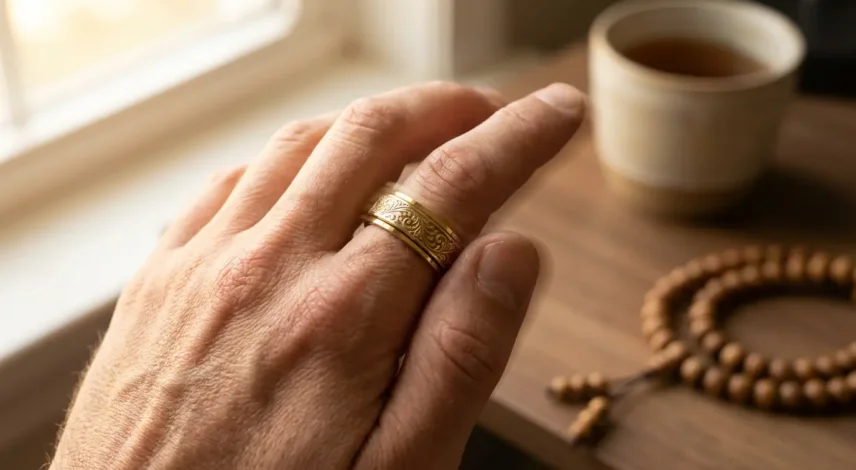

Your thumb already knows the motion. Most people spin an Om Mani ring the way they click a pen—fast, absent, forgotten a second later. Slow it down and turn it clockwise, and that same small gesture becomes a prayer wheel you carry on your hand.
Maybe your ring has drifted into fidget territory. Maybe you’re unsure which way to turn it, or whether wearing it is respectful at all. Or you just want a quiet anchor for a tense meeting or a crowded commute.
Mind racing in a meeting? One clockwise turn per exhale gives your hands a job and your breath a rhythm.
Here’s the short version: clockwise, one turn per breath, 108 turns when you have three minutes.
By the end, you’ll have a 5-step practice that fits in 3–4 minutes—and an honest picture of what it can and can’t do. We lean on Encyclopaedia Britannica for the tradition and on published research for the science. And we’ll say it up front: this ring is not a medical device.
PotalaStore’s product page estimates that 108 rotations take roughly 3–4 minutes; time your first session and see where you land.
Wearing a titanium Om Mani rotating ring? Here’s how to turn it into a practice. Find your size in the Om Mani Padme Hum Titanium Rotating Ring.
Table of Contents
What Makes an Om Mani Spinner Ring Different From a Fidget Ring?
An Om Mani spinner ring carries the six-syllable mantra of compassion on a band that turns—a design that echoes the Tibetan prayer wheel, where each turn is traditionally counted as a recitation. A fidget ring moves the same way, but nothing on it asks for your intention.
The mantra, Om Mani Padme Hum, belongs to Avalokiteshvara—Chenrezig in Tibetan—the bodhisattva of compassion. Britannica describes a mantra as a sacred utterance considered to hold religious or spiritual efficacy. For the word-by-word meaning, read our guide to the six syllables of Om Mani Padme Hum explained. Here, we focus on what the turning band adds.
The Prayer Wheel Behind the Band
Inside a traditional prayer wheel sits a scroll printed with the mantra; turning it is believed to carry the same merit as saying it. Britannica calls the prayer wheel “a mechanical device the use of which is equivalent to the recitation of a mantra.”
In the traditional understanding Britannica describes, one turn by hand equals the oral recitation multiplied by the number of times the mantra is printed on the scroll. Tibetans often call the object a mani khorlo. Large versions turn by wind or water, and pilgrims spin rows of them while walking around temples and stupas.
A spinner ring borrows that idea in miniature. The mantra is laser-engraved on an outer band that can rotate around a fixed inner band.
Fidget vs. Practice: What Actually Changes
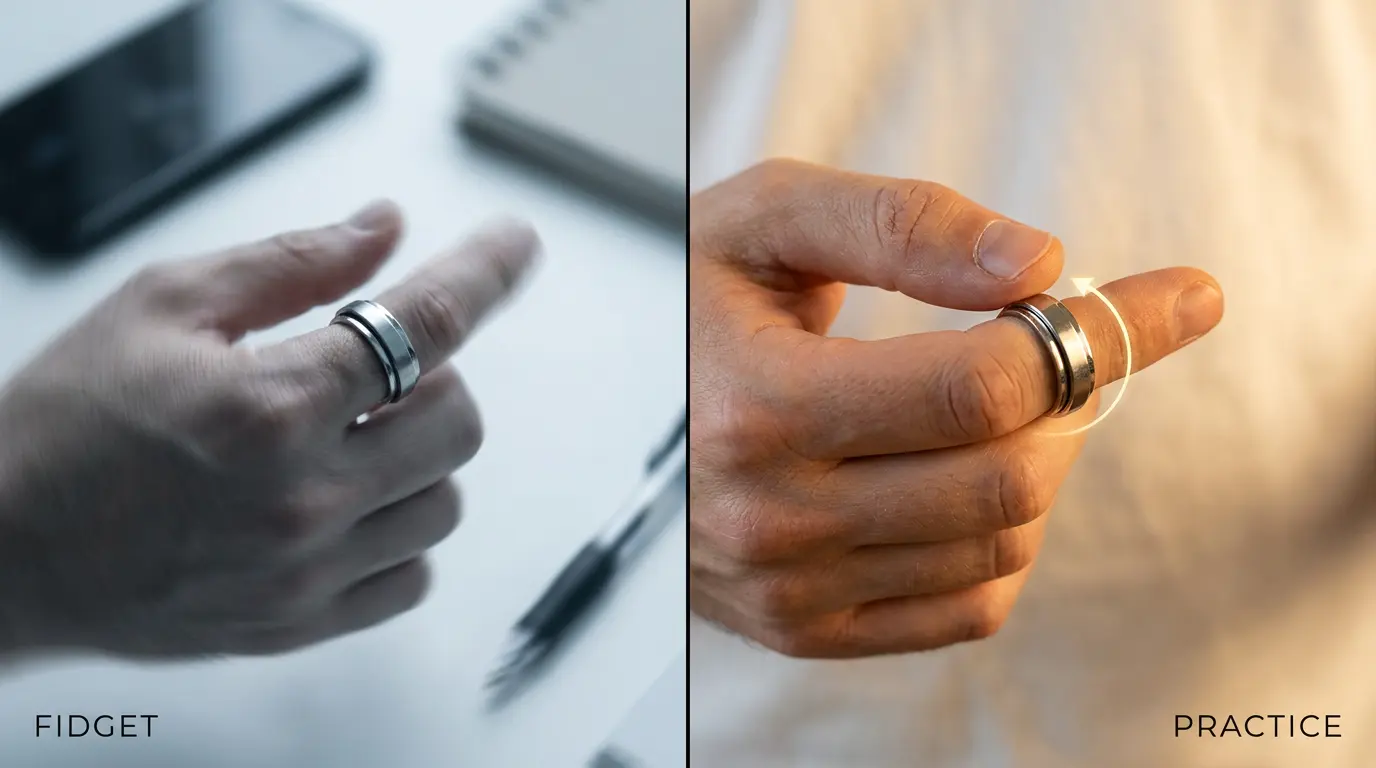
The ring doesn’t change—your attention does. A fidget spin is fast, random in direction, and half-conscious. A practice spin is slow, clockwise, and tied to your breath.
| Factor | Fidget spin | Practice spin |
|---|---|---|
| Speed | Fast, flicking | One slow turn per exhale |
| Direction | Either way, often both | Clockwise, as in Tibetan Buddhism |
| Attention | Elsewhere; the hand runs on autopilot | On the breath, the mantra, or both |
| Purpose | Burn off restless energy | Recitation, intention, a calm pause |
| Ending | Stops whenever you notice | Finishes at 108 turns, then a short dedication |
Try a quick experiment. Spin ten fast turns, then ten slow ones matched to your exhale. Notice which set you actually remember. That gap is the whole difference between a fidget and a practice.
How to Use an Om Mani Spinner Ring: A 5-Step Daily Practice
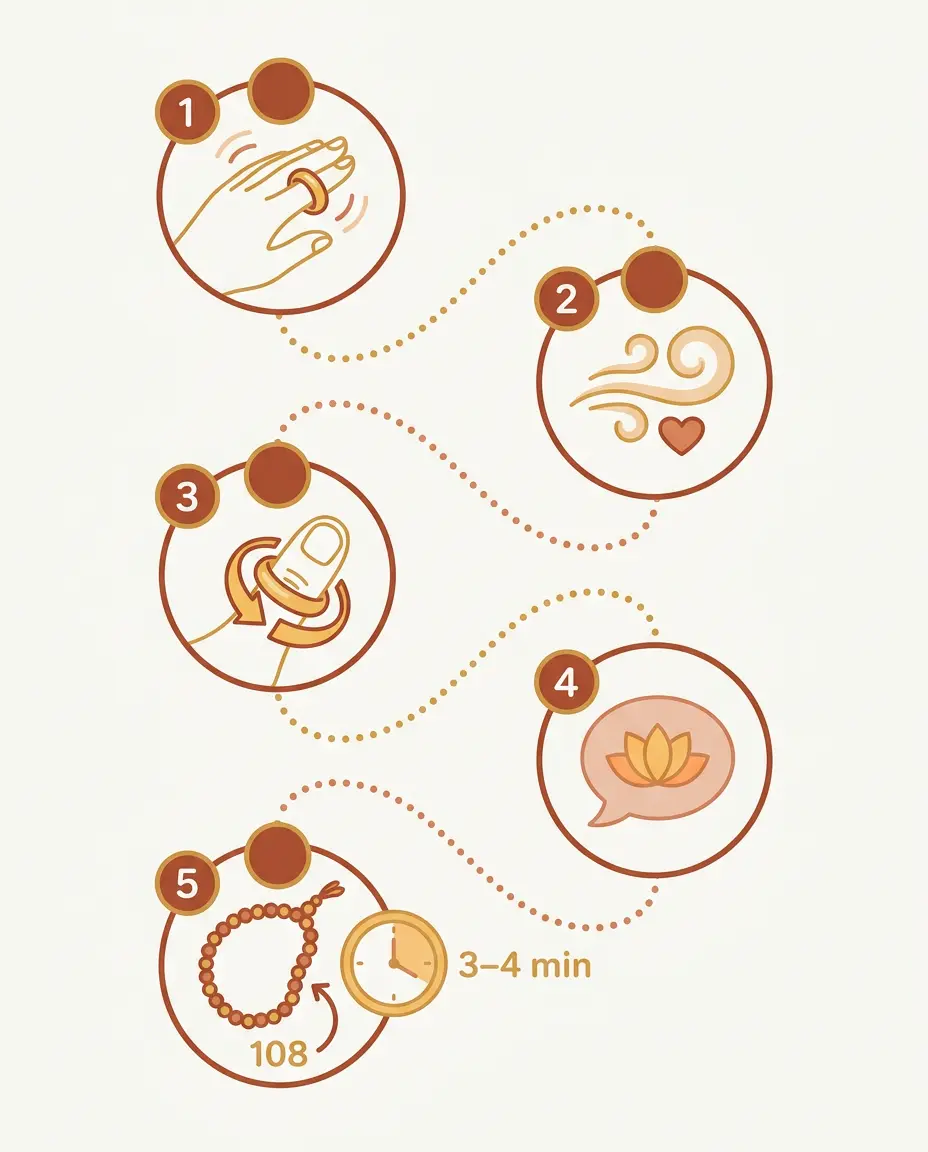
To use an Om Mani spinner ring, wear it on your index or middle finger, spin the outer band clockwise with your thumb, and silently recite Om Mani Padme Hum—or simply exhale—with each turn. A full 108-rotation session takes about 3–4 minutes and works anywhere, from your desk to a waiting room.
- Slide the ring onto your index or middle finger (10 seconds).
- Take one slow breath and set an intention (15 seconds).
- Spin the outer band clockwise with your thumb—one turn per exhale.
- Recite Om Mani Padme Hum silently with each turn, or simply exhale.
- Count to 108 turns (about 3–4 minutes), then pause and dedicate the moment to kindness.
On a free-spinning design like PotalaStore’s titanium rotating ring, the outer band turns both ways. Clockwise is a choice you make, not something the ring does for you.
Keep the intention short. “May I be patient today” works. So does “For my sister’s surgery.” This mantra is tied to compassion, so a wish that includes other people fits naturally.
What You Need Before You Start
Just the ring, a free thumb, and about three minutes. No cushion, no quiet room, no special posture.
Like to keep count? Hold a 108-bead mala in your other hand and move one bead per turn. Otherwise, count in sets of ten, or set a four-minute timer and stop when it ends.
The 108-Turn Micro-Session
108 matches one full mala count, which is why many wearers use it as a natural finish line. The Tibetan Nuns Project notes that long malas have 108 beads and that “malas are used as a tool to keep count of mantra repetitions.”
A fixed number gives the session a clear end, so you stop checking the clock. Short on time? Do 27 turns—a quarter mala—and call it complete.
When you finish, take one breath and dedicate the moment to kindness. Tibetan Buddhist sessions often close by dedicating merit to the benefit of all beings.
Lost count at 40? That’s normal—start again from one. The turning matters more than the tally.
Which direction should you spin an Om Mani Padme Hum ring?
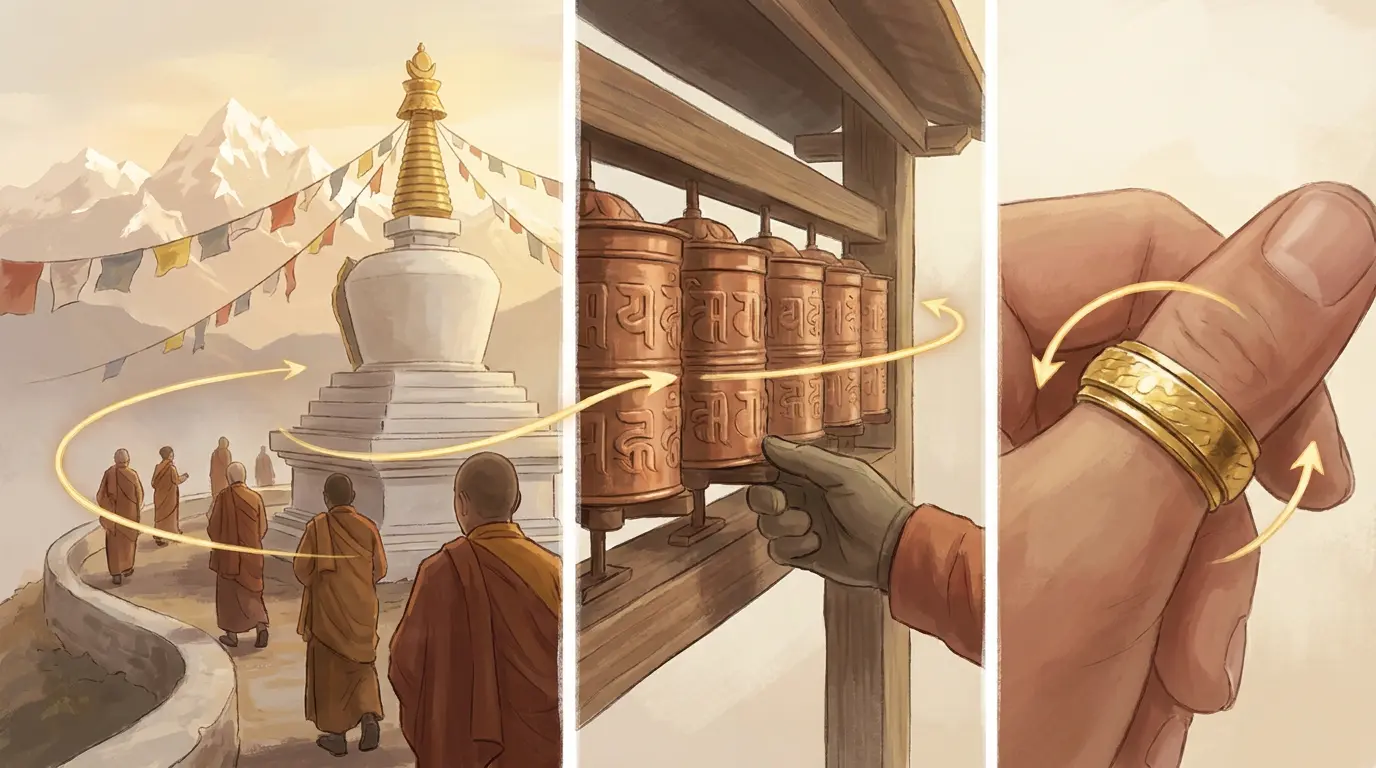
Spin it clockwise. In Tibetan Buddhism, prayer wheels turn and pilgrims walk around stupas in the same sun-wise direction, so the mantra moves in its reading order. Bon practitioners circle counterclockwise, so this guidance belongs to Buddhist practice specifically—and it’s the convention the Om Mani mantra comes from.
The Rubin Museum of Himalayan Art describes Himalayan Buddhists walking clockwise around stupas, monasteries, and sacred mountains to accrue merit, and notes that Bonpos do the same counter-clockwise. That circling practice is called kora. A clockwise ring spin is the same motion, scaled down to your thumb.
The museum also explains that wheels spin clockwise so the mantras inside read correctly, from left to right.
Spun the wrong way? It’s easy to do, since most spinner bands rotate in both directions. Switch and keep going—no need to restart your count.
Which hand should you wear an Om Mani Padme Hum ring on?
There’s no strict Tibetan rule—choose the hand where your thumb reaches the band without looking. PotalaStore’s own wearing guide says either hand works.
Many people prefer their non-dominant hand. That keeps the dominant one free for writing, typing, or holding coffee.
Best Fingers for Easy Thumb Spins
Index and middle fingers give your thumb the shortest reach. Curl your hand loosely and press the pad of your thumb against the outer band. It should rotate without twisting your wrist.
The ring finger works if your thumb is long. The pinky usually forces an awkward stretch, so most wearers skip it.
Mantra Ring for Anxiety: What the Spinning Can and Can’t Do
A spinner ring is not medical care for anxiety, but pairing a slow turn with a slow exhale gives restless hands a job and your attention an anchor. Use it as a portable cue for slower breathing—in meetings, on a commute, or in line—and keep professional support in the picture when you need it.
Where it fits: a tense meeting, a delayed train, a long checkout line. Where it doesn’t: behind the wheel. Don’t spin while driving; keep both hands and your attention on the road.
What the Research on Movement Actually Shows
The best-known study looked at children with ADHD, not at rings. Researchers at the UC Davis MIND Institute—T. A. Hartanto, C. E. Krafft, A. M. Iosif, and senior author J. B. Schweitzer, director of the UC Davis ADHD Program—published it online in Child Neuropsychology in 06/2015. The print version appeared in volume 22, issue 5, pages 618–626 (2016).
Research boundary box
- Who: 44 children aged 10–17; 26 with ADHD, 18 typically developing.
- How: an ankle-worn actometer tracked movement during a flanker task, which tests attention and cognitive control.
- Found: in the ADHD group, more intense movement went with more accurate answers. The typically developing group showed no such link.
- Not tested: rings, adults, anxiety, or breathing. It shows an association, not cause and effect.
Writing for CHADD’s Attention magazine, the team summarized that “children with ADHD were more accurate in responding when they were moving more intensely.” The same, they added, “was not found in the children without ADHD.”
So the honest takeaway is narrow. For some people, movement and focus may travel together. It doesn’t show that a spinner ring calms anxiety.
The One-Turn-Per-Exhale Method
Match the spin to your breath: one full turn as you breathe out. Breathe in through your nose with your thumb resting on the band.
As you exhale, push the outer band one full rotation. Let the exhale run a little longer than the inhale. Mind wandered? Return on the next exhale—there’s no score to keep.
Many wearers find the steady rhythm makes it easier to stay with the breath than counting alone. This ring is not a medical device.
If anxiety is getting in the way of daily life, a ring can sit alongside professional support—not replace it.
Respectful Wear: A Simple Etiquette Guide for Non-Buddhists
You don’t need to be Buddhist to wear the mantra—you just need to handle it as meaningful text, not a costume. In practice, that means wearing it above the waist, setting it down somewhere clean, and putting it on with a moment of intention rather than as a throwaway accessory.
| Do | Don’t |
|---|---|
| Wear it on your hand, above the waist | Wear the mantra as an anklet or toe ring |
| Set it in a clean dish or pouch | Toss it on the floor or a bathroom counter |
| Put it on with one breath and an intention | Use it as a costume or joke prop |
| Learn what the six syllables mean | Claim powers the tradition doesn’t claim |
For a broader look, read our guide to wearing Om Mani Padme Hum jewelry respectfully without being religious.
Can non-Buddhists wear an Om Mani Padme Hum ring?
Yes—and voices close to the tradition say so plainly. The Tibetan Nuns Project, whose malas are made and blessed by nuns at Dolma Ling Nunnery and whose sales support nuns at seven nunneries in northern India, writes: “You don’t have to be a Buddhist to wear or use a mala.”
PotalaStore’s product note says the same about this ring. It adds two traditional requests: keep sacred mantras above the waist, and put the ring on with intention.
5 Beginner Mistakes to Avoid
Most mistakes come from rushing, not disrespect.
- Spinning too fast. Speed turns practice back into fidgeting. Slow to one turn per exhale.
- Going counterclockwise out of habit. Check direction at the start of each session.
- Ordering a size that’s too tight. A pinched band drags instead of spinning. Order your true size.
- Expecting a medical fix. It’s a practice aid, not a substitute for care.
- Leaving it on the floor or wearing it below the waist. Keep the mantra off the ground.
Choosing and Caring for Your Tibetan Prayer Ring
If you’ll spin it daily, choose a band that keeps the mantra legible: laser-engraved titanium steel resists tarnish, while sterling silver needs regular polishing. Then order your true size, wipe the ring with a soft dry cloth, and keep it away from harsh chemical cleaners.
Titanium Steel vs. Sterling Silver for Daily Spinning
The difference shows up after months of thumb friction, not on day one.
| Metal | Tarnish | Water | Care | Best for |
|---|---|---|---|---|
| Titanium steel, laser-engraved | Described by PotalaStore as tarnish-free | Listed as waterproof on the product page | Soft dry cloth; no chemical cleaners | Daily spinning, low upkeep |
| Sterling silver | Darkens over time; chlorine speeds it up | Best removed before showers and pools | Regular polishing | A classic look, if you enjoy upkeep |
| Brass or copper | Develops a patina; can mark skin | Remove before washing | Frequent polishing | Warm tone, occasional wear |
PotalaStore lists its titanium steel as hypoallergenic and nickel-free. That matters if some metals irritate your skin.
Getting the Size Right the First Time
Order your true size; a spinner that fits snugly still turns freely. PotalaStore notes that spinner rings run about a half size large, so skip the usual size-up advice for wide bands.
The band width is about 8 mm (about 0.3 in). The ring comes in US sizes 7–11, in Gold or Silver. Not sure of your ring size? The product page includes a guide to measuring at home.
Here’s what each feature means in daily use:
- Laser-engraved titanium steel → the script is cut into the band, not printed on → the mantra stays legible through hundreds of daily turns.
- Free-spinning outer band, about 8 mm wide → one thumb push turns it → you can finish 108 turns one-handed under a meeting table.
- Waterproof, per the product page → no need to remove it to wash your hands or shower → your practice isn’t interrupted.
- 60-day returns and exchanges → a wrong size is easy to fix → you can order without sizing anxiety.
- $2 charity donation per purchase toward Tibetan monasteries and spiritual communities, plus a FREE Reiki & Mantra Blessing added to all orders → your purchase gives back to the communities the mantra comes from.
Ready to try it? See the Om Mani Padme Hum titanium rotating ring in US sizes 7–11—$46.95 at the time of writing, listed down from $78.95. Want to compare designs first? Browse titanium and sterling silver Tibetan Buddhist rings.
One turn, one exhale. That’s the whole practice—and it fits between emails.
Shopping for someone this holiday season? The ring ships in a gift-ready box with a card explaining the mantra’s meaning. Find your size in the Om Mani Padme Hum Titanium Rotating Ring and give three quiet minutes a day.
Frequently Asked Questions
It depends on the metal. PotalaStore describes its titanium rotating ring as waterproof and non-tarnishing, while sterling silver is best removed before showering to slow tarnish.
Snug enough not to slide off, loose enough that the outer band turns freely. Spinner rings tend to run about half a size large, so order your true size. PotalaStore offers 60-day returns if the first size isn’t right.
In the prayer-wheel tradition, turning a wheel is considered equivalent to reciting the mantra it carries. Many wearers apply the same idea to the ring. Teachers still put motivation first: Lama Zopa Rinpoche advised generating “bodhicitta motivation” before using a prayer wheel, and the Dalai Lama has said that while reciting, “you should be thinking on its meaning.”
Yes, especially for someone starting meditation or going through a stressful season. PotalaStore ships its titanium ring in a gift-ready box with a card explaining the mantra’s meaning.
This article is for general and cultural information and isn’t medical advice.
References
- Encyclopaedia Britannica. “Prayer wheel.” https://www.britannica.com/topic/prayer-wheel
- Encyclopaedia Britannica. “Mantra.” https://www.britannica.com/topic/mantra
- Hartanto TA, Krafft CE, Iosif AM, Schweitzer JB. (2015). A trial-by-trial analysis reveals more intense physical activity is associated with better cognitive control performance in attention-deficit/hyperactivity disorder. Child Neuropsychology, 22(5), 618–626 (2016). DOI: 10.1080/09297049.2015.1044511. Open full text: https://escholarship.org/content/qt85w054gt/qt85w054gt.pdf
- Hartanto T, Lewis S, Schweitzer J. “Don’t Stop the Movement!” Attention magazine (CHADD), 02/2016. https://chadd.org/adhd-news/adhd-news-caregivers/dont-stop-the-movement/
Also cited in text:
- Pakhoutova E. “Prayer Wheel: Accumulating Merit Every Day.” Project Himalayan Art, Rubin Museum of Art, 2023. https://rubinmuseum.org/projecthimalayanart/essays/prayer-wheel/
- Rubin Museum of Himalayan Art. “Prayer Wheel” (collection object). https://rubinmuseum.org/collection/sc2010-32a-h/
- Tibetan Nuns Project. “How to Use and Choose a Tibetan Mala.” https://tnp.org/how-to-use-and-choose-a-tibetan-mala/
- Lama Zopa Rinpoche. “Benefits of Chenrezig Mantra and Prayer Wheel Practice.” FPMT. https∶//fpmt.org/teachers/zopa/advice/benefits-of-chenrezig-mantra-and-prayer-wheel-practice/
- The Dalai Lama. “What Om Mani Padme Hum Means.” Shambhala Publications (Snow Lion). https://www.shambhala.com/snowlion_articles/om-mani-padme-hum-dalai-lama/