

Yes, you can fly with a singing bowl, and carry-on is the safest place for it. Expect TSA to hand-inspect it, and know that U.S. airlines must take a small instrument in the cabin when there’s room.
Flying home for Thanksgiving this week? Heading to a retreat or a yoga class in another city? A little planning keeps your bowl ringing true when you land. This guide covers the checkpoint, the federal cabin rule, packing, and after-trip care for metal and crystal bowls.
Quick answer
- Carry it on. Carry-on instruments get a physical inspection at the TSA checkpoint, so pack the bowl on top.
- Board early. Under 14 CFR Part 251, a small instrument rides in the cabin if it fits the overhead bin or under the seat and space remains at boarding.
- Never check crystal. Metal bowls can scratch or dent; quartz bowls can crack from one knock.
Planning a trip? Start with a travel-size bowl from our Tibetan Singing Bowls collection.
Table of Contents
Can You Bring a Singing Bowl on a Plane?
Yes. TSA has no specific listing for singing bowls, so expect yours to be screened like a musical instrument: carry-on instruments get a physical inspection at the checkpoint. U.S. airlines must let a small instrument ride in the cabin, with no fee beyond the standard carry-on charge, if it fits in the overhead bin or under the seat.
TSA’s wording is short: “Musical instruments transported as carry-on require a physical inspection at the security checkpoint.” It also asks you to “Inform the TSA officer if your instrument requires special care and handling.” Treating a singing bowl as a musical instrument is our reading of these rules, not an official TSA category.
Two TSA pages, two brass answers. The TSA FAQ says, “You may pack brass instruments in your checked or carry-on baggage.” The TSA item pages for Drumsticks and Violins say, “Pack brass instruments in your checked bags.” A singing bowl isn’t a brass instrument like a trumpet, so neither line was written for it. What the mismatch does show is that officers have discretion. Every item page ends the same way: “The final decision rests with the TSA officer on whether an item is allowed through the checkpoint.”
Real-world reports are encouraging but anecdotal. On a Tripadvisor Nepal forum, one traveler wrote that they carried two bowls as carry-on with no problem. That’s one person’s experience, not a rule.
Does TSA Allow a Singing Bowl in Carry-On Bags?
In practice, yes, with screening. Plan for your carry-on instrument to be unwrapped and handled.
- Pack the bowl at the top of your bag so it comes out without unpacking everything.
- Use wrapping that’s easy to undo and redo in under a minute.
- Leave extra time on peak days, like the Sunday after Thanksgiving.
Can You Pack the Mallet or Striker in Your Carry-On?
Most likely, yes. TSA doesn’t list mallets, so the closest listed item is drumsticks, which TSA marks “Yes” for both carry-on and checked bags. Applying that to a wooden mallet or striker is our inference. In the same Tripadvisor thread, one traveler put the sticks in checked luggage on the vendor’s advice, a cautious option if you’re checking a bag anyway.
Never pack the mallet inside the bowl; it knocks the rim with every bump. Keep pointed crystals out of the same bag, too. The Life Changing Energy blog, written by a crystal-bowl retailer, says singing bowls are “usually fine” at security but advises against packing pointed crystals or ceremonial crystal knives.
What Should You Say at the Security Checkpoint?
Keep it to one sentence. Tell the officer: “This is a metal singing bowl, a musical instrument. It’s fragile; may I unwrap it for you?”
Offer to hold the bowl by its base during inspection. If you’re asked to strike it once, tap it gently on its cushion. That request shows up in traveler stories, not in TSA procedure, so don’t expect it.
Carry-On or Checked: The Federal Rule That Protects Your Instrument
Under 14 CFR 251.3, U.S. airlines must let you carry a small musical instrument into the cabin without charging more than their standard fee for comparable carry-on baggage, as long as it can be stowed safely in the overhead bin or under a seat and space is available when you board.
| Option | Rule | Limit | What it means for your bowl |
|---|---|---|---|
| Cabin (carry-on) | 14 CFR 251.3 | Fits the overhead bin or under a seat; space available at boarding | Best choice for nearly every bowl |
| Own seat | 14 CFR 251.4 | Buy an extra seat; up to 165 lb including the case | Rarely needed; very large or very valuable bowls |
| Checked | 14 CFR 251.5 | Up to 150 linear inches (L + W + H) and 165 lb including the case | Metal bowls only, in a hard-sided case |
Overhead bin space is first come, first served. When DOT issued the final rule on January 5, 2015 (effective March 6, 2015), it said stowage “should be made available for all carry-on items on a ‘first come, first served’ basis,” and that travelers “may want to buy the pre-boarding option offered by many carriers.” Your rights depend on space at boarding, so board early.
Part 251 covers U.S. carriers only. DOT’s enforcement FAQ is plain: “Part 251 does not cover non-U.S. carriers or flights operated by non-U.S. carriers.” On a foreign airline, follow that carrier’s own policy.
Airline policies add detail. Delta accepts “Guitars and smaller musical instruments like violins or flutes” as your free carry-on item. It also asks for cases meeting the ATA 300 standard: Category I cases are designed for at least 100 round trips, Category II for at least 10.
When Does an Airline Have to Let Your Bowl in the Cabin?
Two conditions must both be true:
- The bowl can be stowed safely in a cabin compartment or under a passenger seat, under FAA carry-on rules.
- “There is space for such stowage at the time the passenger boards the aircraft.”
The instrument also counts toward your carry-on limit. DOT says a bowl the size of a personal item can count as that item, which leaves your overhead bin spot for a roller bag.
What If the Overhead Bin Is Full?
If the bin is full, ask about under-seat space first, then consider a gate check. If a crew member asks to gate check a crystal bowl, ask about under-seat space first—quartz doesn’t forgive a dropped bag. Airlines don’t have to remove other passengers’ bags for your instrument, so a calm request works better than an argument. If a metal bowl must be gate checked, make sure it’s fully padded and ask for a fragile tag.
What Are the Limits for Checking a Large Bowl?
U.S. carriers must accept a checked instrument up to 150 total linear inches and 165 lb, including the case. They can charge the same oversize or overweight fees as any other bag, but not a fee simply because it’s an instrument. Non-U.S. airlines set their own limits, so check their websites.
Metal vs. Crystal Bowls: How Travel Risk Changes by Material
Metal bowls can scratch or dent but rarely break, while crystal bowls can crack from one hard knock or a fast temperature swing—so metal can ride padded in a carry-on and crystal should never be checked.
| Factor | Metal (copper or bronze) | Crystal (quartz) |
|---|---|---|
| Breakage risk | Low; can dent or scratch | High; can crack or chip |
| Main threat | Rim knocks and scratches from hard items | Impact and fast temperature swings |
| Best place | Padded carry-on; checked only in a hard-sided case | Carry-on only, under the seat when possible |
| Packing must-have | Microfiber cloth and rim padding | Hard-sided case with foam |
Crystal bowls call for extra caution. Bowls of Sound, a crystal bowl retailer, says it directly: “Never leave your crystal singing bowl bag with the airlines.” For a crystal singing bowl, carry-on only is the safe default.

Traveling With a Hand-Hammered Metal Bowl
A hand-hammered copper or bronze bowl is tough, but the rim is where the tone lives. Pad the rim. Keep keys, chargers, and other hard metal out of the same layer. Wrap it so nothing rubs against the patina.
Traveling With a Crystal Singing Bowl
Treat a crystal bowl like a laptop screen: hard case, carry-on only, never under a pile. In winter, don’t leave it in a cold car. When you bring it into a warm room, let it reach room temperature before you play it, because fast temperature swings stress quartz.

How to Pack a Singing Bowl for Travel
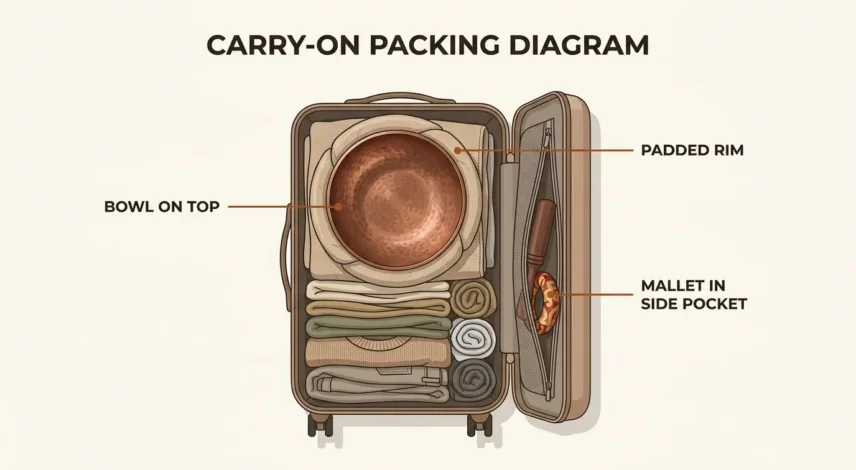
Wrap, cushion, stow. These six steps protect a bowl in any bag:
- Wipe the bowl clean and dry, then wrap it in a microfiber cloth.
- Cushion it with bubble wrap or foam, adding an extra layer around the rim.
- Fill the inside with soft clothing like socks—never the mallet.
- Set it in a padded or hard-sided case so it can’t shift.
- Stow the mallet and ring cushion in a side pocket, not inside the bowl.
- Place the case at the top of your carry-on for the security checkpoint.
Weight adds up fast. Sound-healing teacher Shannon Rose Scott put her Himalayan bowls, 23 pounds’ worth, in her carry-on to save checked-bag weight, on a leg where the carry-on allowance was 35 pounds. Limits vary by airline and fare, so check every leg of your trip. The Life Changing Energy blog reports, “I’ve been able to fit up to an 8-inch bowl under the seat”; that’s one practitioner’s experience, since under-seat space varies by aircraft.
What Packing Materials Do You Need?
- Microfiber cloth: wipes fingerprints and forms the first soft layer.
- Bubble wrap or foam: absorbs bumps, especially at the rim.
- Padded or hard-sided case: keeps the bowl from shifting; choose hard-sided for crystal.
- Mallet pouch: keeps the mallet or striker separate from the bowl.
How Do You Nest Two or More Bowls Safely?
Wrap each bowl on its own. Place the largest bowl first, then nest the next size with foam or clothing between them. Keep mallets out of the stack. Avoid nesting two bowls of nearly the same diameter; they wedge tight and rub at the rim.
Caring for Your Sound Bowl on the Road and After You Land
After a trip, wipe your bowl with a soft, slightly damp cloth, dry it completely, and store it somewhere dry—skip steel wool, harsh cleaners, and letting water sit inside.
Once you’ve unpacked, run our 5-minute singing bowl strike test for sustain and cracks. Drop a silica gel packet into the case to keep humidity down. Expect the patina on copper and bronze to darken over time; that’s normal aging, not damage.
Bowls are traditionally polished with lemon and wood ash. That method changes the patina and can change the tone, so many players recommend leaving it for home, if you use it at all.
How Do You Check Your Bowl for Damage After a Trip?
Strike it once and listen: a clean tone that fades slowly is a good sign, while a buzz or rattle can point to a hairline crack worth a closer look. Then run a fingertip around the rim to feel for chips, and check the base under good light.
How Should You Store a Bowl in Hotels, Cars, and Humid Climates?
- Hotels: keep the bowl in its case on a shelf, away from the floor and the AC vent.
- Cars and road trips: wedge the case behind a seat, not loose in the trunk, and never leave a crystal bowl in a freezing or hot car.
- Humid climates: add silica gel and wipe the bowl dry after playing outdoors.
What Size Bowl Is Best for Travel?
For most flyers, a bowl about 3 to 5 inches (8 to 14 cm) across is the easiest to carry: it fits a personal item, weighs around a pound, and still sounds full enough for daily practice. Our Full Moon product page suggests 12 to 14 cm for a first bowl or for travel.
| Diameter | Weight | Sound | Good for |
|---|---|---|---|
| 4.72 in (12 cm) | 450 g (≈15.9 oz) | Brighter, shorter sustain | Desk, travel, first bowl, gifts |
| 5.51 in (14 cm) | 550 g (≈19.4 oz) | Bright to medium-bright | Daily solo meditation |
| 6.30 in (16 cm) | 800 g (≈1.8 lb) | Balanced mid-tone | Yoga class, small groups |
| 7.09 in (18 cm) | 900 g (≈2.0 lb) | Deeper, longer sustain | Sound baths |
| 7.87 in (20 cm) | 1,100 g (≈2.4 lb) | Deepest, fullest | Group sessions, large rooms |
The trade-off is real: smaller bowls sound brighter, and their sustain is shorter. If deep, long tones matter more than portability, a 14 cm bowl is a sensible middle ground.
Need something smaller? Our Tibetan Singing Bowl Set pairs an 8 cm copper bowl with a wooden striker and a brocade ring cushion for $69.95 at the time of writing. If space is very tight, see singing bowl vs. tuning fork for travel and small spaces.
How Much Do Travel-Size Bowls Weigh?
A 12 cm Full Moon bowl weighs 450 g, about 15.9 oz, a little less than a 16.9 fl oz bottle of water. The 20 cm size is 1,100 g, about 2.4 lb. Add the case, cushion, and mallet before you weigh your carry-on.
Our travel pick: the 12 cm Lunar Rainbow Full Moon copper singing bowl with mallet and cushion.
- 4.72 in (12 cm) across, so it fits in a personal item, and you keep your overhead bin spot for your roller bag.
- 450 g (≈15.9 oz), about the weight of a bottle of water, so it won’t push you toward an airline weight limit.
- Mallet and cushion included, so it’s ready to play on arrival for a 10-minute meditation in your hotel room.
- Hand-hammered copper won’t shatter like quartz, so bag checks and bumpy rides are less of a worry.
Frequently Asked Questions
Travelers report carrying new bowls home without trouble. The Nepal Tourism Board states, “It is illegal to export objects over 100 years old,” and antiques need special certification from the Department of Archaeology in Kathmandu, so check with that office before buying an antique. Keep the receipt for any new bowl.
No rule requires one, but a padded or hard-sided case is the practical choice. Delta recommends ATA 300 cases for instruments, which is more protection than most small bowls need.
Neither TSA guidance nor 14 CFR Part 251 addresses playing an instrument in flight. Sound carries in a quiet cabin, so save it for your hotel room, retreat, or yoga class.
Choose a bowl about 12 cm (4.72 in) across or smaller. It fits a personal item, weighs about a pound, and still sounds full enough for daily practice. You’ll find travel sizes in our Tibetan Singing Bowls collection.
Inspect, Stow, Wipe
Inspect: expect a physical inspection, and keep the bowl on top of your bag. Stow: board early and claim overhead bin or under-seat space. Wipe: clean, dry, and strike-test your bowl when you land.
Find a bowl that fits your carry-on—and your practice.
Shop Tibetan Singing Bowls
Rules change; check TSA.gov and your airline before you fly.
References
- TSA, “What steps are taken to screen musical instruments?” and TSA “What Can I Bring?” item page: Drumsticks. tsa.gov FAQ · tsa.gov Drumsticks. Accessed 11/26/2026.
- U.S. DOT, Carriage of Musical Instruments, 14 CFR Part 251 (§§251.2–251.5), Federal Register, 01/05/2015. govinfo.gov. Accessed 11/26/2026.
- U.S. DOT, Answers to Frequently Asked Questions Concerning Enforcement of the Musical Instruments Rule (03/04/2015). transportation.gov. Accessed 11/26/2026.
- Delta Air Lines, Musical Instruments. delta.com. Accessed 11/26/2026.