
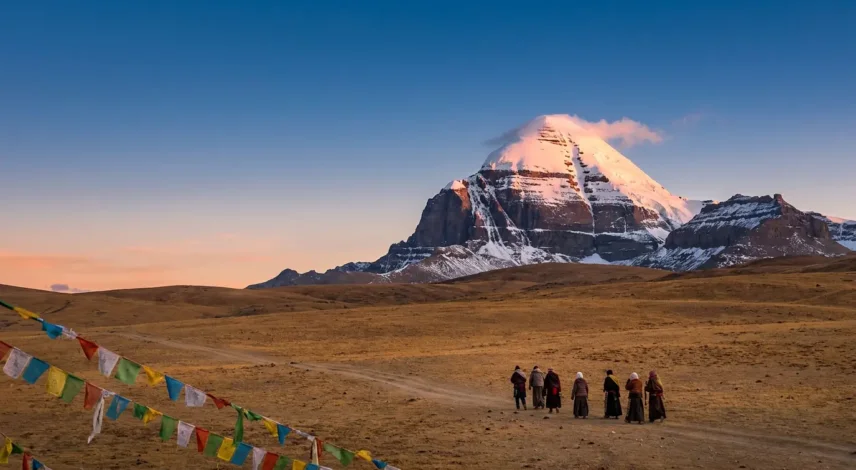

Mount Kailash is lower than Everest by more than 7,000 feet, yet no one is allowed to stand on its summit.
In Tibetan tradition, Mount Kailash matters because it is regarded as Mount Meru on earth and the mandala palace of the tantric deity Chakrasamvara. Tibetans call the 21,778-foot (6,638 m) peak in western Tibet Gang Rinpoche, and pilgrims honor it with a 32-mile (52 km) kora, a ritual walk around its base, instead of climbing it.
This guide covers the mountain’s name, its place in Tibetan Buddhist doctrine, how four traditions compare, the kora, and the historians’ view. Read the first line under each heading for a three-minute overview, or read on for the evidence.
The facts come from Britannica, a 2015 Brill monograph by historian Alex McKay, and field notes from the University of Colorado Boulder. Where sources disagree, we say so. At Potala Store, we write about Tibetan objects and the traditions behind them, so this guide starts with the tradition, not a product.
Table of Contents
Gang Rinpoche: What Does the Tibetan Name Mean, and How High Is the Peak?
Tibetans call Mount Kailash Gang Rinpoche, the “precious jewel of snow,” or Gang Tise. The peak rises 21,778 feet (6,638 m) above sea level in Ngari, western Tibet, within the Gangdise range of the Transhimalaya, near the borders of India and Nepal.
What Does “Gang Rinpoche” Mean?
Gang means snow mountain, and Rinpoche is an honorific meaning “precious one,” so Gang Rinpoche translates as “precious jewel of snow.” Tise is the older name, and Bon tradition still uses it.
Other languages use other names. Sanskrit speakers say Kailasa, and Chinese sources write Kangrinboqe.
How High Is Mount Kailash, and Why Isn’t Height the Point?
Mount Kailash stands 21,778 feet (6,638 m) above sea level, the figure most references give. A few websites list 6,714 m instead. Either way, the peak sits more than 7,000 feet below Everest, which rises 29,032 feet (8,849 m).
Four major rivers rise within about 37 miles (60 km) of the mountain: the Indus, the Sutlej, the Brahmaputra, and the Karnali, which is called the Ghaghara downstream. Height does not decide sacredness here. The mountain’s place in Tibetan Buddhist cosmology does, and the next section explains it.

Why Is Mount Kailash Important to Tibetan Culture?
In Tibetan Buddhist belief, Mount Kailash is the earthly Mount Meru, the axis of the universe, and the palace of the tantric deity Chakrasamvara (Demchok) and his consort Vajravarahi, which is why the whole landscape around it is read as a living mandala.
Mount Meru on Earth: The Axis of the Universe
In Buddhist cosmology, Mount Meru is the mountain at the center of the universe, the axis mundi that holds the world in place. Britannica notes that Kailash is sometimes identified with Meru, and Tibetan Buddhists treat the mountain as Meru’s counterpart on earth.
Because Tibetan Buddhists see the peak as Meru, they also see it as the center of a mandala, a symbolic map of a deity’s palace used in meditation.
Kailash is not Tibet’s only sacred peak. Tibetans also honor Nyenchen Tanglha, Tibet’s mountain god of protection, as a worldly guardian of the north. Kailash differs in rank: it is described as the palace of an enlightened deity, not the home of a local protector.
The Mandala Palace of Chakrasamvara and Vajravarahi
In Vajrayana Buddhism, Chakrasamvara (Tibetan: Demchok) is a tantric deity who appears with his consort Vajravarahi. In tantric symbolism, the pair stands for the union of wisdom and compassion, and tradition places their palace on Kailash.
In Britannica’s account, Chakrasamvara sits at the center of the mandala and is visualized in meditation with Vajravarahi atop their dwelling place, Mount Kailash. Pilgrims read the nearby peaks and valleys as parts of that palace, so walking the kora becomes a way of circling the deity’s home. A thangka of Chakrasamvara is the usual painted form, but such images belong to tantric practice and are best approached with a teacher’s guidance.
Milarepa vs. Naro Bonchung: How Did Kailash Become a Buddhist Site?
Buddhist tradition tells that the yogi Milarepa and the Bon master Naro Bonchung competed in feats of power for the mountain, and that Milarepa prevailed. This is the Buddhist side of the story. Bon tradition keeps its own account, which the next section covers.
Pilgrims still point to places along the circuit where the two are said to have tested their strength. Historians read the tale as the retelling of a real Buddhist and Bon rivalry in the twelfth and thirteenth centuries.
Tise, Kailasa, Ashtapada: How Do Bon, Hindu, and Jain Traditions Compare?
Four traditions honor the same peak for different reasons: Bon sees Tise as the nine-story Swastika Mountain where its founder Tonpa Shenrab is said to have descended, Hindus revere Kailasa as Shiva’s abode, and Jains link Ashtapada to Rishabhadeva’s liberation. Tibetan Buddhists add Chakrasamvara’s palace, covered above.
Bon: Tise and the Nine-Story Swastika Mountain
In Bon, Tibet’s older spiritual tradition, the mountain is Tise, a nine-story Swastika Mountain and the seat of spiritual power. Tonpa Shenrab Miwoche, Bon’s founder, is said to have taught in the region around the mountain and Lake Manasarovar. Some Bon sources also name the sky goddess Sipaimen as the mountain’s resident.
Bon’s symbol, the yungdrung, is an ancient sign of permanence. It predates the twentieth-century political misuse of the swastika in Europe and has no link to it.
Bon pilgrims walk the circuit counterclockwise, and one story shows how the two directions meet. In the version recorded by the University of Colorado Boulder, Milarepa was walking clockwise and Naro Bonchung counterclockwise when they met in a hailstorm at what is now Dzutrul Phug monastery. Each showed off his strength while they built a shelter, and pilgrims are shown rock imprints there that tradition attributes to Milarepa. That is the believers’ reading, not a geological claim.
Hindu and Jain Views: Shiva’s Abode and Ashtapada
Hindus revere the mountain as Kailasa, the home of Shiva and his consort Parvati. Hindu pilgrims circle it clockwise in a practice called parikrama, and bathing in nearby Lake Manasarovar is believed to cleanse sins.
Jains call the peak Ashtapada and link it to Rishabhadeva (also called Rishabhanatha), the first Tirthankara, who is said to have attained liberation there. Britannica adds that not all Jains agree, and some contend that Ashtapada is not the mountain now called Kailash.

Clockwise or Counterclockwise? A Four-Tradition Comparison Table
Buddhists and Hindus walk clockwise, Bon pilgrims walk counterclockwise, and Britannica places Jains in the counterclockwise group.
| Tradition | Name for the peak | Central figure | Kora direction | Source note |
|---|---|---|---|---|
| Tibetan Buddhism | Gang Rinpoche (Gang Tise) | Chakrasamvara (Demchok) and Vajravarahi | Clockwise | Britannica; CU Boulder |
| Bon | Tise, the Swastika Mountain | Tonpa Shenrab Miwoche; sky goddess Sipaimen | Counterclockwise | CU Boulder |
| Hinduism | Kailasa | Shiva and Parvati | Clockwise (parikrama) | Britannica; CU Boulder |
| Jainism | Ashtapada | Rishabhadeva | Counterclockwise | Britannica; some tour sources say clockwise |
What Is the Pilgrimage Practice Around Mount Kailash?
The core practice is the kora, a clockwise walk of about 32 miles (52 km) around the mountain’s base.
- Start at Darchen (15,321 ft / 4,670 m). This small town is the usual starting point for the circuit.
- Cross the Dolma La on day two (18,471 ft / 5,630 m). This is the highest and steepest stretch. Pilgrims hang prayer flags at the pass, and crossing it is said to mark a passage from a former life to a new one.
- Finish in about three days. Most visitors take three days. Tibetan pilgrims typically finish in one long day of about 15 hours, according to University of Colorado Boulder field notes.
- Prostrate along the whole route, if devoted. Some pilgrims perform full-body prostrations for the entire circuit, which can take weeks.
Sources give the pass at 5,600 m to 5,645 m; 5,630 m is the common value.
The 32-Mile Outer Kora: Three Days and the Dolma La
The outer kora is a physical commitment, and the Dolma La is the hard part of it. CU Boulder’s field notes describe a family from Ngari’s prefectural seat who came to walk the circuit over a weekend, and three women from Gerze who were making full-body prostrations around the mountain. The women said they did it to rid themselves of demerits and to repay their parents’ kindness. A sign along the route asks visitors not to step on prayer flags, a courtesy worth copying.
One Circuit, 13 Circuits, 108 Circuits: What Do the Numbers Mean?
Tradition ties each kora to merit. A popular belief holds that one circuit clears a lifetime of wrongdoing. After 13 outer circuits, pilgrims may walk the inner kora, a shorter route of about 21 miles (34 km), and 108 circuits are linked in traditional belief with liberation.
Pilgrims take the numbers seriously. On a 2016 visit, CU Boulder researchers met two women from Ngari who had walked the Kailash kora 13 times and were on their fourth circuit of Lake Manasarovar (Mapham Yumtso), which is 55 miles (88 km) around. They also saw mani stones, stones carved with the mantra Om Mani Padme Hum, that craftsmen had newly made in 2014, the last Horse year.
Why Do Pilgrims Circle Instead of Climbing?
Tradition treats the peak as a deity’s home, so the respectful act is to walk around it, not onto it. No documented ascent exists, and in the Buddhist telling only Milarepa reached the top.
Mountaineer Reinhold Messner declined an invitation to climb Kailash in the mid-1980s, reportedly saying that beating this mountain would mean beating something in people’s souls. In 2001, a Spanish team’s climbing plan ended after worldwide protests, and authorities said all climbing is strictly prohibited. Accounts differ on whether that team’s permission was ever granted.
Saga Dawa, the Tarboche Flagpole, and the 2026 Horse Year
Saga Dawa is the fourth Tibetan lunar month, called the month of merit, when Tibetan Buddhists believe the merit of virtuous actions is multiplied. Its full-moon day, Saga Dawa Düchen, fell on 05/31/2026, according to the Tibetan Nuns Project.
At Tarboche, on the route near Darchen, a large flagpole is raised during Saga Dawa. Tour operators give its height as 82 to 98 feet (25 to 30 m), and their figures disagree. Pilgrims hang new prayer flags and watch whether the pole stands straight, which they read as an omen. For the colors and their order, see what the five colors of Tibetan prayer flags mean.
The window for a Horse-year kora is closing. Pilgrims describe the Year of the Horse as the most auspicious time to walk, and the Fire Horse year began on 02/18/2026 and ends on 02/06/2027, the day before Losar on 02/07/2027, according to the Tibetan Nuns Project. One tour operator gives 02/05/2027, so treat the last day with care. Tour operators put the main Saga Dawa ceremony of 2027 on 06/18/2027, after the Horse year has ended.
Many pilgrims believe one kora in a Horse year carries the merit of 13. This claim appears mainly on tour-operator sites, and one operator writes 12 instead, so read it as popular belief, not doctrine.
How Old Is Kailash’s Sacred Status? A Historian’s View
Historians add a surprising layer: in Alex McKay’s Kailas Histories (Brill, 2015), Tibetan evidence for the mountain as a great sacred site appears only in the second millennium CE, and the earliest sacredness attaches to Lake Mapham (Manasarovar) rather than the peak.
The Lake Before the Mountain
Mapham Yumtso, the Tibetan name for Lake Manasarovar, drew veneration before the peak did. University of Colorado Boulder’s field notes summarize McKay’s finding: there is little evidence that the earthly mountain was considered sacred before the twelfth or thirteenth century. Until the early 1900s, Kailash was often an ideal heavenly place more than a specific spot on earth.
The same notes add that Kailash became the premier pilgrimage site of Tibet only in the twentieth century. McKay argues that the modern image of a timeless, universal sacred site was shaped by British colonial, Hindu modernist, and New Age interests. History and faith can both be true: devotion at Kailash is real and living, even when documents show how and when the mountain’s status grew.
Who “Opened” Kailash to Pilgrims?
Tradition credits the Kagyu master Gotsangpa with “opening” the circuit to pilgrims in the thirteenth century. Historians describe him as the figure who mapped the Demchok mandala onto the landscape and welcomed lay pilgrims. The circuit he opened is the kora described above.
Since 2010, the Kailash Sacred Landscape initiative has worked across about 12,000 square miles (31,000 sq km) of China, India, and Nepal, where about 1,300,000 people live, according to its ICIMOD authors.

How Can You Honor the Precious Snow Mountain From Home?
You can honor Kailash from home the way Tibetans do on ordinary days: count mantras on a 108-bead mala, hang five-color prayer flags in a high, clean place, and observe Saga Dawa, all with intention rather than expectation.
Count Mantras on a 108-Bead Mala
You don’t need to be Buddhist to honor Kailash respectfully; tradition asks for care, not membership.
A mala is a string of 108 beads plus one larger guru bead, used to count repetitions of a mantra such as Om Mani Padme Hum. Tradition links 108 with the ideal number of circuits around the mountain, so one round of the beads echoes a pilgrim’s count.
Potala Store’s wood mala bracelet follows that structure: 108 beads plus a guru bead, so one lap equals 108 repetitions, a number with a real source in the tradition. The 8 mm (0.31 in) natural wood beads sit on an elastic cord with no clasp and wrap four times around the wrist, in Rosewood, Ebony, Wenge, or Tiger Skin, so a round of mantras fits into a commute or a desk break.
An object cannot replace pilgrimage, and it promises no outcome. Our complete guide to Tibetan ritual objects explains how malas, flags, and altar pieces work together in daily practice.
Hang Prayer Flags the Way Pilgrims Do at Tarboche
Tibetan prayer flags come in five colors, hung left to right in the order blue, white, red, green, and yellow. Pilgrims hang them at Tarboche and at the Dolma La, and you can hang a set at home in a high, clean place. Saga Dawa is a natural day to put up new flags, which gives you a concrete and respectful way to mark it.
- Keep flags and malas off the floor. Store and hang them above ground level.
- Never step on prayer flags. A sign on the Kailash route asks pilgrims for exactly this.
- Retire faded flags with care. Let them weather naturally or burn them respectfully instead of throwing them in the trash.
In summary, Mount Kailash matters in Tibetan tradition because Tibetan Buddhists regard it as Mount Meru on earth and as the palace of Chakrasamvara, so they honor the mountain by circling it, not climbing it.
Bring the practice of circling into your day. A 108-bead wood mala keeps count of mantras the way pilgrims keep count of koras. Explore the 108-bead wood mala bracelet for mantra counting.
Frequently Asked Questions
Not literally. Mount Meru is the mythical center of the universe in Buddhist and Hindu cosmology, and Tibetan Buddhists regard Kailash as its earthly embodiment.
No. Buddhists and Hindus walk clockwise, while Bon practitioners walk counterclockwise. Britannica adds Jains to the counterclockwise group, though some tour sources disagree. Many pilgrims also circle Lake Manasarovar (Mapham Yumtso), which is about 55 miles (88 km) around and sits at 15,046 feet (4,586 m).
2026 is the Tibetan Fire Horse year, which runs from 02/18/2026 to 02/06/2027, and Tibetan pilgrims consider a Horse year the most auspicious time to walk the kora. Many pilgrims believe one kora in this year carries the merit of 13, a claim repeated mainly by tour operators.
Keep a simple daily practice: count mantras on a 108-bead mala or hang five-color prayer flags with care. Start with our complete guide to Tibetan ritual objects before you choose anything.
Important note: This article describes religious beliefs as held within Tibetan Buddhist, Bon, Hindu, and Jain traditions. Statements about merit or blessings reflect traditional belief, not verifiable outcomes. High-altitude travel carries real health risks; consult a physician and a licensed operator before planning a kora.
References
- Mount Kailash: Overview of the mountain’s roles in Hindu, Buddhist, Jain, and Bon tradition, with names and kora direction. Encyclopaedia Britannica
- Kailas Histories: Renunciate Traditions and the Construction of Himalayan Sacred Geography: Alex McKay’s historical study of how the mountain became a sacred site (Brill’s Tibetan Studies Library, vol. 38, Brill, 2015, DOI 10.1163/9789004306189). De Gruyter Brill
- Circumambulation of Mount Kailash: Emily Yeh’s 2017 photo essay with field observations of the kora, mani stones, and pilgrim practice. University of Colorado Boulder, Tibet Himalaya Initiative
- Important Tibetan Buddhist Holidays in 2026: Dates for Losar, Saga Dawa Düchen, and the start of the Year of the Fire Sheep. Tibetan Nuns Project